
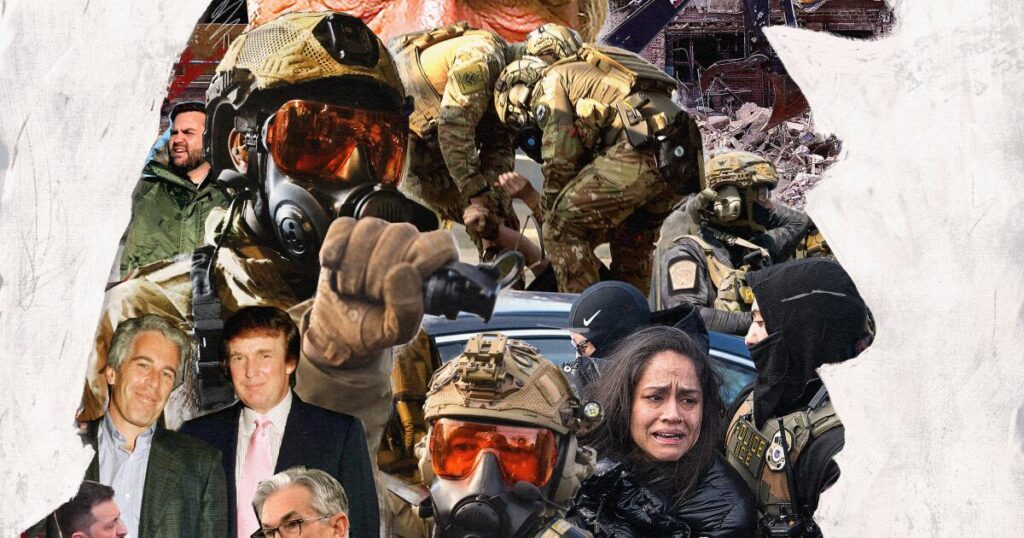
During his first term, President Trump was both praised and condemned for being wildly unpredictable, pushing boundaries and disregarding long-standing norms in Washington.
During the 2024 presidential campaign, then-Vice President Kamala Harris — Trump’s opponent — spoke directly to his volatile leadership style in her final pitch to voters, saying their choice would determine “whether we have a country rooted in freedom for every American or ruled by chaos and division.”
Of course, Americans returned Trump to the White House. And in the year since, they have watched Trump once again take stunning and unprecedented action — sometimes in line with his campaign promises, other times in direct conflict with them.
Deploying immigration forces, troops
Residents and protesters clash with federal agents in Chicago on Oct. 14.
(Joshua Lott / Washington Post via Getty Images)
During his campaign, Trump promised to launch the “largest deportation operation in American history.” The rollout has been tense as masked agents with U.S. Immigration and Customs Enforcement, U.S. Customs and Border Protection and other agencies have swarmed into American cities and detained large numbers of people — including many with no criminal convictions and some who are U.S. citizens.
The agents’ use of aggressive tactics and deadly force, including in the recent fatal shooting of Renee Nicole Good by an ICE agent in Minnesota, has sparked protests and concern among local leaders and members of Congress.
Trump has responded to some protests by ordering National Guard troops into cities, including Los Angeles. He also sent U.S. Marines into L.A. Those deployments were challenged in court, and — after a loss in the Supreme Court — Trump ended them. However, he has since threatened to send troops into Minnesota by invoking the Insurrection Act.
Threatening to take Greenland


Vice President JD Vance arrives in Pituffik, Greenland, in March.
(Jim Watson / Pool / Getty Images)
Trump has repeatedly threatened to seize Greenland from Denmark, a NATO ally, and the White House has declined to rule out military force.
Despite an existing agreement allowing the U.S. to maintain a strong military presence there, Trump has said full U.S. control of Greenland is necessary for regional security and to prevent Russia or China from taking control. “Anything less than that is unacceptable,” he said.
A U.S. seizure of the island would mark a stunning abandonment of NATO, which has linked the security of the U.S. and Europe for more than 75 years. European leaders have staunchly opposed any such move and called on the Trump administration to back off. Danish Prime Minister Mette Frederiksen has said a U.S. takeover of Greenland would end the NATO alliance.
Demolishing the East Wing


Architect Shalom Baranes shows a site plan for a new $400-million White House ballroom during a meeting this month of the National Capital Planning Commission.
(Chip Somodevilla / Getty Images)
In October, Trump surprised historic preservationists and other political leaders by demolishing the East Wing of the White House, which was built in 1902 under President Theodore Roosevelt and rebuilt in the 1940s under President Franklin D. Roosevelt.
Trump argued the historic building — which housed the first lady’s offices for half a century — needed to be cleared to make way for a $300-million ballroom for state dinners and other large events, which in the past have been hosted in tents on the White House lawn. Some defended the choice, saying a larger hosting space was long overdue.
Still, the demolition of the iconic site riled many, not least because Trump carried it out without adhering to established processes for altering historic federal buildings — including by failing to submit his ballroom plans to the National Capital Planning Commission, which oversees renovations and additions to federal buildings in Washington.
Deposing Maduro of Venezuela


President Trump and CIA Director John Ratcliffe monitor U.S. military operations in Venezuela, from Trump’s Mar-a-Lago Club on Jan. 3.
(Molly Riley / White House via Getty Images)
On Jan. 3, Trump announced that U.S. special forces had captured Venezuelan President Nicolás Maduro and his wife during an overnight military operation involving more than 150 U.S. aircraft entering Venezuelan airspace. Venezuelan authorities said 100 people were killed, including Venezuelan and Cuban security forces, and denounced the operation as a violation of Venezuela’s sovereignty.
Trump administration officials said the operation was to bring Maduro to justice on drug, weapons and conspiracy charges, to which Maduro has pleaded not guilty. Several foreign allies and adversaries, and many Democratic leaders in Congress, denounced the operation as a violation of international law that would embolden Russia and China to act with similar regional aggression.
Trump cited the legal case against Maduro but also Venezuela’s vast oil reserves, which he said would be tapped to uplift Venezuelans, repay debts to American oil companies and fund U.S. oversight of the country. Some critics were surprised Trump was so forthright about his interest in Venezuela’s oil.
Pardoning Jan. 6 rioters

Ben Pollock awaits the possible release of his children outside of the DC Central Detention Facility on Jan. 20, the day President Trump was sworn in for his second term.
(Bryan Woolston / Getty Images)
One of Trump’s first actions in office was to pardon or commute the sentences of those involved in the Jan. 6, 2021, attack on the U.S. Capitol, in which his supporters beat U.S. Capitol police officers in an attempt to stop Congress from certifying President Biden’s 2020 election.
Trump had telegraphed that he might pardon some of those charged in the assault, after downplaying the attack and calling them “hostages.” However, he surprised many when he pardoned or commuted the sentences of everyone involved — more than 1,500 people, including those charged and convicted of the most violent attacks on officers.
Among those freed by Trump was David Dempsey, a Van Nuys man who had been described by federal prosecutors as “one of the most violent rioters.” Dempsey had been sentenced to 20 years in prison after pleading guilty to assaulting a law enforcement officer with a dangerous weapon and breaching the seat of Congress.
Berating Zelensky of Ukraine


President Trump and Vice President JD Vance meet with Ukrainian President Volodymyr Zelensky in the Oval Office on Feb. 28. Vance said Zelensky was being “disrespectful” and had failed to thank Trump for his support, even though Zelensky had thanked him.
(Andrew Harnik / Getty Images)
In February, Trump and Vice President JD Vance raised diplomatic eyebrows around the globe when they publicly berated Ukraine President Volodymyr Zelensky in an unprecedented exchange in the Oval Office, accusing the U.S. ally of being ungrateful for American help in combating Russian attacks.
Vance said Zelensky was being “disrespectful” and had failed to thank Trump for his support, even though Zelensky had thanked him.
Then, after Zelensky said Ukraine would require security guarantees as part of any deal to end the war, and that a ceasefire was untenable because Russia would use it to regroup, Trump laid into him, saying, “The problem is, I’ve empowered you to be a tough guy. And I don’t think you’d be a tough guy without the United States.”
He said Zelensky would make a deal with Russia or the U.S. would “be out,” which he said wouldn’t be “pretty” for Ukraine. “You don’t have the cards,” Trump said, before accusing Zelensky of “gambling with World War III.”
Investigating political opponents


Atty. Gen. Pam Bondi departs after testifying before the Senate Judiciary Committee in October.
(Alex Wong / Getty Images)
One after another, Trump’s political opponents have been targeted with investigations led by political appointees in the Justice Department, often despite career prosecutors raising concerns.
Several have been pursued by Bill Pulte, the Trump-appointed director of the Federal Housing Finance Agency, for allegedly committing fraud when securing home mortgages years ago, including by claiming multiple homes as their primary residence. Mortgage allegations have been made against Sen. Adam Schiff (D-Calif.), Rep. Eric Swalwell (D-Dublin), New York Atty. Gen. Letitia James and Federal Reserve Governor Lisa Cook.
In addition, former FBI Director James Comey was charged with allegedly lying to Congress and obstruction. And just this month, Federal Reserve Chair Jerome Powell said the Justice Department had threatened the central bank with a criminal indictment over Powell’s testimony about Fed building renovations — which he said was a pretext for the administration to undermine the Fed’s independence in setting interest rates.
Trump has defended the investigations as legitimate efforts to hold powerful people accountable for alleged crimes. However, many experts have argued the cases smack of political persecution. Charges against James and Comey were tossed.
Instigating tariff wars

President Trump displays a list of tariffs he announced at a White House event in April.
(Chip Somodevilla/Getty Images)
Trump has repeatedly destabilized global markets by instituting, lifting and reimposing sweeping tariffs on foreign nations. On April 2, Trump held a “Liberation Day” event at the White House where he announced “reciprocal tariffs” against nations around the world — which he said were in response to the U.S. for decades being “looted, pillaged, raped and plundered by nations near and far, both friend and foe alike.”
Trump help up a poster board with new tariff rates, including a 67% tariff on China and a 39% tariff on the European Union. He said the latter, a close U.S. ally, is seen as “friendly,” but “they rip us off.”
Experts immediately questioned the methodology Trump used for calculating the figures, said the tariffs were not reciprocal and raised concerns they would destabilize markets and increase costs for American consumers — which they did.
The tariffs have also raised billions of dollars for the U.S. Treasury, but harmed some of the poorest nations in the world and sparked tensions with the nation’s largest trading partners, including China, Canada and Mexico.
Bombing Iran’s nuclear sites

President Trump addresses the nation in June following the announcement that the U.S. had bombed nuclear sites in Iran.
(Carlos Barria / AFP via Getty Images)
In June, the U.S. joined Israel in attacking Iran, sending American stealth bombers to drop “bunker-buster” bombs on three sites associated with Tehran’s nuclear program. The attack followed Israeli strikes to destroy Iran’s air defenses and offensive missile capabilities.
In an address to the nation, Trump said Iran’s key nuclear facilities were “completely and fully obliterated.” Iranian President Masoud Pezeshkian condemned the attacks, saying the bombings “showed that the United States is the primary instigator of the Zionist regime’s hostile actions.”
Many worried the attack would be the precursor to a larger conflict, but Tehran’s response was muted.
Waffling on the Epstein files


Donald Trump in shown in 2000 at Mar-a-Lago with his then-girlfriend and future wife, Melania Knauss, Jeffrey Epstein and Ghislaine Maxwell.
(Davidoff Studios Photography / Getty Images)
During his campaign, Trump promised to release the Epstein files — a trove of records from investigations into disgraced billionaire and convicted sex offender Jeffrey Epstein, a one-time friend of Trump’s who died in federal prison in 2019. Many Americans, including Trump’s supporters, have long demanded the records, in part to assess whether other powerful men were complicit or involved in the abuse.
However, after taking office, Trump — who has long denied any wrongdoing — worked to prevent the release, pressuring members of Congress not to back a bill mandating it. Not until Congress appeared poised to pass the bill anyway did Trump relent, reverse course and sign the measure into law.
The Justice Department released a massive but extensively redacted trove of records in response to the new law in December. They contained references to Trump being involved in or aware of Epstein’s sexual abuse, which the White House called untrue.
Declaring end to birthright citizenship
Trump has signed a wave of executive orders radically altering U.S. policy and the federal government. One that stands out is his order purporting to end birthright citizenship for the U.S.-born children of many immigrants — which is guaranteed by the 14th Amendment of 1868, which states, “All persons born or naturalized in the United States and subject to the jurisdiction thereof are citizens of the United States and the state wherein they reside.”
The Trump administration has argued that language applies to freed slaves, not the children of immigrants in the country temporarily or illegally. California, other states and private groups challenged the order in court, and federal judges have put it on hold.
Last month, the Supreme Court said it would hear arguments on Trump’s order — teeing up a major test of Trump’s power.