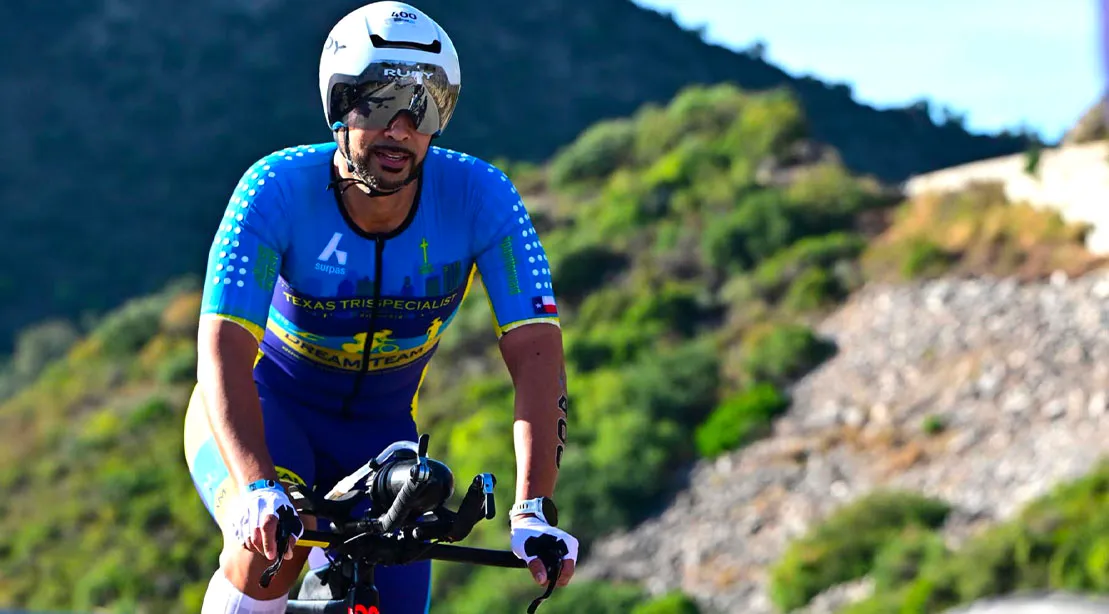
The dust may now have settled after the Precision Fuel & Hydration IRONMAN 70.3 World Championships held last month in Spain, but the indelible mark that race day has made on those who entered is a life changing experience. Athletes from all walks of life, not to mention individual mental and physical challenges, headed to Marbella to make that iconic 1.2-mile (1.9km) swim, 56-mile (90km) bike ride and 13.1-mile (21.1km) run in November to test the edge of their limits.
So, to find out more, M&F caught up with four inspiring athletes and discovered what motivated these people to compete, and what they have learned from pushing themselves well beyond their comfort zone. Often, the journey toward a competition is just as inspirational as the final performance itself.
Rafael Rivera
- Finishing Time: 5:50:12
- Biggest IRONMAN 70.3 Fear: Distance
Rafael Rivera, 42, who was born in Mexico before moving to the U.S. weighed 300 pounds and struggled with alcoholism before turning his life around with triathlon. What motivated Rivera the most was the desire to become a husband and father that his family could be proud of. After banishing the booze, the changemaker has since dropped 150 pounds and has completed multiple IRONMAN and other endurance events. Having qualified for the IRONMAN 70.3 Championship, he completed the race under the six-hour average, but Rivera’s efforts have always been more focused on conquering fears than world records.
Starting out with triathlon, Rivera’s biggest fear was the distance of the race itself. “The sheer scale—swimming 2.4 miles, biking 112 miles, and running 26.2 miles consecutively—felt not just hard, but impossible,” he tells M&F. “It was a fear of failure that bordered on the fear of realizing how far I still had to go. But ultimately, that terrifying impossibility is exactly what fueled my desire to prove my transformation was real and irreversible.”
Rivera says that his participation in the championships has helped to replace fear with euphoria, a milestone made through years of training. “Fear has been completely replaced by uncontrolled exhilaration,” he says proudly. For Rivera, making the hallowed finish line is a win over his former life, “proving that deep, life-altering change is possible.”
To follow Rafael Rivera’s progress on Instagram, click here.
Ryan Briscoe

- Finishing Time: 4:56:05
- Biggest IRONMAN 70.3 Fear: The busy start to the swim
Sydney, Australia’s Ryan Briscoe was a professional car racer, competing in Europe and America, and achieving significant success as an IndyCar driver. He won nervy races like the 24 Hours of Daytona in 2020, but progress with triathlon has fueled his adrenaline just as much as life inside of a speeding car.
In his first triathlon, more than twenty years ago, Briscoe recalls that he was a little worried about the water. “I think my biggest fear was how I would handle the commotion of the swim with a mass start,” he tells M&F. To combat a sometimes-chaotic start during swimming endurance events, Briscoe decided to navigate through future races with a better plan. “Also, IRONMAN does such a nice job with the rolling starts, so there really isn’t any stress at all,” he reassures those interested in dipping their own toe in the water.
Another of Briscoe’s educated tips for proper prep is around food and liquid intake. “Nutrition remains so crucial and difficult because of the sheer amount of time that you’re out there,” he explains, but while the multisport athlete is eager to push himself, he shares that a life competing in endurance sports need not get in the way of a normal home life. “Balancing training with family time is most important to me,” shares Briscoe. “This is a hobby for me, and I can’t sacrifice missing important moments with my family. So, it’s all about good planning and often training at odd hours of the day! We make it work!”
To follow Ryan Briscoe’s progress on Instagram, click here.
Corey Hawes

- Finishing Time: 5:57:31
- Biggest IRONMAN 70.3 Fear: Exhaustion
Lexington, Kentucky’s Corey Hawes had been leaning into several endurance disciplines before the IRONMAN 70.2. His story is one of defying the odds. At 17 years of age, Hawes survived a serious car accident that almost left him paralyzed. Following a six-month stint with a back brace, he decided to build back stronger, surpassing medical expectations and ultimately correcting his spinal issues in large part due to his formidable training. Hawes has now competed in dozens of races but recalls the fear of cardio and muscular failure.
“Could I do it” he asked himself right back at the start of his IRONMAN journey. “I had done a few local sprint triathlons, and some longer ultramarathon runs, but never something so prolonged and with various muscle and metabolic demands,” he told M&F. His advice to those on the fence about throwing their own hat into the ring? “Do it!” he enthuses. “It’s a blast! Be prepared and recognize that it is a way of life. Once you start, there is no turning back.”
With the 2026 Championships recently completed, Hawes is already setting his next goals. “I know that I have smaller goals to improve every day with functional threshold power, strength, and run split goals. As for the large goal, these next few weeks of the off-season is where I spend my time dreaming up the next best thing!”
To follow Corey Hawes’ progress on Instagram, click here.
Gregory Schaefer

- Finishing Time: 5:57:31
- Biggest IRONMAN 70.3 Fear: The time demands of training
Gregory Schaefer’s story is yet another triumph of the human spirit, competing the 2025 IRONMAN 70.3 Championships with early onset Parkinson’s disease. “Consistency and durability aren’t just training principles, they’re life principles,” he tells M&F. “Over the years, triathlon has become less about preparing for a single race and more about building a body and mind capable of enduring whatever life hands me.” He’s definitely on to something, as studies (https://pubmed.ncbi.nlm.nih.gov/35113386/) show endurance training has a positive effect Parkinson’s, slowing the signs of the condition.
“In many ways, the sport prepared me long before Parkinson’s entered the picture,” shares Schaefer. “That diagnosis changed everything, but oddly enough, it also made sense of the years I had spent building resilience, routine, and strength. Exercise is the best medicine for Parkinson’s, and I genuinely can’t imagine a better prescription than triathlon. It feels like I’ve unknowingly been training for the long race all along.”
It’s not just the race that Schaefer relishes. There’s an entire community to be part of, too. “Expect setbacks, because they will come, but also get ready to join one of the most supportive, welcoming communities you’ll ever encounter,” he tells M&F. “Triathlon embraces everyone: every pace, every shape, every background. I love nothing more than helping a first-timer, because even after 18 IRONMAN finishes, I still learn something every single race.” Schaefer’s biggest fear had been that training would take over his world, but he figured it out. “Balance didn’t arrive overnight,” he explains. “It came from embracing the sport, not as a season, but as a way of living.”
To follow Gregory Schaefer’s progress on Instagram, click here.
If you would like to join a committed community and feel the same mental and physical exhilaration as these inspirational athletes, it’s not too late to dream big and work towards the 2026 IRONMAN 70.3 World Championship. Find a qualifying event by clicking here.