Volvo hasn’t exactly had a great run of EVs lately. The rollout of its flagship EX90 was stymied out of the gate by a bevy of software glitches. The EX30, meanwhile, was too expensive when it launched — the promised $35,000 model was incompatible with the currently chaotic global tariff situation.
Now, it’s time for a new generation of EV from Volvo, one that’s radically different at its core with a gigacast frame, a much higher-density battery and enough digital and literal horsepower to impress the most jaded of automotive enthusiasts. Mix in high-performance chipsets from both NVIDIA and Qualcomm, plus Google’s Gemini AI onboard, and on paper, it has a lot to offer. After getting an early look at the thing at its unveiling in Sweden, I feel like this EV is ready and able to face off against BMW’s new iX3 and Mercedes-Benz’s upcoming GLC.
Let’s start with the basics: The EX60 slots in the Volvo product lineup right alongside the existing XC60, Volvo’s most popular model in the U.S. It’s a two-row, mid-size SUV that seats five, the sort of thing perfect for those with small families or big dogs. It’ll be available in three different basic configurations, starting with the single-motor, rear-drive, 369-horsepower, 310-mile EX60 P6. Next up is the AWD dual-motor, 503-hp, 320-mile P10, and finally the top-shelf, 670-hp, 400-mile P12.
670 horsepower in an SUV of this size seems frankly excessive to me, but then it does have a lot of weight to move around — 5,137 pounds to be exact. That’s thanks in large part to the P12’s 112-kilowatt-hour net battery pack which is about 50 percent bigger than the one inside a Tesla Model Y. The P6 is a relatively svelte 4,663 pounds thanks to its smaller 80-kWh net battery pack, while the P10 has 91 kWh.
Volvo EX60 (Volvo)
Beyond the powertrain divisions, the Volvo EX60 will also be available in a variety of different trims with varying amounts of equipment, including the Volvo Cross Country edition with air suspension and a 20mm boost of ride height. Prices are said to start “around $60k” for an EX60 P10 Plus with a 21-speaker Bose system, but a 28-speaker Bowers & Wilkins system with Dolby Atmos will be available for those who really need all the channels.
Of course, Atmos support is no good without a good source, and to that end, the EX60 will be the first Volvo with Apple Music built in. That’ll be part of the company’s Android Automotive-based infotainment system, running on a curved 15-inch OLED screen and powered by a Qualcomm 8255 chipset. It’s paired with a low, wide gauge cluster set far back on the dashboard behind the steering wheel.
This will also be Volvo’s first car with integrated Gemini, and indeed one of the first cars on the road with Google’s smart agent. You can, of course, do typical Gemini things like ask about the weather or the nuances of René Descartes’s concepts on dualism. Beyond that, Volvo CTO Anders Bell said that it will eventually gain access to the car’s outward-looking cameras, meaning you’ll be able to ask for more details on whatever it is you can see looming on the horizon.

Volvo EX60 (Volvo)
Volvo calls the car’s software-defined architecture and the hardware that powers it HuginCore, named for Huginn, the raven of Norse mythology and represents Odin’s mind and senses. Qualcomm powers the infotainment side of the avian experience, but when it comes to active safety, the EX60 relies on an NVIDIA Drive AGX Orin chipset. Unlike the EX90, the EX60 will not use a LiDAR sensor.
Volvo CTO Bell downplayed the absence of the sensor. “We realized we can now achieve many more meaningful and safe automated functions without LiDAR than we could have years ago,” he said. Per Bell, LiDAR was never really in the plan for the EX60 anyway, a decision looking all the brighter given the recent bankruptcy of Volvo’s former LiDAR partner Luminar.
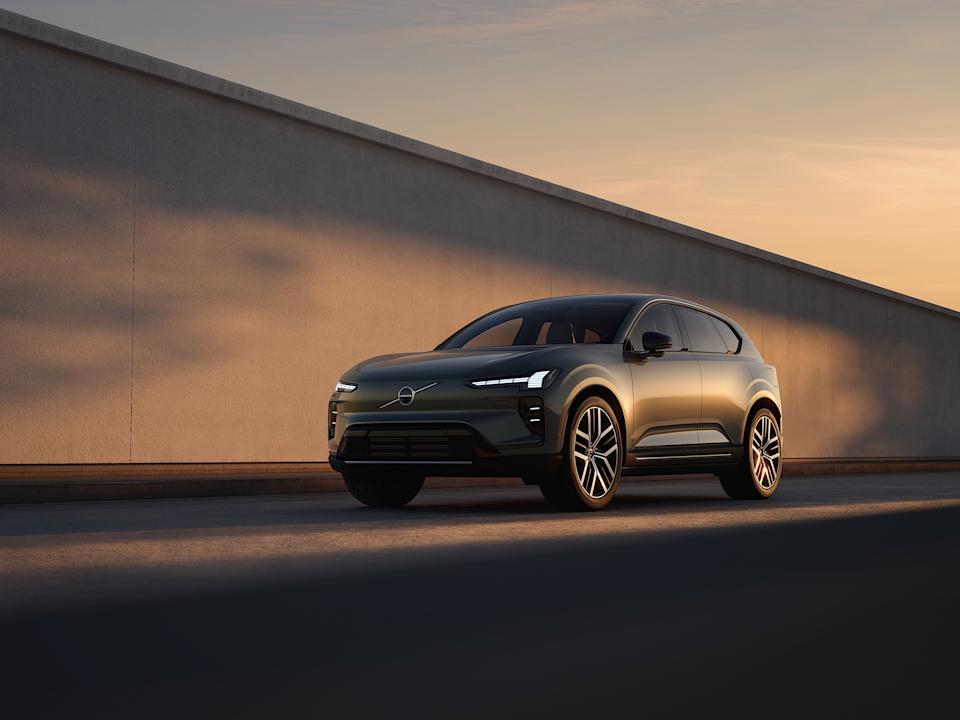
The car’s cameras and radar sensors all tuck nicely into the new exterior of the EX60, which certainly doesn’t look miles off from the EX90 or indeed the current, gas-powered XC60. But the pronounced flares on the front fenders are a nice touch of personality on an otherwise understated SUV.
At the core of the EX60 is a new platform Volvo calls SPA3, with a chassis made using gigacasting. This refers to the force required to inject molten aluminum into massive castings, allowing more of the car to be made from fewer components. Volvo says the carbon footprint of the EX60 is lower even than that of the much smaller EX30.
The battery packs use the on-trend cell-to-pack construction method, which means all the cells are lumped together into a single unit. Typically, this boosts density at the cost of repairability, a tradeoff most manufacturers seem willing to make in pursuit of higher range and lower costs. However, Bell said that the company has actually made pack maintenance easier by optimizing the layout of the ancillary equipment.

Volvo EX60 (Volvo)
“The absolute vast majority, 90 percent of anything that ever needs to be repaired on a battery pack is electronics,” he said. In the EX60, Volvo positioned the battery electronics beneath the rear seat to make them even easier to access. “We save a lot of weight, save a lot of cost.”
The EX60 will be Volvo’s first car to use the Tesla-style NACS charging standard, and the largest two packs will support charging speeds up to 370 kW. That drops to 320 kW on the 80-kWh net P6.
In practical terms, though, they’re all roughly the same. Each model charges from 10 to 80 percent in less than 20 minutes, adding between 160 and 173 miles of range in 10 minutes. That’s not quite the 200 miles BMW’s iX3 can manage in the same time, but it is close.
The iX3 will probably be the EX60’s fiercest competition when Volvo opens up orders later this spring. The EX60’s $60,000 price for a midrange P10 Plus puts it right in line with the $60,000 that BMW says to expect for its iX3. Mercedes hasn’t set American pricing for its GLC yet, but that, too, will be on a lot of shoppers’ lists to compare.
I’ve already been impressed by how both the iX3 and the GLC drive. Sadly, Volvo wouldn’t let me behind the wheel of its EX60 just yet, but hopefully I can report back with impressions soon to start to see how all these stack up on the road.