In the algorithm-driven economy of 2025, one man’s shrimp Jesus is another man’s side hustle.
AI slop – the low-quality, surreal content flooding social media platforms, designed to farm views – is a phenomenon, some would say the phenomenon of the 2024 and 2025 internet. Merriam-Webster’s word of the year this year is “slop”, referring exclusively to the internet variety.
It came about shortly after the advent of popular large language models, such as ChatGPT and Dall-E, which democratised content creation and enabled vast swathes of internet denizens to create images and videos that resembled – to varying degrees – the creations of professionals.
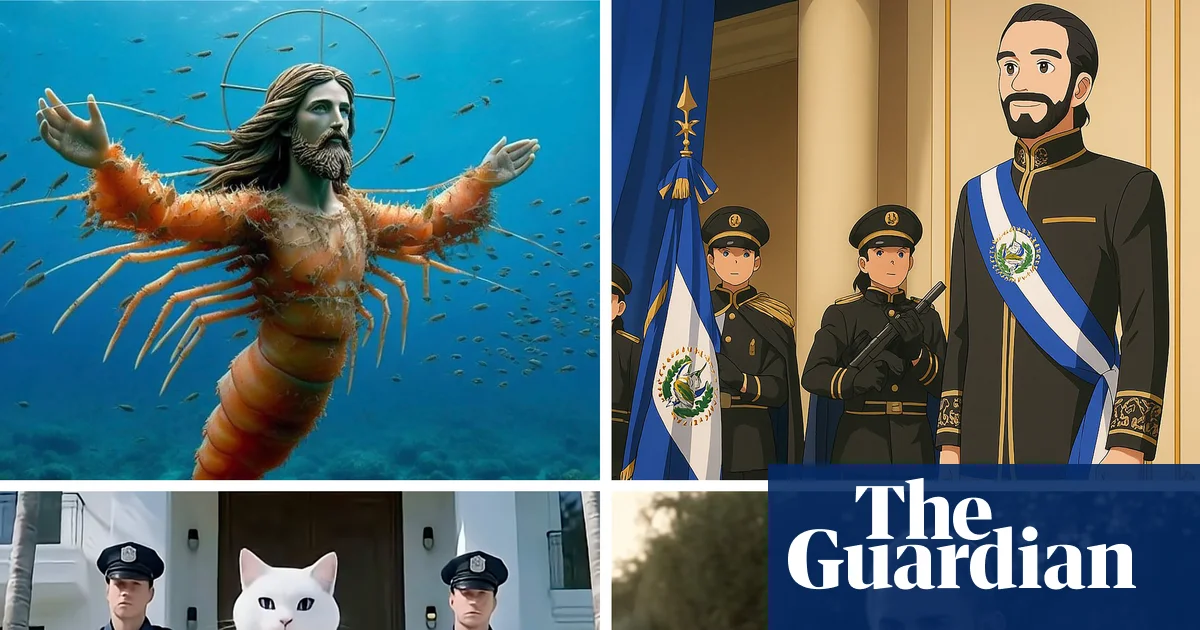
In 2024, it began to achieve peak cultural moments. Notable among these was shrimp Jesus, a viral trend in which Facebook was briefly flooded with AI-generated images of the deity fused with crustaceans. Shrimp Jesus was quickly followed by hallmarks of the AI slop genre: videos of old women claiming to celebrate their 122nd birthday, and mini soap operas about the dramatic lives of cats.
In 2025, the flood continued, growing more uncanny and more explicitly copyright-violating. This spring saw the advent of Ghiblification – that is, a trend in which users from Nayib Bukele to the White House rendered images, including of deportations, in the style of Hayao Miyazaki’s Studio Ghibli. This particular moment was enabled by OpenAI’s release of an image generator powered by GPT-4o; Sam Altman, OpenAI’s chief executive, jumped on the trend by Ghiblifying his X profile and writing the rather remarkable post:
>be me
>grind for a decade trying to help make superintelligence to cure cancer or whatever
>mostly no one cares for first 7.5 years, then for 2.5 years everyone hates you for everything
>wake up one day to hundreds of messages: “look i made you into a twink ghibli style haha”— Sam Altman (@sama) March 26, 2025
Miyazaki, the chief architect of Studio Ghibli’s distinctive, hand-drawn animation style, has elsewhere said, on the subject of artificial intelligence: “I would never wish to incorporate this technology into my work at all. I strongly feel this is an insult to life itself.”
Other AI slop moments followed: a spate of videos of AI-generated obese people participating in the Olympics, pressure cookers exploding, more cats. Ibrahim Traoré, the leader of the military junta in Burkina Faso, became the centrepiece of an AI slop cult featuring videos of Justin Bieber singing on the streets of Ouagadougou.
In some ways, AI slop has improved. Gone – mostly – are the days of six-fingered hands and missing limbs that characterised the output of early image generators. In some ways, though, AI slop has hardly changed at all. It is still uncanny and contextless, still aimed directly at the amygdala, still chasing virality by virtue of having the lowest barriers to entry imaginable: no plot, no exposition, surreal imagery and cats, cats, cats.
Describing this flood of unreality as solely a technological phenomenon misses one of the main drivers of AI slop. In one view it is the endpoint of an algorithmically determined internet optimised for engagement and turbocharged with new, powerful tools. It won’t change as long as the platforms and their algorithms don’t.
But it is also the product of an underlying global economy – one that is everywhere, increasingly dependent on a few powerful technology companies and a few powerful platforms, one which appears to offer dwindling returns for real work, but lavish fortunes for the lucky, viral few.
AI slop creator is, after all, a profession. They come from everywhere – from the US to India to Kenya to Ukraine. In some ways, it can be argued that AI tools have enabled a strange globalisation of content, says Arsenii Alenichev, who studies the production of images in global health. Earlier this year, Alenichev noticed a flood of “AI poverty porn” on major stock photo sites. Many of the creators of the images, he said, appeared to have eastern European usernames.
“I wouldn’t be surprised if these are just artists that are trying to generate extreme images of everything, hoping that someone would buy them,” he said.
Making it in AI slop isn’t easy. Oleksandr, an AI YouTube creator based in Chernivtsi, Ukraine, estimates that only the top 5% of creators ever monetise a video, and only 1% make a living from it.
Oleksandr began his business in 2024, after retiring from being a professional volleyball player. He was deep in debt, he said, and at a low point in his life: his girlfriend had left him, his parents were living in occupied Mariupol. He started to join Telegram channels and watch YouTube videos on how to make money from YouTube.
His first efforts were music channels, playing AI-generated music over images of sexy AI girls. He had seven: retrowave, rock, jazz and more. At first he put a great deal of effort into each video, he said, but he realised quickly that that didn’t matter on YouTube. “It was a conveyor belt, with fairly low quality.”
His videos got attention, standing out from hundreds of other similar channels, even to the point where a Japanese film-maker contacted him to license one of his pieces for a short movie.
Then he expanded. At the high point of his business, he had a team of 15 people operating 930 channels, 270 of which he successfully monetised. They cleared up to $20,000 (£15,000) a month at one point, although YouTube often blocked or took down his channels – including the sexy AI girls – for unclear reasons.
His content evolved. One fruitful niche he found was life stories – long anecdotes written by ChatGPT or Gemini, overlaid with visuals, which were extremely popular: “Grandparents listen to it before bed, or while walking in the park.”
Another niche, he said, was videos on “vulgar adult themes” – such as erotic tractors – which were in great demand, but bordering on what YouTube allows. These channels were riskier to produce, but at times were easier to monetise, because they had less competition.
With “erotic ones it’s easier, because they are blocked more often, so not many people want to bother and periodically recreate channels”, he said. “I saw the opportunity, and other people saw the difficulty.”
Now, the work has shrunk somewhat: YouTube has become more aggressive with its takedowns of content, meaning he has to recreate channels. He and his team now take in closer to $3,000. But Oleksandr credits the platform – and the videos he watched – with changing his life, allowing him to resolve his debts and build a career he (somewhat) loves.
It is not a site for artistic aspirations, though. A fair amount of the work involves adding nearly naked AI women to videos of tractors.
“To make money here, you need to spend as little as possible,” he said. “YouTube is basically just clickbait and sexualisation, no matter how morally sad it is. Such is the world and the consumer.”
A YouTube spokesperson said: “Generative AI is a tool, and like any tool it can be used to make both high- and low-quality content. We remain focused on connecting our users with high-quality content, regardless of how it was made. All content uploaded to YouTube must comply with our community guidelines, and if we find that content violates a policy, we remove it.”