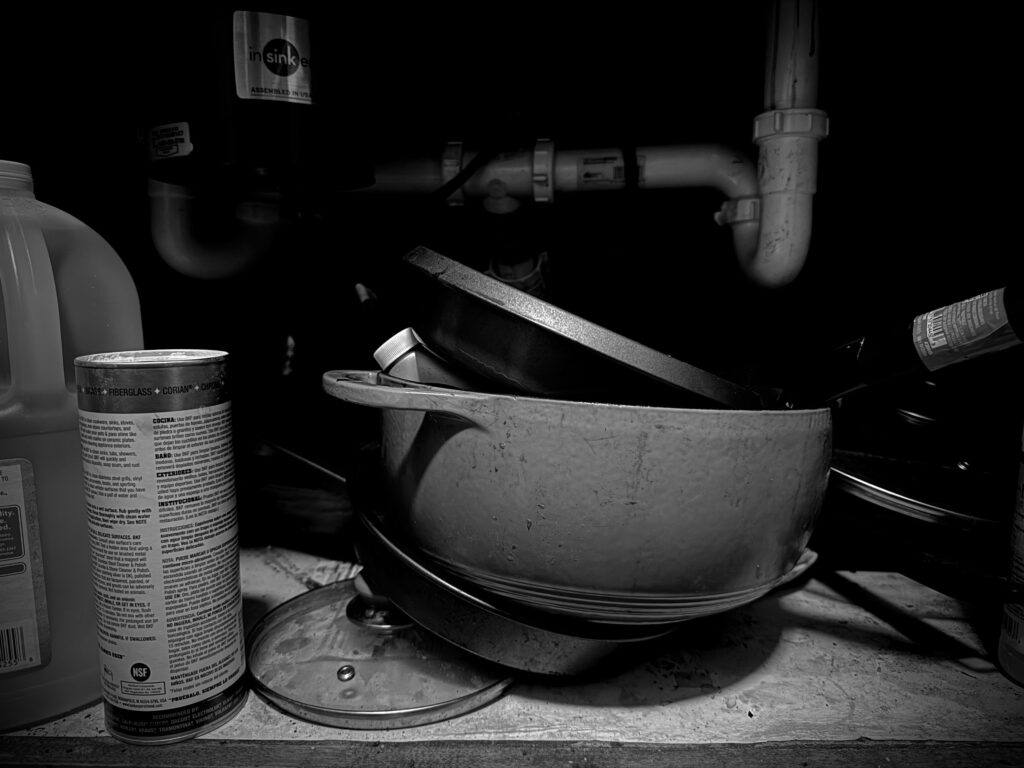
A vaguely sinister array of pots, pans and cleaning supplies cluster underneath opinion editor Clay Wirestone’s sink. (Photo by Clay Wirestone/Kansas Reflector)
You know where it is in your kitchen. It rests comfortably inside a drawer or cupboard.
It might be a baking pan. It might be a mixing bowl. It might be a pot or pan. Whatever it is, somewhere in your kitchen sits an ancient piece of cookware. Perhaps it was owned by your parents or grandparents. Perhaps you alone have owned it for many decades. Or perhaps it came with the kitchen itself through some unspeakably ancient ritual.
Little things
Small essays on simple subjects.
In case I’m not making myself clear, let me explain the item that made me think about this topic. In my family, it was a baking sheet. Specifically, it was a baking sheet owned by my mother. It looked impossibly old. It wasn’t just black but a motley assortment of burned and scorched colors, each one slightly covering the other in a charred patchwork.
What did we use this baking sheet for? The easier question would have been what didn’t we use this baking sheet for? We made open-face cheese sandwiches. Seasoned steaks. Twice-baked potatoes. Pork chops. Sizzling whole potatoes wrapped in foil jackets.
OK, in retrospect there seem to be a lot of potato-related dishes being made in my family.
I’m not generally a childhood memoir type of writer. I remember certain incidents and images from those years, but I’m not confident enough on my hold of details to reconstruct that entire world for page after page after page. At least not now.
But my goodness, I can remember that baking sheet. I can remember it as clear as day. I can also remember wondering: Why didn’t we just get a new one?
In my own kitchen, there is no dish quite with the dark power of my mother‘s baking sheet. However, we do own a saucepan that has been separated from its fellows and kept serving through the years. It no longer includes a lid. However, the saucepan serves up an array of soups and other concoctions brewed by my son. We also use a tea kettle that I know logically must only be a few years old, but in terms of appearance and sound suggests it came from a magicians’ hut from the middle ages.
Keeping such old items does raise fascinating questions. Such as: What can you expect dishwashing to realistically achieve? What happens after we’ve eaten all the forever chemicals? And, how can metal become transparent?
When we cook, we commune with the past. We think about the food we once ate, the people who taught us how to cook it and who sat alongside us through those years. We don’t just speak to ghosts; we ask them to remind us of recipes and catch us up on gossip from the hereafter.
I like to think that the old pot or pan, the decrepit fork in the back of the drawer, opens these portals between past and present. The item bridges time, exposes the continuum of human and gustatory experience.
Either that or its cheaper to use the old pan than buying a new one. Have you seen how bad inflation is these days?
Clay Wirestone is Kansas Reflector opinion editor. Through its opinion section, Kansas Reflector works to amplify the voices of people who are affected by public policies or excluded from public debate. Find information, including how to submit your own commentary, here.