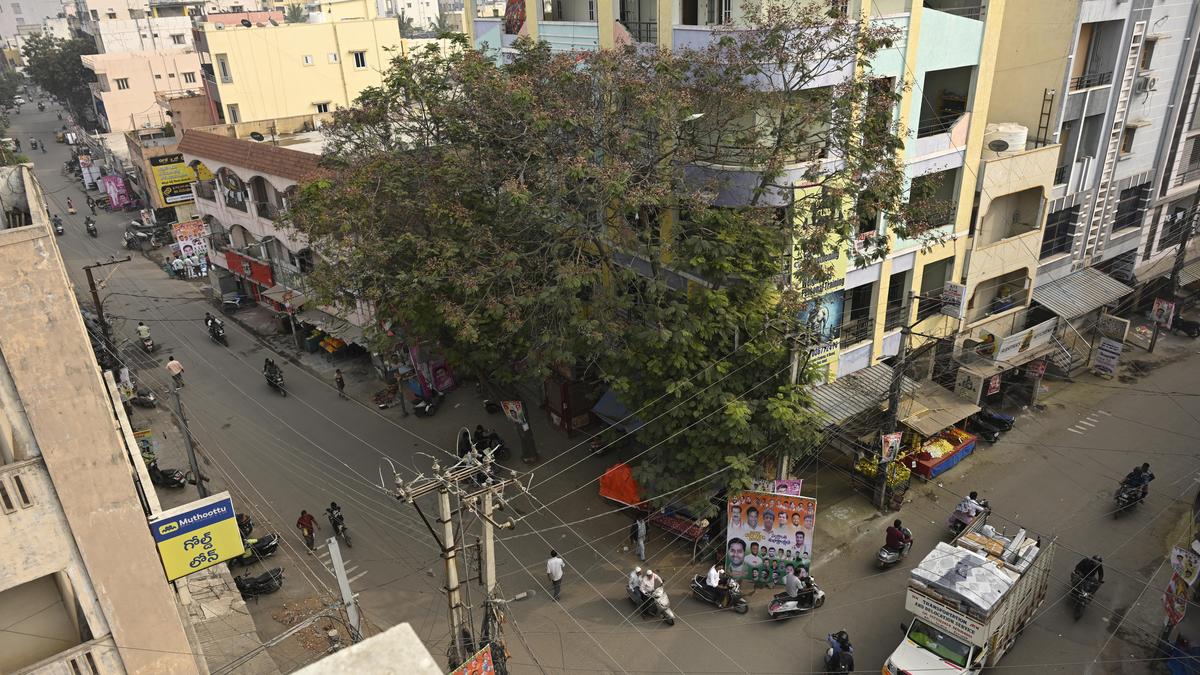
Nothing about the lane outside Medha School in Bowenpally suggests that it should be remembered for anything more than the daily school rush. Located on the northwest fringe of Secunderabad, it is narrow, noisy and deeply ordinary. Auto rickshaws idle impatiently in the mornings, vendors selling stationery and snacks hover near the gate and parents linger long enough to ensure their children disappear safely inside the campus. The school building itself rises without drama, a functional concrete structure that blends seamlessly into a neighbourhood shaped by small businesses, rented houses and steady footfall. Nothing about it hints at secrecy. And that, investigators now believe, was precisely the point.
For nearly nine months, while classes were being taught for classes 1 to 10, parts of this same building were being used to manufacture alprazolam, a psychotropic drug that feeds addiction far beyond the lanes of Bowenpally. The facade finally collapsed on September 13 last year, when officers of Telangana’s Elite Action Group for Drug Law Enforcement (EAGLE) raided the premises and uncovered a clandestine drug lab operating within the school.
Inside, police seized 3.4 kilograms of finished alprazolam, 4.3 kilograms of unfinished product and ₹21 lakh in cash. Investigators say the money reflected proceeds from just two days of sales. The accused was identified as Malela Jaya Prakash Goud, 39, a resident of Old Bowenpally and director of Medha School. According to investigators, Goud had been running the operation for months, deliberately using the school as a shield against scrutiny.
The building, officers say, had been meticulously compartmentalised to sustain the deception. The cellar housed classrooms, where children sat on benches reciting lessons. The ground floor had a bank, adding another layer of legitimacy and steady public presence. Parts of the first floor were also used for teaching. The rear portion of the structure, however, remained under Goud’s exclusive control. “That is where the drug lab was set up. The second floor, which earlier served as a gym, remained locked and largely off limits,” says an officer.
That physical separation, he says, ensured the operation ran without raising alarm. “Schools often have restricted areas. Locked rooms don’t raise questions. He used that to his advantage,” the officer adds.
Across the road, a middle-aged shopkeeper who sells notebooks, pens and school bags leans against his counter, still struggling to process the goings-on. He has been there for over a decade, watching batches of children grow taller and move on. “We did see boxes going in and out sometimes,” he says, lowering his voice despite the street’s constant din. “But every school has supplies — furniture, exam papers, computers. Who would ever think of drugs?”
He recalls delivery vehicles arriving at odd hours, sometimes late in the evening. “They weren’t secretive. That is what fooled everyone. If someone is hiding something, they act nervous. Here, everything looked normal. Too normal.”
A parent who lives two lanes away says the revelation unsettled him in ways he struggles to articulate. “You drop your child at the gate and assume that inside, everything is controlled. Your worries stop at studies. You don’t imagine chemicals and drugs,” he says, requesting anonymity.
Investigators says Goud supplied the alprazolam to known contacts in Boothpur in Mahabubnagar district. His background, they found, lay far from education. He earlier operated a toddy shop in Mahabubnagar and had paid ₹2 lakh to one Guruva Reddy to obtain the manufacturing formula. Employees assisted in running the operation, and police have identified several chemical suppliers linked to the racket.
As the probe widened, officers say they identified 35 accused connected to the case and have arrested seven so far. Several have approached courts seeking bail and anticipatory bail. The EAGLE Force of Telangana is opposing these pleas, citing the commercial quantity involved.
“Under Section 36A(4) of the NDPS Act, bail cannot be granted for a minimum of 180 days in such cases, which can be extended by another 180 days if the investigation is ongoing. The case is still under investigation and more arrests are likely,” says Sandeep Shandilya, director of EAGLE-Telangana.
For residents living around Medha School, the aftermath has been unsettling, to say the least. The gate still opens each morning, but conversations stretch longer than before. Parents now look at the building differently. The familiarity, that was once reassuring, has begun to feel deceptive.
In 2025, the EAGLE Force, formerly the Telangana Anti-Narcotics Bureau, recorded its most aggressive year of enforcement since its inception, targeting both street-level supply chains and organised interstate and international drug networks. Operations extended across Telangana and multiple States, involving coordinated action with Central agencies, police forces and financial intelligence units.
Across Telangana, 2,542 NDPS cases were registered up to November 30 last year, involving 8,322 accused. Drugs worth ₹172.93 crore were seized, including consignments intercepted during inter-State operations and handed over to agencies in Goa, Maharashtra, Delhi and Ranchi.
The average number of accused per case stood at just over three, indicating a shift towards dismantling distribution networks rather than making isolated arrests.
An industrial belt offering deception
Just days later, in Cherlapalli, about 14 kilometres north of Bowenpally, another discovery startled the local law enforcement. Hyderabad’s drug trade, they realised, was not hiding in abandoned buildings or dark alleys; it was thriving in places engineered to appear legitimate.
The Cherlapalli industrial area sprawls across the city’s eastern edge, wide and dusty, a dense patchwork of warehouses, chemical units and transport offices stitched together by narrow roads and routine. It is a zone built on movement. Tankers thunder past, carrying liquids few can pronounce. Workers clock in and out at irregular hours. Activity rarely pauses long enough to draw attention.
Vagdevi Laboratories fit neatly into this landscape. From the outside, it looked no different from its neighbouring units. Its walls were plain, its signboard modest. Trucks rolled in and out. Labourers arrived with lunch boxes slung over their shoulders. It was, by all outward measures, a functioning chemical factory.
At a small stall a few metres away, a man in his mid-50s pours countless glasses of tea every day. He knows the rhythms of the area intimately. “This place never sleeps,” he says, wiping his hands on a cloth. “Some factories work day and night. So when vehicles move at strange hours, nobody notices.”
Shipments from Vagdevi Laboratories, he says, appeared routine. “Tankers, cartons, chemicals… this is Cherlapalli. That is normal.” What briefly caught his eye were the cars. “You would see fancy cars, coming fast and leaving fast; not what you expect for a small unit. But even then, you think maybe the owner is rich.”
Behind those walls, investigators allege, operated a large scale mephedrone manufacturing unit that had been running quietly for years. The case came to light far from Cherlapalli.
Bus stop bust to global supply line
About a month before the raid, on August 8, Maharashtra police arrested Fatima Murad Shaikh, alias Molla, 23, at the Kashimira bus stop on Mira Road in Thane district. She was found with 178 grams of mephedrone and ₹23.97 lakh in cash. During questioning, she told investigators her source was based in Telangana.
That disclosure triggered a chain of events that brought the Mira Bhayandar-Vasai Virar Crime Branch to Hyderabad. Officers arrived quietly, placed Vagdevi Laboratories under surveillance and began tracking patterns. When they raided the premises on September 5, their suspicions were confirmed.
Inside the unit, police recovered nearly 5.8 kilograms of finished mephedrone, 35,500 litres of precursor chemicals, 950 kilograms of chemical powder and specialised manufacturing equipment. An officer involved in the probe says the volume of precursor alone could have yielded around 6,000 kilograms of mephedrone. At an estimated international market price of ₹20,000 per gram, the potential output was valued at nearly ₹12,000 crore.
The prime accused, Srinivas Vijay Voleti, 34, owner of Vagdevi Laboratories Pvt Ltd, was taken into custody along with the firm’s chemical analyst, Tanaji. During questioning, Voleti allegedly admitted to manufacturing and selling mephedrone since 2020, supplying markets in cities such as Mumbai and to buyers in Dubai and parts of Europe. Officers described him as tech savvy and highly cautious, avoiding mainstream communication platforms and relying instead on lesser-known applications.
Laboratory analysis conducted in Mumbai confirmed the seized substance as a scheduled chemical. Investigators say synthetic drug manufacturers across southern India have increasingly shifted towards compounds such as 3-Chloromethcathinone (3 CMC), underlining how quickly these networks adapt to enforcement pressure. Agencies including the Narcotics Control Bureau, air cargo operators and international counterparts have been alerted as police work towards tracing overseas buyers.
The Cherlapalli probe also intersected with the life and death of Azim Abu Salem Khan, 51, a history-sheeter wanted in multiple narcotics cases. Khan was tracked to a flat in Pune’s Kondhwa area in October. When officers attempted to arrest him, he allegedly resisted, bit a constable and collapsed within minutes. He was declared dead on arrival at a hospital. An autopsy later pointed to head injuries and coronary atherosclerosis, and the State CID took over the probe as per protocol. Police said Khan had been a drug addict for over a decade and a heart patient for several years.
Investigators allege Khan was a key link in a larger trafficking network that connected manufacturing units, couriers and money handlers. His name also surfaced in parallel financial investigations. In November, during an operation in Goa, the EAGLE Force busted a Nigerian cartel, seizing consignments worth ₹2.85 crore and uncovering a hawala network involving transactions linked to ₹65 lakh. Raids across multiple States led to the arrest of 20 hawala operators and the seizure of ₹3.08 crore. Police said drug proceeds were routed abroad through the purchase of goods shipped via cargo services.
At the tail end of the investigation, a senior officer sums up the challenge bluntly: “What makes cases like these so difficult is that nothing looks criminal at first glance — a school, a factory, a business operating in full public view. These are fronts hiding in plain sight, and that is what complicates enforcement. When everything appears routine, suspicion fades, intelligence dries up and the drug trade gets breathing space. Cracking down in such situations takes time, patience and often a bit of luck. By the time we see through the facade, the damage is already widespread.”
That sense of ordinariness, officers say, is the most effective camouflage of all. When drugs operate behind school bells and factory sirens, detection becomes harder and the consequences stretch far beyond the places that first appear untouched.