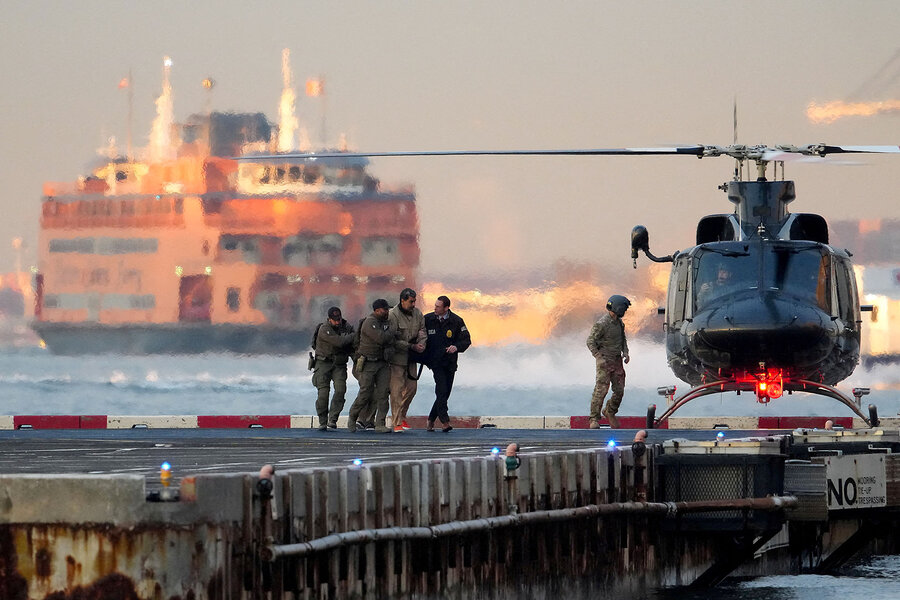
After the stunning late-night capture of Venezuelan President Nicolás Maduro and his wife, Cilia Flores, by the U.S. military at their home in Caracas, Secretary of State Marco Rubio asked the public to think of the operation in simple terms.
“At its core, this was an arrest of two indicted fugitives of American justice,” he said during a press conference Jan. 3 at President Donald Trump’s Mar-a-Lago estate.
The U.S. military, he added, “supported the Department of Justice in that job.”
Why We Wrote This
The U.S. military’s removal of Nicolás Maduro from Venezuela to face trial in a U.S. courtroom raises a host of questions about the legality of the Trump administration’s actions. We look at what international law, domestic law, and historical precedent say about the legal rationale.
Within hours of the arrests, the Justice Department unsealed a 2020 indictment and a superseding indictment listing Mr. Maduro and his wife among several defendants, including his son, charging them with drug smuggling and gun possession crimes.
But is it that simple?
Experts in international and military law – including some who witnessed another controversial U.S. intervention in Latin America – say the situation is more complex. Lawmakers on both sides of the aisle have criticized the Trump administration’s actions.
Instead of a simple arrest of a runaway fugitive, this was an arrest, in his own country, of a de facto head of state. Under international law, as stated in the charter of the United Nations, heads of state generally have immunity from foreign criminal prosecution. Mr. Maduro was sworn in for a third term as president in January 2025 after an election that was widely considered, including by international observers, to be fraudulent. The United States and the European Union do not recognize Mr. Maduro’s government.
His arrest on Saturday in Caracas featured support from all branches of the U.S. military and months of preparation. President Trump and Mr. Rubio said prior notification of Congress was not necessary, given their framing of it as a law enforcement operation. The 1973 War Powers Resolution directs a president to report to the legislative branch within 48 hours of deploying U.S. forces. It’s an effort to divide authority to wage war between Congress and the president, as the U.S. Constitution ordains.
Mr. Maduro’s legal journey will now follow the typical path toward a federal trial – though possibly with the added twist of prisoner-of-war rights. One thing the courts will likely not scrutinize is how Mr. Maduro and his wife, the former president of Venezuela’s National Assembly, came to be in U.S. custody. Once a defendant is on U.S. soil, courts have said it doesn’t matter how they came to be there.
What legal justification has the administration provided for the arrest?
The Trump administration has not provided a specific legal reasoning for its actions during the early hours of Jan. 3. But experts believe that three strands of reasoning have emerged from officials’ public comments.
First, administration officials argue, President Trump’s constitutional position as commander in chief gave him the authority to launch the military operation without notifying Congress.
Mr. Trump has cited this authority in recent months as his administration has launched lethal airstrikes on alleged drug traffickers in international waters, killing over 100 people. America is in an armed conflict with Latin American drug cartels, the administration has argued in public statements. The Justice Department indictment accuses Mr. Maduro of leading a drug cartel, Cartel de los Soles, for decades.
Second, as Secretary Rubio and other officials have said, the operation was not Mr. Trump committing American troops to an armed conflict. The troops were, in fact, supporting an effort to enforce U.S. domestic law on foreign soil. (FBI agents were on the ground in Caracas, meaning American law enforcement personnel were involved.)
“You don’t get to avoid justice for drug trafficking in the United States because you live in a palace in Caracas,” Vice President JD Vance said on social media hours after the arrests.

There is a degree of legal precedent for this. When the U.S. invaded Panama in 1989, William Barr – then head of the DOJ Office of Legal Counsel and eventually Mr. Trump’s attorney general – wrote a controversial memo claiming that the FBI could legally arrest the country’s dictator, Gen. Manuel Noriega. The memo concluded that the president has “inherent constitutional authority” to order the FBI to arrest individuals for violations of U.S. law, “even if those … arrests are not consistent with international law.”
The president can ignore the U.N. charter “and other unexecuted treaties or treaty provisions that have not become part of the domestic law of the United States,” the memo claimed.
Legal memos are advisory and have no precedential force in the courts. No Trump administration official appears to have publicly cited the memo, which legal pundits are widely discussing as a legal justification that the administration may cite.
There is also historical precedent for U.S. presidents to order military strikes without congressional approval. In 2011, President Barack Obama authorized airstrikes in Libya, and in 1999, President Bill Clinton coordinated an air campaign in Serbia with other NATO countries.
What are critics saying?
The administration says that Mr. Maduro’s ouster did not require congressional approval since it “was not an extended military action” but rather “a very precise operation that involved a couple hours of action,” as Mr. Rubio argued on NBC News’ “Meet the Press” on Sunday. But critics see it differently.
The operation included roughly 150 military aircraft launched from 20 military bases, as well as dozens of U.S. Navy ships and the Army’s Delta Force, a special operations detachment with expertise in pinpointing high-value targets. “So of course this was a military action, and pursuant to the Constitution, only Congress has the power to declare war,” Rep. Hakeem Jeffries, a New York Democrat who serves as the House minority leader, told “Meet the Press.”
At least 32 Cubans who serve in military and intelligence roles in Venezuela were killed in the operation, Cuban officials said Sunday. Mr. Trump told “Fox & Friends Weekend” that while “a couple” of U.S. members of the operation were injured, no one was killed.
One reason some lawmakers weren’t more forceful in demanding oversight in the run-up to U.S. military operations in the region is because of explicit assurances from Trump officials that the administration was not planning an invasion or regime change operation, says Katherine Yon Ebright, a counsel specializing in war powers at the Brennan Center for Justice at the New York University School of Law.
The U.S. constitutional system and the War Powers Resolution are designed to compel presidents to “loop in Congress” and make public their cases for the use of military force, she adds. “None of that has happened here.”
Trump supporters, including House Speaker Mike Johnson, have argued that the War Powers Resolution is unconstitutional because it violates the Article 2 powers of the commander in chief. Article 1, Section 8 of the Constitution gives Congress the power to “declare war,” “raise and support armies,” and “provide for a navy,” in addition to its power of the purse.
Yet even among lawmakers who support Mr. Maduro’s ouster, there are concerns about how U.S. adversaries could interpret the precedents that Mr. Trump is setting.

Tom Williams/CQ Roll Call/AP
Rep. Don Bacon, a Nebraska Republican and retired Air Force brigadier general who sits on the House Armed Services Committee, said in a statement Sunday that he believes the operation is “great for the future of Venezuelans.”
He added, however, “My main concern now is that Russia will use this to justify their illegal and barbaric military action against Ukraine, or China to justify an invasion of Taiwan. Freedom and rule of law were defended last night, but dictators will try to exploit this to rationalize their selfish objectives.”
Sen. Tim Kaine, a Democrat from Virginia, said he plans to force a vote this week to block further U.S. military operations in Venezuela without congressional approval.
What happened in Panama?
The U.S. strike in Venezuela came 36 years to the day after the U.S. removed another regional dictator.
Tensions between the U.S. and Panama had been rising for years before grand juries in Florida indicted Mr. Noriega on charges of drug trafficking in 1988. A year later, Mr. Noriega voided the presidential election in Panama and declared himself “maximum leader” of the country. Panama’s National Assembly declared war on the U.S. soon after.
The U.S. had a sizable military presence in the country at the time, stemming from the construction of the Panama Canal in the early 1900s. By the late ’80s, about 10,000 personnel were stationed in Panama, according to the U.S. Southern Command. In December 1989, a U.S. serviceman was shot and killed in Panama City.
President George H.W. Bush ordered an invasion of Panama, citing Panama’s declaration of war against the U.S. that week and the killing of the U.S. serviceman. Mr. Noriega eventually surrendered to U.S. forces and went on trial. In 1991, he was convicted of drug trafficking charges and sentenced to 40 years in prison.
The two operations share some similarities. Both Mr. Noriega and Mr. Maduro were de facto heads of state under indictment in the U.S. Both were accused of conspiring to traffic drugs to the U.S. Beyond that, however, the two apprehensions have little in common, says Geoffrey Corn, a law professor at Texas Tech University who was serving in the country at the time as an intelligence officer.
“We went into Panama out of legitimate concern that the lives of Americans were in danger,” he adds. “We didn’t invade a country to arrest somebody.”
What happens now?
Mr. Maduro and his wife appeared in court on Monday after spending Saturday en route to New York City and Sunday in jail. They both pleaded not guilty, with Mr. Maduro saying in Spanish that he was “captured” and “a decent man, the president of my country.”
The DOJ indictment charges them with four counts related to drug trafficking and the possession of “machineguns and destructive devices.” It lists Mr. Maduro and his wife as co-defendants along with his son, two other Venezuelan government officials, and the leader of the Tren de Aragua gang. (Ms. Flores, Mr. Maduro’s son, and the Tren de Aragua leader were all added to the superseding indictment released last week.)
According to the indictment, Mr. Maduro “sits atop a corrupt, illegitimate government that, for decades, has leveraged government power to protect and promote illegal activity, including drug trafficking.”
Per the indictment, Mr. Maduro has used his official powers, since 1999 when he was in the National Assembly, to partner with a half dozen drug cartels across Latin America and “distribute tons of cocaine to the United States.”
Mr. Maduro could make several pretrial arguments in future court hearings. Like Mr. Noriega before him, he could claim immunity from prosecution as a foreign head of state.
The courts approved of the prosecution of Mr. Noriega because the U.S. government did not recognize him as the legitimate leader of Panama. The same is true in the case of Mr. Maduro and Venezuela. In fact, multiple Democratic and Republican administrations have refused to recognize Mr. Maduro as Venezuela’s lawfully elected ruler. The European Union also hasn’t formally recognized him; 10 nations in Latin America refused to recognize his controversial reelection last year.
Mr. Maduro could also claim that his arrest was unlawful, but that argument appears to be foreclosed by legal precedent. Two U.S. Supreme Court decisions – known collectively as the Ker-Frisbie doctrine – held that courts have jurisdiction over criminal defendants even if they were not lawfully apprehended.
Mr. Maduro could also ask to be classified as a prisoner of war. This would entitle him to more comfortable confinement than for a typical criminal defendant and the ability to wear a uniform during court appearances, but not much else.