The COP30 climate summit, held in Belém the heart of the Amazon, Brazil, took place against a backdrop of indigenous resistance and ecological fragility. This summit generated high expectations, compelling the world to confront the intertwined colonial legacies, global inequality, and emerging climate crisis. However, it concluded as another climate summit, producing a balanced document which is thick in acknowledgements and thin on obligations; rich in symbolism, yet poor in structural commitments; framed by appeals to science, but constrained by global power.
Despite this, COP30 holds significance for addressing global inequalities, climate justice, accountability and sustainable growth which transcend mere discussion, even if the summit didn’t meet broader expectations. For India, COP30’s outcomes directly impact agriculture, the country’s most crucial but most vulnerable sector. As Indian farmers grapple with rising temperatures, erratic rainfall, groundwater depletion, and degradation of soil, the stakes of global climate regulations and governance have real-life implications. Understanding who bears the burden of climate action and who benefits is crucial, especially amid the global push toward decarbonisation. Thus, Belém COP30 offers both warnings and insights into the future of agriculture and agrarian society in India.
A summit of contradictions
COP30 at Belém has greater significance as it was the first COP to meet after the Global Stocktake had formally declared that the world is perilously off-track in combating climate change by limiting the temperature goals in the 2015 Paris Agreement at COP21. The expectations from COP30 were high: developing countries demanded stronger commitments on finance and adaptation, while scientific bodies underscored the urgency of rapid decarbonisation. The Brazilian presidency sought to reinsert ‘justice’, ‘equity’, and ‘ecological integrity’, the terms that had gradually faded from the centre of climate diplomacy and discourse into the vocabulary of global negotiations.
The outcomes of COP30 again exposed contradictions with in multilateral frameworks. Although countries expressed intentions to “transition away from fossil fuels,” there was no firm commitment to an unequivocal phase-out. Adaptation finance, vital for climate-vulnerable countries, received merely rhetorical support without binding targets. A decision on a measurable global goal was deferred and postponed, despite lobbying by developing countries. Additionally, a new framework for reporting agricultural emissions was introduced and cloaked in voluntariness but implied future obligations. This revealed the persistent structural asymmetries undermining global climate negotiations.
Agriculture as the new climate battleground
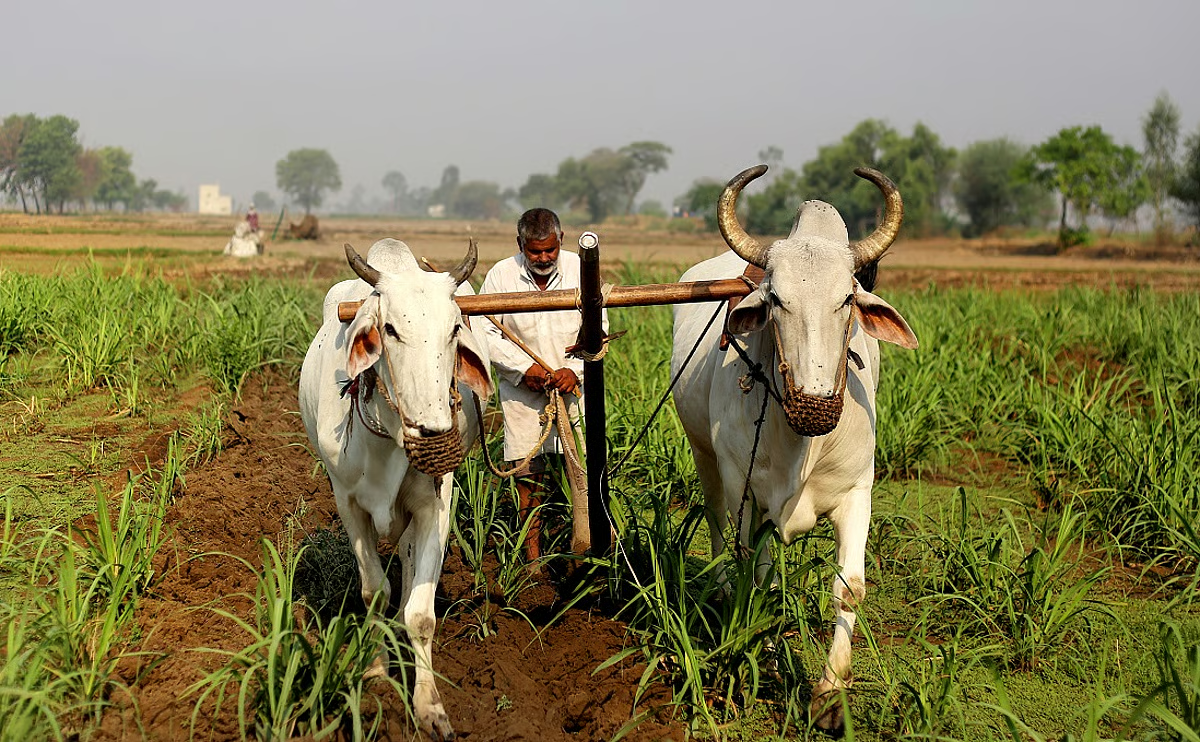
Although agriculture was not a formal focus at COP30, it emerged as highly charged topic of negotiation, particularly significant for countries like India. Agriculture employs nearly half of the workforce in India, including millions of small and marginal holders farmers, yet it remains the sector most vulnerable to climate impacts but least protected by global financing.
The scrutiny of agriculture in climate agreements has intensified, especially concerning methane emissions from livestock and paddy fields as well as nitrous oxide emissions from fertilisers. The guidelines adopted in Belém encouraged countries to report agricultural emissions more accurately and promote “best practices” for mitigation. Although voluntary, these guidelines suggest a political shift towards recognising the role of agriculture in climate mitigation, primarily led by developed countries.
For India, the implications are far-reaching and profound. The emissions of methane are tied to mixed crop-livestock systems and proposals to reduce cattle populations overlook their multifaceted roles in small holder livelihoods. That is a purely technocratic risk overburdening small-scale farmers while industrial agriculture remains unchecked.
The persistent crisis of climate finance
While agriculture emerged as a key area of contention at COP30, climate finance remained the most entrenched fault line. The conference once again highlighted a significant gap between the adaptation (mostly, financial) needs of developing countries and the willingness of developed countries to fulfil them. The developing countries had called for an annual funding range of $300-$400 billion annually by 2030, but the final agreement merely “encouraged” donors to increase their efforts. The Loss and Damage Fund received symbolic reinforcement. It remains severely underfunded, lacking predictable and grant-based financing. In the meantime, developed courtiers continued to promote private and blended finance as the primary mechanisms for scaling up climate investments.
For Indian agriculture, this shortfall is devastating. Climate resilience requires sustained public investment in micro-irrigation, restored watersheds, agro-ecological diversification, soil regeneration, strengthening rural extension services; and improved climate forecasting systems. These are public goods and requires public spending and concessional, long-term international finance support. COP30’s failure to establish binding financial commitments leaves much of the Global South, including India, facing an increasingly overwhelming adaptation deficit.
India’s strategic gains and limitations
At COP30, India approached with a clear diplomatic strategy anchored in three priorities: obtaining commitments on climate finance, safeguarding policy space for development, and maintaining flexibility in the reporting of agricultural emissions. India achieved partial success, notably incorporating references to food security and rural livelihoods into the COP30 document. Further, India also successfully resisted the binding methane targets in agriculture and ensured their voluntary reporting. However, it could not secure any meaningful breakthrough on finance or binding obligations.
The domestic vulnerability in India also influenced its position at COP30. The country is grappling with a deepening agrarian crisis exacerbated by the impact of climate change, including depletion of groundwater levels, heat stress, crop losses, livelihood insecurity and rising debt. Despite the challenges, domestic adaptation investments remain inadequate, and institutional capacity is uneven across states. These contradictions undermine climate diplomacy initiatives of India, making it harder to articulate a transformative agricultural vision at global forums.
Belém and the return of climate justice discourse
COP30 signalled a notable revival of climate justice discourse, driven by Brazil’s presidency, Indigenous leaders, and the G77+China bloc. The Amazon emerged as a symbol of global ecological concern and historical exploitation, illustrating the unequal impact of climate change. Indigenous leaders underscored the violence of land dispossession, deforestation, and resource extraction, the issues that resonate strongly with the tribal and forest dependent population in India. This renewed focus on justice is crucial as it challenges the narrow technocratic approaches to climate action and brings back the attention to historical roots of the ecological crisis. Despite its renewed significance, mere rhetoric alone cannot reshape the global climate governance. The real challenge lies in whether justice be embedded in financial commitments, technology transfer, and regulations, the domains where COP30 offered little substantive progress.
The road beyond Belém
COP30 at Belém revealed the limits of international climate governance and widening divide between those generating global emissions and those who bear the brunt of their consequences. In India, these disparities are felt most acutely in agriculture where erratic monsoons disrupt livelihoods, shrinking incomes and deepening rural distress. Further, Belém makes one reality clear: the future of climate justice in India will be determined not only by energy transitions or industrial policies, but by the fate of small and marginal farmers. Unless global climate commitments are matched by shared responsibility, and domestic policies embrace a genuinely transformative vision for agriculture, climate justice will remain a mere aspiration rather than a lived reality.