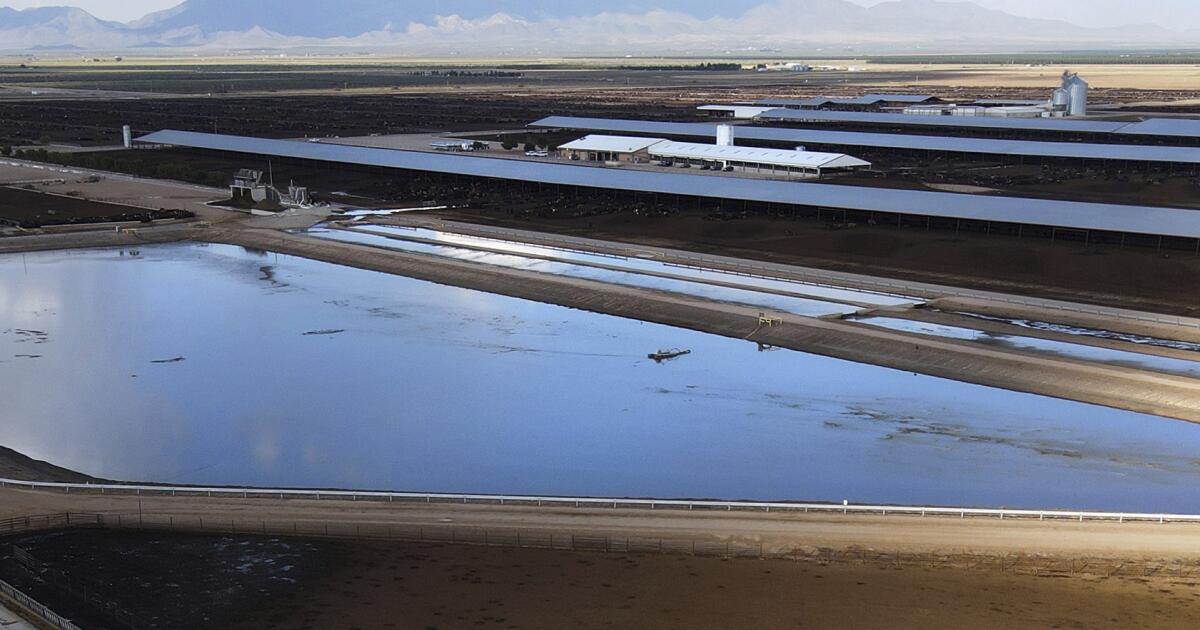
One of the largest farming businesses in Arizona has agreed to use less water and pay $11 million in a deal that state officials say will help preserve disappearing groundwater and provide financial help for residents whose wells have run dry.
Arizona Atty. Gen. Kris Mayes announced the binding legal agreement with Minnesota-based dairy company Riverview LLP on Thursday, calling it the first of its kind in the nation.
“This settlement sets a new precedent in Arizona — one where businesses commit to being good neighbors to the communities they operate in and make meaningful efforts to reduce pumping of our most precious resource,” Mayes said. “Today’s announcement is an immediate and concrete action to address the increasingly dangerous depletion of groundwater in rural parts of our state.”
Groundwater levels have been dropping rapidly over the last decade in the Willcox area of southeastern Arizona’s Sulphur Springs Valley, where Riverview runs a giant dairy and farming operation.
The company started buying land in the area in 2014 and owns more than 37,000 acres. In 2019, an Arizona Republic investigation revealed the company had 420 wells, some drilled half a mile deep. Riverview has expanded its dairy operation while growing wheat, alfalfa and corn for its cattle.
As the water table has declined, some residents’ wells have run dry, forcing them to install tanks and pay for trucked-in water until they can have new wells drilled.
Under the agreement, Riverview will stop irrigating 2,000 acres of crops in phases within 12 years.
The company will contribute $11 million to defray costs for residents, schools and local water systems to haul water, install tanks or drill replacement wells.
Riverview said in a written statement it “values stewardship of the land and water,” recognizes the area’s water challenges and wants “to be part of the solution.”
Mayes announced the agreement at a meeting in the community of Pearce in Cochise County, telling residents and farmers she launched an investigation into the company’s water use after hearing people’s fears about the growing number of dry wells and sinking ground damaging roads and houses. She recalled some telling her at a 2024 meeting that they feared their community could become unlivable if water is eventually exhausted.
She said it took a year of “hard-fought negotiations” with the company to reach the agreement. It is far from perfect, Mayes said, but it’s a start and can be a model for getting other big farms to rein in excessive water use.
Mayes negotiated with the company while pursuing a lawsuit against another large company to limit its water use. She is suing the Saudi-owned dairy company Fondomonte, which grows hay on thousands of acres in western Arizona, alleging its excessive pumping represents an illegal “public nuisance” by causing declines in groundwater, land subsidence and worsening water quality.
Large farming operations have expanded in Arizona over the last two decades, while global warming has increasingly strained the region’s scarce water. Scientists using satellite data estimate that since 2003, the amount of groundwater depleted in the Colorado River Basin is comparable to the total capacity of Lake Mead, the nation’s largest reservoir.
Until recently, farming companies and investors have been allowed to pump unlimited amounts of groundwater in most rural areas across Arizona.
Since Gov. Katie Hobbs took office in 2023, however, she has sought to curb overpumping where aquifers are in severe decline.
Her efforts to pass reforms have so far failed in the state Legislature. But last year, her administration established a new regulated area around the city of Willcox, and she recently appointed five local leaders to serve on an advisory council to help develop a plan for reducing agricultural water use in the area.
Ed Curry, a Hatch chile farmer who is a member of the council, said groundwater pumping would be cut by half over the next 50 years under the plan they’re developing.
“We have a reasonable chance at sustainability in this valley,” Curry said, adding that this kind of agreement brings “a little bit more hope.”
Steve Kisiel, a Cochise County resident, said the water table in his area has dropped about 150 feet since the 1990s, which forced him to have a deeper well drilled for his home.
“It affects everybody,” he said. “This is a move in the right direction.”
Environmental advocates praised the agreement with the Riverview dairy. Kevin Moran of the Environmental Defense Fund said it “finally acknowledges the harms being done to rural Arizona by exploitative and unsustainable water pumping.”
Sen. Ruben Gallego (D-Ariz.) said the deal sets a precedent that “if you use our state’s water, you have a responsibility to protect it.”
But some residents said the announcement doesn’t ease their concerns.
Victoria Sky, who lives near the dairy operation, said a creek where she once spotted turtles has run dry, and she blames excessive groundwater pumping.
“There’s no water. They have effectively stopped Turkey Creek from running,” she said. “What about the wildlife? This is a travesty.”
Gerry Gonzalez, who also farms in Cochise County, said for a big farm like Riverview, the water they are giving up is a “drop in the bucket,” while smaller farms are struggling because they can’t afford to deepen wells.
“We’re being squeezed out because we’re not a mega-farm,” he said. “We didn’t have these problems before these guys showed up, and now there’s no end to it. They’re going to drain it, but it’s going to be a little slower.”
Mayes replied that the state Legislature has not passed laws “that limit this kind of farming,” and she chose to reach an agreement that she felt would benefit the community, and that “we could build off of.”
“There is so much more that needs to be done, not just here, but also in other parts of the state,” she said. “We cannot afford to be dumb with water anymore, and this level of agricultural pumping in a way that clearly harms surrounding neighbors and puts entire aquifers in jeopardy is just not appropriate anymore, especially in light of climate change and in light of our dwindling water supplies.”