- Despite India launching the National Clean Air Programme in 2019, most cities continue to report high levels of pollution.
- Experts call for changes to the programme, including pollutants targeted, incentives provided, and setting up a comprehensive, standardised monitoring framework.
- A report on the programme recommends expanding monitoring systems, assessing pollution levels at more local levels within cities, and using a three-year rolling average to track pollution trends as opposed to annual.
A new assessment of air pollution trends in highly polluted cities finds that since 2017, levels of particulate pollution have actually been reducing – but it’s unclear how or why.
In 2019, India launched the National Clean Air Programme — a flagship scheme aimed at reducing levels of pollution in “non-attainment cities” — those exceeding the National Ambient Air Quality Standards (NAAQS) consecutively for five years. Despite five years since the programme was launched, there’s been marginal improvement, with most cities continuing to report high levels of pollution.
Failure of the programme to effect meaningful change has been, in part, due to its design. The NCAP set a target for non-attainment cities to reduce PM10 levels by 20-30% by 2024, using 2017 levels as a baseline. In 2022, the scheme was renewed with a revised target of reducing PM10 levels by 40% by 2026.
As fresh renewal of the Programme approaches, experts have been calling for an overhaul, including making changes to the pollutants targeted under the programme, incentives provided, and setting up a comprehensive, standardised monitoring framework.
An assessment of changes in air pollution levels in NCAP cities by the Health Effects Institute, released on January 13, found reductions in both PM10 and PM2.5 levels at monitoring stations assessed. However, attributing these changes to the NCAP alone is challenging, due to an unclear monitoring system and other interventions that may have played a role.
“We’re making huge investments in improving our air quality monitoring systems. But if we do not pay attention to data management and data quality, then it’s an all wasted investment,” said Anumita Roychowdhary, Executive Director, Research and Advocacy at the Centre for Science and Environment, during the report’s launch. “The NCAP is now the basis of Air Quality Management in this country, and it certainly requires a much more sophisticated, multi- layered analytical approach, which needs to move much beyond these very simple, ad hoc metrics that are applied today,” she added.
Snapshot of NCAP
The NCAP covers 130 cities in total, of which 48 are funded under the 15th Finance Commission because they host populations of over one million people. The rest are funded under the Union Environment Ministry’s Control of Pollution Scheme.
Access to this funding is linked to performance in reducing pollution loads. However, both sources of funding have differing metrics through which to track progress. The Finance Commission tracks progress by looking at reductions in PM10 levels as well as the frequency of days crossing “high” AQI levels exceeding 200. The Ministry, on the other hand, tracks the progress by calculating a “progress factor,” computed using both actual and targeted reductions of PM10 levels.
Progress based on these metrics is tracked annually. The Centre for Research on Energy and Clean Air’s (CREA) annual report on the NCAP found that by the end of 2025, Rs 13,415 crore had been disbursed to various cities of which 77% had been utilised. A majority of funds — ₹11,021 — was disbursed through the Finance Commission.
“While the utilisation rate for million-plus cities improved in recent years, the overall trend shows persistent delays and gaps in implementing planned interventions. The low utilisation rate for 82 non-attainment cities is particularly concerning, given the pressing need to address air quality issues,” the CREA report says.
Several experts have also called for the NCAP to link progress with more harmful pollutants, like PM2.5 — smaller particles capable of causing respiratory problems, cardiovascular disease, diabetes, and a host of other health issues. “Right now, our air quality standards are substantially higher than what is globally considered acceptable by the World Health Organisation and are not necessarily fully aligned with what the health evidence also tells us with respect to health,” said Bhargav Krishna, Convenor, Sustainable Futures Collaborative and an expert contributor to the report.
Linking progress of the NCAP with the control of more harmful pollutants can have a positive effect on health outcomes.

Trends in pollution
The HEI report notes that air quality monitoring has grown substantially since 2017, the NCAP’s baseline year, from just 78 stations across 38 cities then to 346 stations in 101 cities in 2024. But despite this expansion, coverage remains uneven. The biggest expansions are in the big cities of Mumbai, Delhi, and Bengaluru, Pune, and Chennai, while there are no continuous monitoring systems in rural India at all.
More representative coverage can help not only discern sources of pollution but also help track whether interventions are working. To track trends in air pollution across the NCAP cities, the analysis only considered monitoring stations which reported levels for 18 hours each day, 23 days each month, 11 months each year, for three years consecutively. This was to ensure “completeness” of data across all seasons, and representation across time.
The results are surprising: For PM10, the number of stations exceeding the national air quality standards between 2017 and 2024 remained largely unchanged, with a majority of stations reporting exceedances each year. This indicates PM10 is a major polluter.
By contrast, for PM2.5, the number of stations crossing the standards steadily declined year on year, reducing by 33%. The National Capital Region reported the most number of stations crossing standards.
These decreases were made evident after the researchers “deseasonalised” the data and adjusted for changes in meteorology, in an attempt to capture organic changes to pollution levels over time.
When the national standards are kept aside, a clearer trend of pollution reduction is seen across both sources in stations assessed. For PM10 levels, over 66% of 209 stations analysed showed decreases in air pollution levels compared to 2017, while over 33% showed increases. For PM2.5 levels, almost 68% of the 211 stations analysed showed decreases, and just over 32% showed increases.
“This is something that perhaps requires a little further looking into, with respect to how data was collected and what has actually happened on the ground, to try and understand why this distinction exists between these two pollutants that are quite similar in origin,” said Krishna.
Attributing reductions in pollution to the NCAP alone is challenging, the HEI report says. “A number of major interventions – such as leapfrogging from BS-IV to BS-VI (more efficient fuel engine standards), the implementation of Pradhan Mantri Ujiwala Yojana, and various state and local policies – were introduced during a similar period. In addition, in most cities NCAP funds were allocated and released at vastly different points in time, making it even harder to draw a direct link between the programme and observed trends, at least in the current time frame.”
CREA notes that the siting of each monitor, its calibration, and maintenance are all important factors in ensuring the data is accurate. The HEI report did not comment on the location of each machine, or its calibration.
Using newer metrics to track improvements
To improve monitoring under the NCAP, the HEI report has three broad recommendations — the first of which is to expand monitoring system coverage to a more representative degree. Having an expansive network of monitoring systems that capture information consistently and reliably “is essential to establish stable and reliable patterns” in air pollution.
Currently, assessments for improvement under the NCAP are conducted based on city-level averages. However, the HEI analysis noted wide variance in pollution levels within cities, caused by a variety of hyperlocal pollution sources. For the NCAP to truly capture the efficacy of interventions at the local body level. Using station-level averages could be a more accurate way to capture impacts of interventions, the study says.
Finally, it recommends using a three-year rolling average to track trends in air pollution, as opposed to an annual average. “Using a rolling average (e.g., 3-year rolling averages) can provide clear trend in pollutant concentrations. It smoothens short-term fluctuations, reduces anomalies, and provides more accurate long-term trends.”
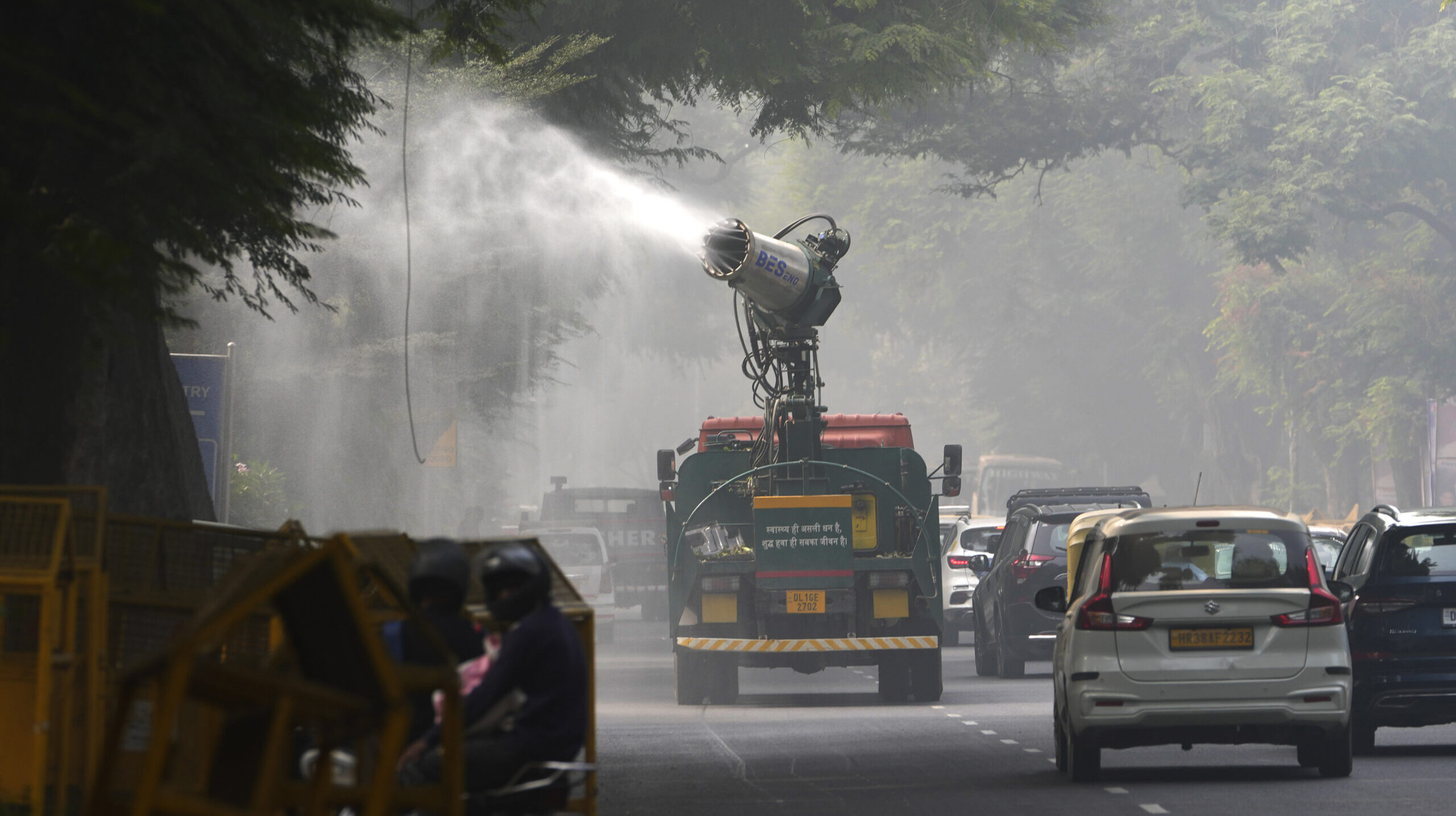
Banner image: A government vehicle sprinkles water to control air pollution in New Delhi. Representative image. (AP Photo/Manish Swarup)