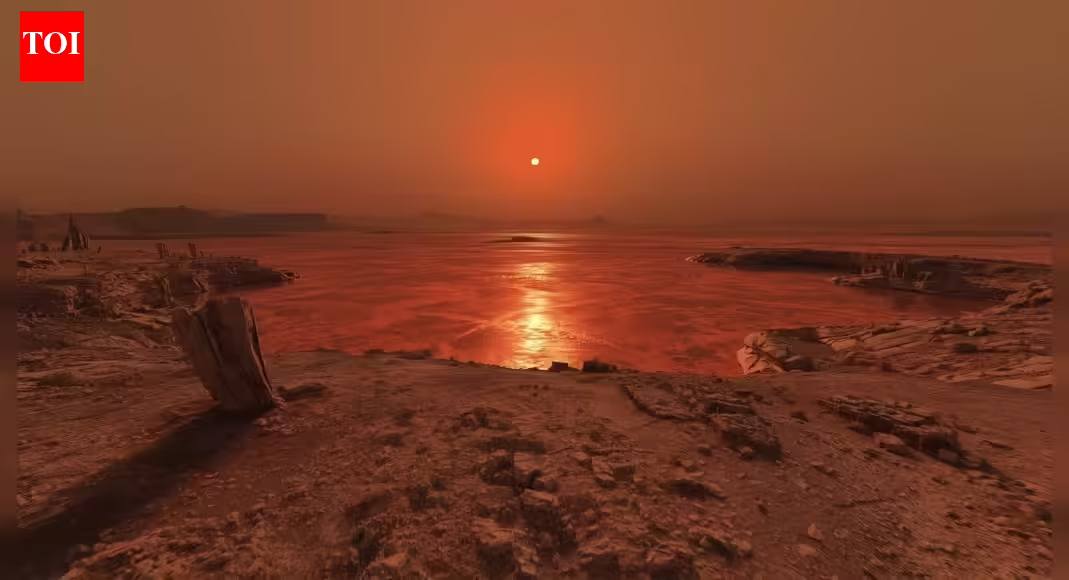
Mars had an Arctic-sized ocean, and scientists are only now beginning to see the outline of it. For a long time, the planet has been described as dry and stripped of anything familiar. Yet images gathered over years have kept suggesting something quieter and older beneath the dust. Channels that do not quite fade. Slopes that look worked rather than carved. A new study brings some of these pieces closer together. It focuses on features that resemble river deltas, found far from the northern plains where Martian oceans were once imagined. Instead of broad theory, the research works from shapes, edges and sediment. The result is a picture that feels less speculative. Mars, it suggests, once held a stable body of water large enough to shape coastlines and hold them in place for long periods of time.
Scientists uncover new evidence of an Arctic-sized ocean on Mars
Liquid water has stayed at the centre of Mars research named “Scarp-fronted deposits record the highest water level in Mars’ Valles Marineris,” because it changes what the planet might once have been. Water allows chemistry to settle, not rush. It shapes landscapes slowly. Earlier missions showed signs of rivers and lakes, but these often appeared short lived or local. What scientists lacked was firm evidence of a long standing ocean with a defined edge. Without that, ideas about habitability stayed uncertain. The new findings do not answer questions about life directly, but they narrow the gap. They suggest Mars had conditions that lasted rather than flashed into existence and disappeared.
New features found were found near Martian equator
The structures were identified in Coprates Chasma, part of the vast Valles Marineris canyon system near the Martian equator. This location surprised researchers. Oceans were usually placed in the northern lowlands, not connected to deep canyon walls. Using detailed images, the team mapped fan-shaped deposits along slopes that resemble river mouths on Earth. These deposits sit against scarps in a way that implies water once flowed into a larger body rather than simply spreading across land. The shapes appear ordered, not random, and they repeat across the area.The new study is narrower in scopeEarlier claims of Martian oceans relied heavily on broad topography and theoretical sea levels. The new study is narrower in scope but firmer in detail. The delta-like features match Earth examples not just in outline but in structure. They show layered sediment and consistent angles. According to Professor Fritz Schlunegger of the University of Bern, these are not ambiguous forms. He described them as clear signs of rivers entering an ocean. This confidence comes from comparison rather than modelling. The researchers looked at how water behaves on Earth and asked whether Mars showed the same quiet logic.
Imaging technology change the picture
The work relied on high-resolution colour images from the CaSSIS camera aboard ESA’s ExoMars Trace Gas Orbiter. Developed at the University of Bern, CaSSIS has been operating since 2018. It allows scientists to see surface detail at a scale that was not possible before. These images were combined with data from Mars Express and the Mars Reconnaissance Orbiter. Professor Nicolas Thomas, who led the camera’s development, said he was pleased to see the images used for geological interpretation rather than only surface description. The technology allowed the team to trace shoreline patterns across large areas.
Martian ocean similar to the Arctic Ocean in size
Based on the reconstructed coastline, the researchers estimate the ocean covered an area similar in size to Earth’s Arctic Ocean. It would have spread across much of Mars’ northern hemisphere. This is not a claim of constant depth or uniform conditions. Instead, it suggests a stable sea that lasted long enough to accept sediment and maintain a clear boundary. Wind erosion and dust storms later reshaped the surface, but the core forms remain. Dunes now lie across many of the deposits, though their original structure is still visible beneath.
What comes next for this research
The team plans to study the mineral content of the ancient sediments. Minerals can preserve traces of water chemistry and environmental conditions. For doctoral researcher Ignatius Argadestya, who led the mapping, the work feels familiar in an unexpected way. He noted how closely Martian valleys resemble landscapes on Earth once shaped by water. The study does not close the case on Mars’ oceans. It opens another layer. One that feels less dramatic, perhaps, but harder to ignore.