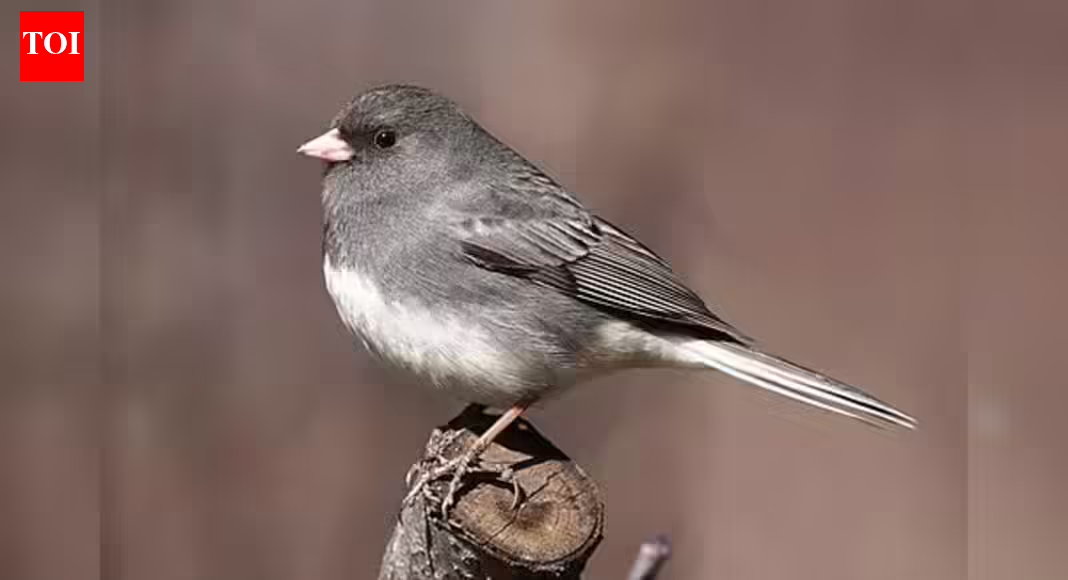
For a brief period during the pandemic, cities slowed down in ways rarely seen. Streets emptied, food waste declined, and daily human presence dropped sharply. For wildlife living close to people, this shift created an unusual pause. New research now suggests that this moment left a physical mark on at least one urban bird species. Scientists studying dark-eyed juncos in California found that birds born during COVID-19 restrictions developed different beak shapes compared with those raised before and after lockdowns. The changes appeared quickly and then faded once normal activity returned. The findings point to how closely some urban animals track human behaviour, even in their physical form, and how small changes in our routines can ripple through nearby ecosystems.
How COVID-19 changed the beaks of dark-eyed juncos
Dark-eyed juncos are small grey birds common across North America. In California, some populations have settled permanently in cities, including on the University of California, Los Angeles campus. These urban juncos have been studied for decades and are known to differ from their wildland relatives.Before the pandemic, researchers had already noticed that city juncos in Los Angeles tended to have shorter and thicker beaks. One leading explanation was access to human food waste. Scraps and processed food may favour stronger, broader bills rather than longer ones used for natural foraging. Other theories have been proposed, including changes linked to noise, heat, or the built environment. But separating these overlapping factors has always been difficult.
COVID restrictions created an accidental experiment
When COVID lockdowns began in March 2020, the UCLA campus changed almost overnight. Classes moved online. Foot traffic dropped. Most food outlets closed. Researchers later measured a roughly sevenfold reduction in human activity during the strictest period compared with normal conditions. Researchers at the University of California, Los Angeles, published research named “Rapid morphological change in an urban bird due to COVID-19 restrictions.” This sudden shift became what scientists call an anthropause, a temporary reduction in human pressure. For the junco population, it meant less discarded food and fewer daily interactions with people. Crucially, birds hatched during this period experienced these conditions throughout their early development. This allowed researchers to compare individuals born before, during, and after restrictions under otherwise similar urban settings.
Shapeshifted toward a wildland form
The findings revealed a distinct pattern. The Juncos that hatched during the anthropause grew beaks that were longer and narrower, resembling more of the birds from neighbouring mountainous wildlands. Their bill shape and size were different from those of birds born before lockdowns.Birds that hatched during the first months of 2020 did not exhibit an immediate change. Birds born in 2021 showed a clearer transformation after a longer period of reduced human presence. This indicates a lag at the population level rather than a sudden reaction. For a short period, the city birds physically resembled their non-urban relatives.
The change reversed when human activity returned
As restrictions eased in late 2021 and into 2022, human movement and food waste increased again. Birds hatched after this return showed a shift back toward the earlier urban beak shape.By 2023 and 2024, the junco population had largely returned to its pre-pandemic form. The change was not permanent. It tracked closely with human behaviour. This rapid back and forth suggests that the birds were responding to immediate conditions rather than long-term genetic change. Developmental flexibility likely played a role.
Food waste appears to be a key driver
Among the many urban factors, food availability stood out. During lockdowns, dining halls and cafés were closed for months. Organic waste on campus dropped sharply. With fewer easy calories available, birds may have relied more on natural food sources that favour longer, narrower bills. When human food returned, the advantage shifted again.The study could not rule out other influences entirely. But food waste remains the strongest explanation that fits both the timing and direction of change.
Small human shifts can shape wildlife quickly
The findings add to growing evidence that wildlife responds rapidly to human patterns. Behavioural changes during the anthropause were widely reported. Physical changes have been harder to document. Here, the shift occurred within a few years and reversed just as quickly. It highlights how urban animals are not just living near people but are closely tied to our routines.The junco study also raises questions about how future changes in cities might shape wildlife in subtle ways. Not all effects are obvious. Some show up quietly, in small details, and then fade back again when the city wakes up.