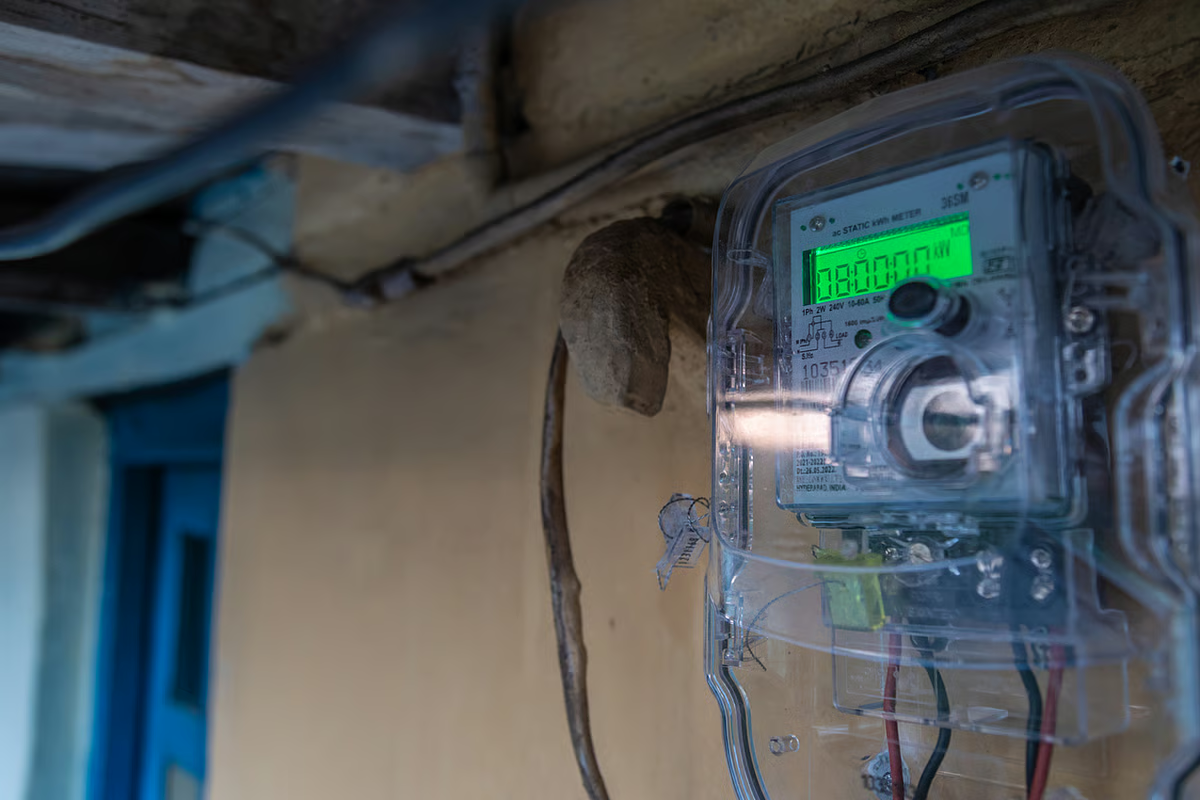
India’s ambitious smart metering programme is delivering measurable financial and operational gains for several power distribution companies, but experts and utility heads warn that unresolved challenges around data utilisation, manpower capacity and consumer engagement could limit its long-term impact unless urgently addressed.
Senior officials from state utilities and the power sector at an industry event on January 19, 2026 highlighted that while smart prepaid meters have helped improve billing efficiency and revenue recovery, the sector is still struggling to convert the vast volumes of data generated into actionable outcomes on the ground.
Financial gains, but uneven progress
Bihar’s experience has emerged as a key reference point. According to Manoj Kumar Singh of Bihar energy department, the installation of over 84 lakh smart prepaid meters has coincided with a dramatic financial turnaround. Aggregate losses of around Rs 300 crore in FY21 have flipped into profits exceeding Rs 2,000 crore by FY25, while billing efficiency improved from 75 per cent to nearly 87 per cent .
Revenue collection has nearly doubled over the period, supported by energy audits that helped identify theft-prone areas and under-billing at the feeder and distribution transformer levels. Singh stressed that smart meters enabled a shift away from “assumption-based operations” to predictive, evidence-based decision-making, reducing regulatory disallowances and improving tariff credibility .
However, other experts and utility companies cautioned that such gains are not automatic and remain uneven across states and utilities.
Data deluge, limited capacity
One of the most persistent challenges flagged was the inability of utilities to fully exploit the data generated by smart meters. Senior discom officials admitted that even advanced utilities are currently using less than a quarter of the available data, largely due to the absence of dedicated analytics teams and institutional capacity .
Shalu Agarwal of Council on Energy, Environment and Water noted that converting granular meter data into insights for field engineers requires specialised skills spanning IT, finance and operations. Without this integration, smart metering risks becoming a compliance exercise rather than a transformative tool.
To address this, some utilities have proposed creating dedicated IT and data analytics wings, while the Ministry of Power is pushing capacity-building initiatives to ensure data interpretation reaches the sub-division and feeder levels .
Consumer resistance and trust deficit
Consumer acceptance remains another fault line. Utility heads acknowledged that resistance, misinformation and billing anxieties, especially during meter replacement and transition to prepaid systems continue to trigger complaints and political pressure.
Samuel Paul, managing director of Kanpur Electricity Supply Company pointed to challenges such as delayed reconnection after recharge, communication failures between meter, network and billing systems, and confusion among rooftop solar consumers shifting to prepaid meters .
They emphasised that sustained awareness campaigns, simplified billing formats and post-installation handholding are essential to prevent backlash. “It is not about deploying more meters, but about ensuring consumers clearly see the benefits,” a union power ministry official said during the discussion.
Manpower and vendor risks
The rollout has also exposed structural weaknesses in manpower deployment. High attrition among meter installation and maintenance staff, skill gaps in advanced metering infrastructure companies, and inconsistent performance across vendors were repeatedly flagged as risks that could slow progress.
Utilities warned that smart metering is a long-term investment with meter lifespans of 10-12 years, making sustainable operations and service quality as important as installation targets.
Way forward
Agarwal of CEEW and Swetha Kumar of FSR Global converged on a few key solutions: Scaling up training programmes for discom engineers, enforcing stronger performance standards for vendors, mandating third-party studies to quantify consumer benefits, and accelerating the development of interoperable data-sharing frameworks such as the India Energy Stack .
Without these systemic fixes, they cautioned, smart meters may improve short-term revenue metrics but fall short of enabling the deeper distribution reforms needed to support India’s clean energy transition.
As Kumar summed up, “Without data, we are just another person with an opinion but without the capacity to use data, even smart meters cannot deliver their full value”.