For years, the public face of ocean pollution has been the same: floating bottles, drifting bags, and beaches littered with waste. But scientists say the most dangerous build-up is happening far below the surface, on the seafloor, where debris settles and remains for decades. A global scientific review led by Professor Miquel Canals at the University of Barcelona warns that deep-sea basins and underwater canyons are becoming collection zones for human-made waste. The damage is not only environmental but biological, as plastic and abandoned fishing gear continue harming marine life long after the rubbish disappears from view.The warning comes from a 2021 review paper published in Environmental Research Letters titled “The quest for seafloor macrolitter”. The study, led by Canals and supported by an international team of researchers, brought together what scientists already know about deep-sea debris, how it is monitored, and why it is so difficult to control.Co-authors include marine litter specialists such as Christopher K. Pham, Melanie Bergmann, Georg Hanke, Erik van Sebille, and François Galgani. The review also reflects broader European research efforts involving organisations like the European Commission’s Joint Research Centre and Germany’s Alfred Wegener Institute.
The biggest plastic problem in the ocean is sinking
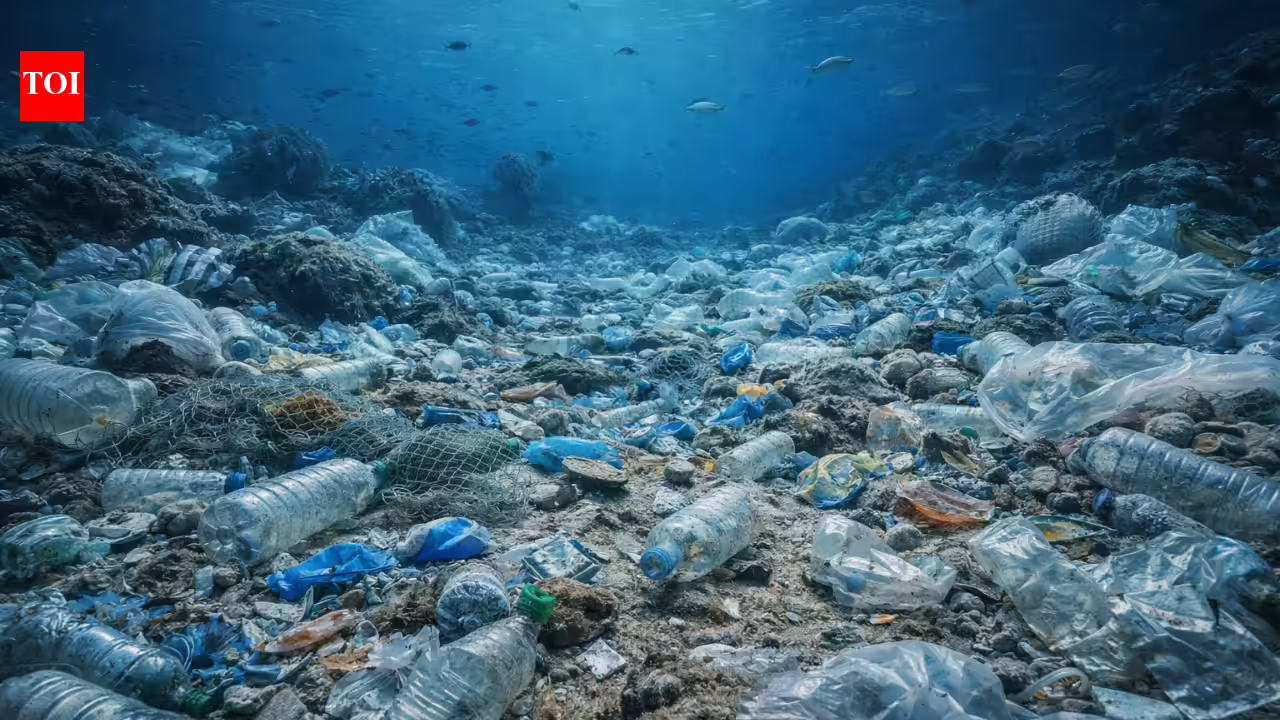
While floating plastic gets most of the attention, the seabed is where a large share of marine debris ends up. Once waste reaches deep water, it becomes extremely difficult to locate and even harder to remove. As a result, the seafloor can store plastics, metal, glass, and fishing gear for years, allowing pollution to build up quietly over time.One of the most severe seafloor litter zones identified by researchers is the Strait of Messina, between Italy and Sicily. Surveys in parts of its underwater canyon system have recorded debris densities ranging from roughly 121,000 items per square kilometre to as high as 1.3 million items per square kilometre.The area’s geography and strong currents help explain why the debris concentrates there. Instead of dispersing evenly, litter is funnelled into narrow deep-sea pathways where it accumulates in dense clusters.
Underwater canyons are dragging rubbish into the deep sea
Marine litter does not simply sink straight down. It can be pushed offshore by storms, carried by ocean currents, and then pulled down into deep basins through submarine canyons. These canyons act like channels that transport waste away from coastlines and concentrate it far below the surface.This helps explain why deep-sea debris can appear in places that seem distant from human activity. The ocean is constantly moving, and the waste moves with it.
Plastics dominate, and they keep breaking into smaller pieces
Plastics account for the largest share of seafloor debris in many studies, largely because they are lightweight, widespread, and slow to degrade. Over time, bigger items fragment into smaller pieces, increasing the number of pollutants in the environment and expanding the range of species exposed to them.Unlike materials that corrode or dissolve more quickly, plastic can persist for long periods in deep water, where temperatures are low and biological activity is limited.
Plastic has reached even the deepest parts of the planet
Deep-sea explorers have recorded plastic debris at extreme depths, including near the Mariana Trench. The discovery has reinforced a worrying reality: even the most remote parts of the ocean are not isolated from global waste.This is no longer a coastal problem. It is a planet-wide one.
Ghost fishing turns lost gear into a long-term threat
Among the most dangerous forms of seafloor debris is abandoned fishing gear. Nets, ropes, and lines can continue catching and killing marine animals for years, a phenomenon known as ghost fishing.Because this gear is built to trap living creatures, it causes damage in a way ordinary litter does not. It also damages habitats, especially when heavy nets drag across reefs or snag onto seabed structures.
How seabed debris is killing marine life
Scientists warn that seafloor pollution harms marine animals in three main ways.First, wildlife becomes entangled in nets and ropes, which can cause injury, starvation, or drowning. Second, animals ingest plastic, either by mistaking it for food or swallowing it accidentally while feeding. Third, debris disrupts habitats by smothering the seabed, damaging corals, or altering ecosystems that are already fragile.Researchers say hundreds of marine species worldwide are affected by marine debris, with long-term risks that are still being studied.
Why deep-sea pollution is difficult to track
Unlike surface pollution, deep-sea debris cannot be monitored easily. Researchers rely on tools such as remotely operated vehicles, deep-sea cameras, sonar mapping, and specialist research vessels. These surveys cover limited areas, meaning scientists believe the problem is likely undercounted in many parts of the world.This lack of visibility is part of what makes seafloor pollution so persistent. If it cannot be easily seen, it is easier to ignore.
The only realistic solution is prevention
Cleaning the deep seafloor at scale is not practical in most places. It is expensive, technically difficult, and could disturb sensitive ecosystems. That is why scientists and environmental organisations focus on stopping waste before it reaches the ocean.This includes better waste collection on land, stronger enforcement against illegal dumping, reducing plastic leakage through rivers and ports, and cutting the loss of fishing gear that becomes deadly ghost equipment.The message from researchers is clear. The ocean is not a disappearing bin. What falls into it can settle on the seafloor for decades, turning the deep sea into a hidden rubbish store that marine life cannot escape.