When he’s not busy slathering the White House in gold or recklessly sundering foreign alliances, President Trump loves to talk about voter fraud.
Although the incidence is rare — like, spotting-a-pangolin-in-the-wild rare — Trump persistently emits a gaseous cloud of false claims. About rigged voting machines, dead people casting ballots, mail-in votes being manipulated and other fevered figments of his overripe imagination.
Voting is the most elemental of democratic exercises, a virtuous act residing right up there alongside motherhood and apple pie. But Trump has treated it as a cudgel, something dark and sinister, fueling a partisan divide that has increasingly undermined faith in the accuracy and integrity of our elections.
One result is a batch of new laws making it harder to vote.
Since the 2020 presidential election — the most secure in American history, per the Trump administration’s own watchdogs — at least 30 states have enacted more than 100 restrictive laws, according to New York University’s Brennan Center and the Democracy Policy Lab at UC Berkeley, which keep a running tally.
Texas passed legislation allowing fewer polling places. Mississippi made it harder for people with disabilities to vote by mail. North Carolina shortened the window to return mail ballots.
In California, state Sen. Carl DeMaio and allies are working to qualify a November ballot measure that would require a government-issued ID to vote, a solution in desperate search of a problem.
“We have the lowest level of public trust and confidence in our elections that we have ever seen,” the San Diego Republican said in launching the effort, sounding the way someone would by lamenting the damage a fire has done while ignoring the arsonist spreading paint thinner all around.
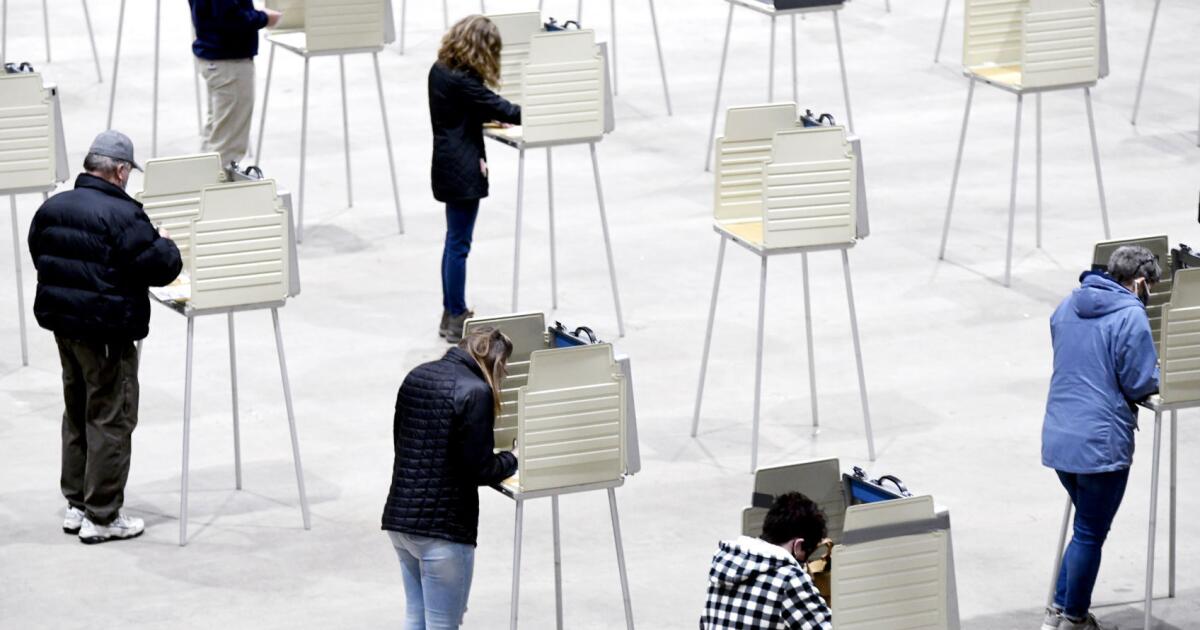
Amid all the manufactured hysteria, there is a place that is unique in America, with no voter registration requirement whatsoever.
If you’re a U.S. citizen, 18 years or older and have lived in North Dakota for 30 days prior to election day, you’re eligible to vote. It’s been that way for more than 70 years, ever since voter registration was abolished in the state in 1951.
How’s it working?
Pretty darn well, according to those who’ve observed the system up close.
“It works excellent,” said Sandy McMerty, North Dakota’s deputy secretary of state.
“In general, I think most people are happy with this,” political scientist Mark Jendrysik agreed, “because it lowers the record-keeping burdens and saves money.”
Jendrysik, who teaches at the University of North Dakota in Grand Forks, said voter registration was abandoned at a time when the state — now redder than the side of a barn — had vigorous two-party competition and, with it, a bipartisan spirit of prairie populism.
“There was an idea we should make it easier to vote,” Jendrysik said. “We should open up things.”
What a concept.
Walk-up voting hasn’t made North Dakota a standout when it comes to casting ballots. In the last three elections, voter turnout has run close to the national average, which puts it in the middle of the pack among states.
But there also hasn’t been a high incidence of fraud. In 2022, a study by the state auditor’s office found it “exceptionally” unlikely an election in North Dakota could be fraudulently influenced. (Again, like the country as a whole.)
In fact, Jendrysik said he can’t recall a single case of election fraud being prosecuted in the 26 years he’s lived in North Dakota and followed its politics.
It’s not as though just anyone can show up and cast a ballot.
Voting in North Dakota requires a valid form of identification, such as a state-issued driver’s license, a tribal ID or a long-term care certificate. It must be presented each and every election.
By contrast, a California voter is not required to show identification at a polling place before casting their ballot — though they may be asked to do so if they are voting for the first time after registering to vote by mail and their application failed to include certain information. That includes a driver’s license number or the last four digits of their Social Security number.
Could North Dakota’s non-registration system be replicated elsewhere?
Jendrysik is dubious, especially in today’s political environment.
North Dakota is a sparsely populated state with hundreds of small communities where, seemingly, everyone knows everyone else. There are about 600,000 eligible voters, which is a lot more manageable number than, say, California’s 30 million adult-age residents. (California has more than a dozen counties with north of half a million registered voters.)
“It’s unique to this state,” Jendrysik said, “and I think if they hadn’t done it decades ago, it would have never happened.”
(Fun fact: North Dakota also has no parking meters on its public streets, owing to a state law passed in 1948, according to Jendrysik, who has published two academic papers on the subject.)
McMerty, of the secretary of state’s office, believes others could emulate North Dakota’s example.
It would require, she suggested, rigorous data-sharing and close coordination among various state agencies. “We’re updating our voter rolls daily — who’s obtained a driver’s license, births, deaths. That kind of thing,” McMerty said.
Again, that’s a much easier task in a state with the population the size of North Dakota’s. (About 800,000 at last count.)
And there’s no particular impetus for others to end their systems of voter registration — unless it could be proved to significantly boost turnout.
We should be doing all we can to get people to vote and invest in our beleaguered political system. Rather than wasting time chasing shadows and phantoms or indulging the delusions of a sore-loser president.