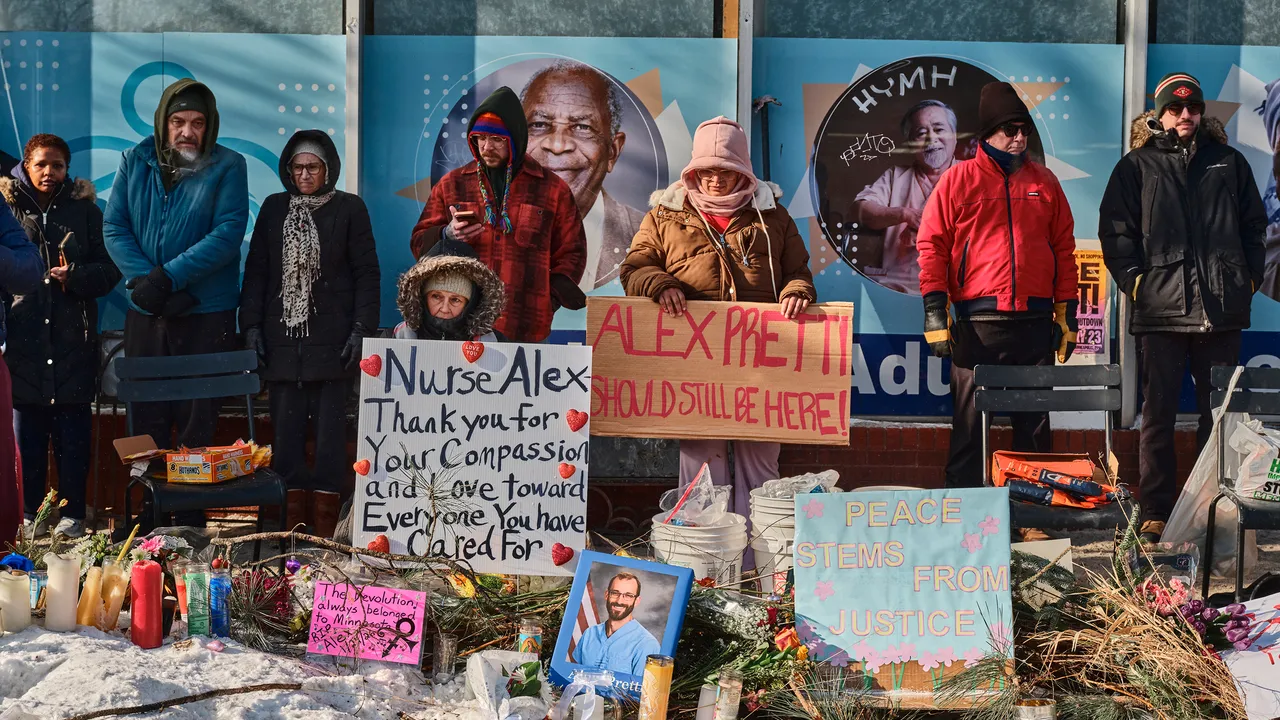
On Saturday, agents with U.S. Border Patrol killed a man named Alex Jeffrey Pretti, the second person who has been shot dead by federal personnel in Minneapolis since President Donald Trump launched an immigration-enforcement operation in the city earlier this month. After the first killing, of a woman named Renee Good, who was shot behind the wheel of her car by an ICE agent, federal officials made clear that they had little interest in conducting an impartial investigation into the circumstances of her death. During a press conference, Vice-President J. D. Vance said that federal officials have “absolute immunity” in performing their duties. In the aftermath of Pretti’s death, which has prompted even some Republican officeholders to call for an investigation, state officials have accused the federal government of blocking access to the scene of the shooting. Multiple members of the Trump Administration have called Pretti a “domestic terrorist” and falsely described what occurred when he was gunned down, which was captured on video. On Saturday night, a federal judge ordered the government not to destroy or alter evidence after a lawsuit was filed by Minnesota authorities.
To talk about what state officials can and cannot do to investigate and prosecute crimes allegedly committed by federal officials, I spoke by phone with Steve Vladeck, a law professor at Georgetown who writes a newsletter on legal issues called “One First.” During our conversation, which has been edited for length and clarity, we discussed why the law on these questions is so unsettled, how the Trump Administration could try to sabotage potential state actions, and how the Supreme Court might view future cases that feature a clash between executive power and states’ rights.
Tell me if this is helpful—there are two different ways it can be difficult for states to investigate or prosecute federal officials. One of them has to do with the law itself as defined by the courts, and the second has to do with the Trump Administration trying to throw up every roadblock it can. Those seem like different things.
I think that’s very helpful. There’s both the question of whether the law would allow a prosecution and whether as a matter of pure logistics, the prosecution is viable. We haven’t usually had to worry about the second one, but we certainly have to worry about it right now.
So then let’s start with the first one, which relates to why it could be complicated for state officials to charge federal officers with crimes in a state such as Minnesota. What is the primary legal roadblock?
The primary legal roadblock is the doctrine that’s become known as supremacy-clause immunity. This is a not-very-well-developed idea dating back to an 1890 Supreme Court decision, which basically says that federal officers are immune from the consequences of state law for actions they’re performing in the legitimate exercise of their federal duties. And the idea, which I think is actually relatively uncontroversial, is that federal officers who are lawfully acting within their federal duties are necessarily acting in a way that has to override contrary state laws. It’s analogous in that respect to the doctrine that’s generally known as preëmption—that valid federal laws will always displace valid state laws.
So the idea here, in the best case, is that if federal officials are trying to enforce desegregation at a school in the South in the nineteen-fifties, for instance, then state and local officials cannot mess with them?
That’s exactly right. You can’t prosecute federal officers for trespassing, for example, for enforcing a court order on a public school in the civil-rights era.
Was the thinking behind the decision so high-minded, though, back in 1890?
Actually, it was. So, the 1890 decision is this remarkably colorful case about the attempted assassination of Justice Stephen Field, and the question was whether his bodyguard, who was a deputy U.S. marshal, could be prosecuted by California for the murder of the Justice’s would-be assassin. And that was a context where I don’t think it’s especially surprising that the Supreme Court was of the view that the federal officer was immune from prosecution under state law for protecting one of their colleagues.
What other decisions have come up about these questions since 1890?
The biggest problem is that there really haven’t been that many cases, and virtually none that have gone back to the Supreme Court. Most of the development of the doctrine has actually been in lower courts. And one of the things I think is unhelpful is that, even when lower courts held in at least some of these cases that prosecutions could go forward, they were often dropped by the prosecutors before they produced a verdict. So we actually have a very, very tiny number of examples of successful state prosecutions of federal officers in American history. Of course, one might also say we don’t have that many examples in American history of what’s been happening in Minneapolis over the past three weeks.
Has the Supreme Court ruled that Congress needs to provide authorization for states to go after federal officials? Am I understanding that correctly?
The Supreme Court has never said that. There are other contexts in which the Supreme Court has said that Congress needs to specifically authorize, for example, [civil] damages suits before federal officers can be sued for violating the Constitution. But we’ve never quite had that ruling in the context of criminal prosecutions. And that’s because these cases have been so few and far between.
The real development in case law has been trying to figure out exactly where the line is between the officer who was immunized because he was acting in good faith and the officer who went too far and should have known that he was going too far. There is a 2006 ruling in the federal appeals court in Denver, which was written by Michael McConnell, a very highly regarded and pretty right-of-center federal appeals judge. And McConnell says you can prosecute federal officers if it wasn’t necessary and reasonable for the officer, in the carrying out of their federal duties, to do what they did.
And that ruling has held?
I think the best that can be said is it’s the law of the Tenth Circuit right now. Minnesota is in the Eighth Circuit. So we’re in a place where there’s no obvious binding authority on this issue for state or local prosecutors.
But let’s say that state or local prosecutors in Minnesota decide that that’s a good standard that you laid out from McConnell. Could you potentially have a situation where the question of whether what the federal officials were doing was “necessary and reasonable” would go to court?