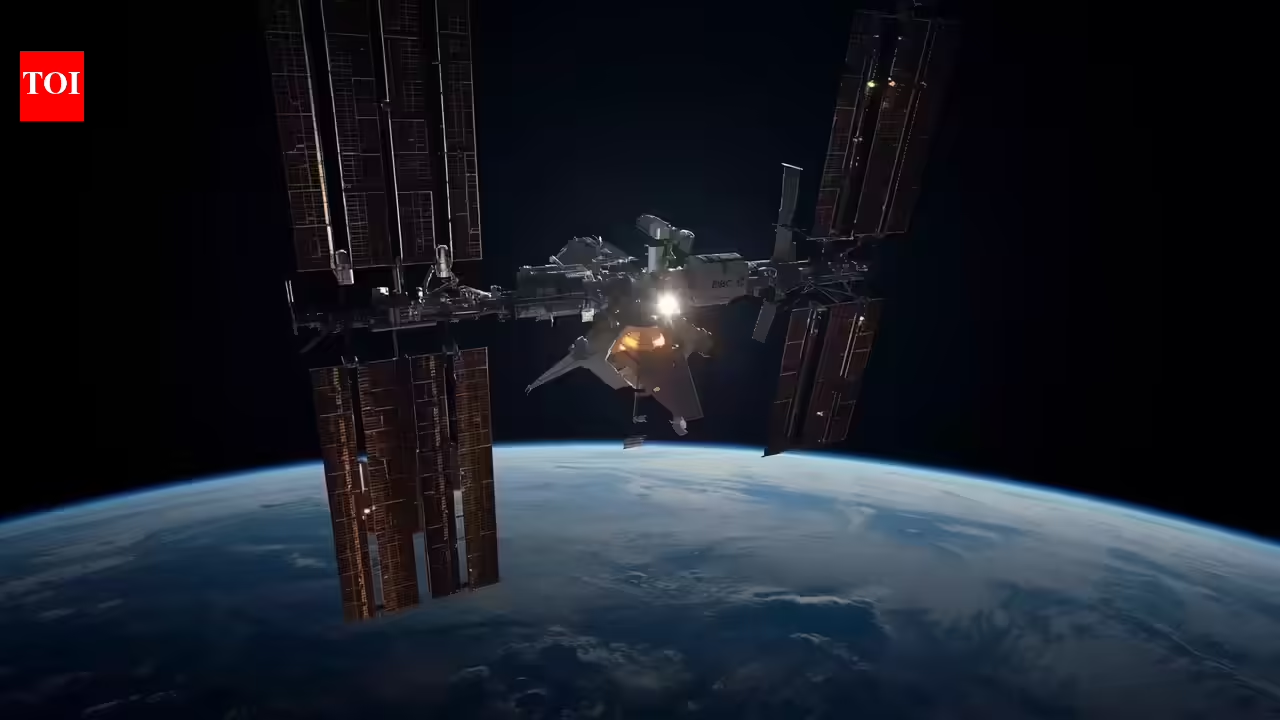
The International Space Station received another small lift late last week, continuing a routine but essential process that keeps the orbiting laboratory at the right height above Earth. On Friday, January 23, a SpaceX Dragon spacecraft attached to the station fired its engines for just over 26 minutes, gently raising the outpost’s orbit. The manoeuvre was carried out as part of ongoing station maintenance rather than a response to any immediate threat. Orbital boosts like this compensate for the thin drag of Earth’s atmosphere, which slowly pulls the station lower over time. While such events rarely attract attention, they reflect the steady coordination between NASA and commercial partners that allows the ISS to remain safely inhabited after more than two decades in orbit there.
Elon Musk ’s Dragon spacecraft lifts the ISS as reboost burn runs 26 minutes
The reboost came from two Draco engines on the SpaceX Dragon spacecraft, still docked to the station at the time. They sit in the Dragon’s trunk and run on their own propellant, separate from the rest of the vehicle. The burn itself was long rather than forceful. Just over 26 minutes. The effect was modest but measurable. The station rose a little at the top of its orbit, a little less at the bottom, settling into a track of roughly 269 by 255 miles. From inside the ISS, there was little to notice. From the ground, it mattered.A routine task for a long-serving cargo vehicleThis particular Dragon is flying SpaceX’s 33rd commercial resupply mission for NASA. It arrived back in late August and has stayed on longer than most, quietly doing its job. Reboosts were spread across the autumn and early winter, early September, then again later that month, followed by October, November, and December. January’s burn was the last one planned. Soon, the spacecraft will undock and head home, carrying research samples and equipment, with a splashdown planned off California.Draco engines remain central to station operationsDragon carries 16 Draco thrusters in total. Each one produces about 90 pounds of thrust in a vacuum, not much on its own, but enough when used carefully. They handle orientation, fine orbital changes, and the slow choreography of docking and departure. The spacecraft also has eight SuperDraco engines, far more powerful, built for launch escape rather than station work. They stay quiet in orbit, but their presence is part of why Dragon is trusted.Orbital boosts support science as well as safetyKeeping the ISS at the right height is not only about stopping it from slipping lower. The orbit affects what can be done inside. Microgravity experiments are sensitive to small changes. Crystal growth, fluid motion, and long-term Earth monitoring all benefit from stability. Slightly higher paths can also bring clearer views of auroral activity, which researchers continue to watch during periods of increased solar activity.The station’s future draws gradually closerThe ISS moves fast, at about 17,500 miles per hour, circling the planet every 90 to 93 minutes. It has been occupied without pause for more than 25 years. That continuity is easy to overlook. With plans in place for a controlled deorbit around 2030, these routine reboosts feel different. They are minor corrections, carried out without fuss, keeping the station where it needs to be for a little longer.