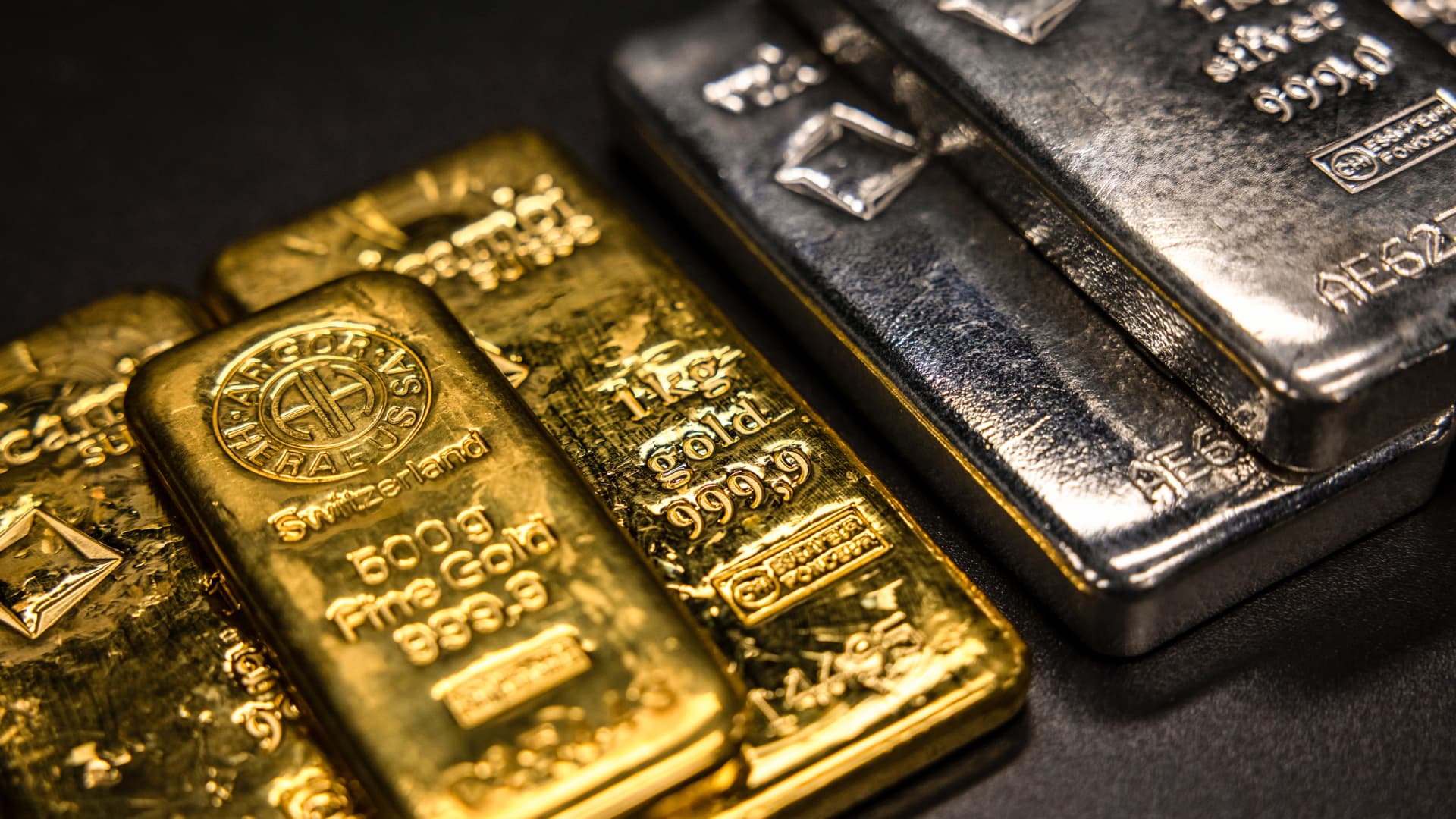
One kilogram and a five hundred gram gold bars next to one kilogram silver bars at The Vaults Group gold dealers arranged in Barcelona, Spain, on Monday, April 28, 2025.
Bloomberg | Bloomberg | Getty Images
Gold and silver prices rebounded on Tuesday after suffering a historic sell-off, pulling global stocks and funds linked to the metals higher.
Spot gold was last up about 5.5% to $4,913.97 per ounce. Gold futures in New York gained more than 6%, hovering at around $4,935.40 as of 7:44 a.m. ET.
Spot silver rose over 9% to settle at around $86.89 per ounce. Silver futures in New York were up 12.5% at $86.57.
Gold and silver prices rebound after steep selloff
The moves marked a slight recovery from a decline on Monday that came after a fall of nearly 10% for gold on Friday, and a 30% collapse in silver prices that marked the metal’s worst one-day performance since 1980.
Mining stocks and exchange-traded funds listed across the globe also notched gains, as the metals continued to rise Tuesday.
In Europe, the regional Stoxx 600 Basic Resources index — home to the continent’s most valuable mining firms — jumped more than 2% on Tuesday morning.
London-listed mining giants notched gains in early trade on Tuesday, with Rio Tinto up 2.2%, Anglo American up more than 3%, and Antofagasta jumping 2.5%. Fresnillo — the world’s leading silver producer and the top performing stock on London’s FTSE 100 in 2025 — was last seen trading 3.1% higher.
In U.S. markets, the ProShares Ultra Silver ETF was last seen trading 15% higher ahead of the opening bell, while the abrdn Physical Silver Shares ETF gained around 8.3%. The iShares Silver Trust (SLV) — which has been at the center of a retail investment frenzy — had also gained 8.3%.
Shares of U.S.-listed gold and silver miners were also significantly higher. Endeavour Silver jumped 7.5% in pre-market trading, while Coeur Mining added 7.7%. Hecla Mining and First Majestic Silver were both up by around 8%.
Will the gold and silver rally continue?
The rebound came as investors reassessed whether the rout signaled a structural turning point or an exaggerated reaction to short-term catalysts.
Strategists at Deutsche Bank said history suggests it is short-term catalysts, even as the scale of the sell-off has raised fresh questions about market positioning. The bank said that while signs of elevated speculative activity have been building for months, they are insufficient on their own to explain the magnitude of last week’s move.
“The adjustment in precious metal prices overshot the significance of its ostensible catalysts. Moreover, investor intentions in precious (official, institutional, individual) have not likely changed for the worse.”
The sell-off was triggered by a combination of factors, including a rebound in the U.S. dollar, shifts in expectations around Federal Reserve leadership following President Donald Trump’s nomination of Kevin Warsh as the next Fed chair, and position-trimming ahead of the weekend.
Deutsche Bank said the broader investment case for gold and silver remains intact.
“Gold’s thematic drivers remain positive and we believe investors’ rationale for gold (and precious) allocations will not have changed. The conditions do not appear primed for a sustained reversal in gold prices, and we draw some contrasts between today’s circumstance and the context for gold’s weakness in the 1980s and 2013.”
Barclays struck a similar tone, acknowledging overheated technicals and stretched positioning, but said that the broader “bid” for gold can remain resilient amid geopolitical and policy uncertainties and reserve-diversification themes.
Silver’s whipsaw has been more dramatic, reflecting its smaller market, higher volatility and heavier retail participation. However, some analysts still maintain a bullish case for the white metal.
“Speculative positioning has definitely played a role in the short term. Silver has attracted more retail participation than gold and that makes it that much more sensitive to fast-moving sentiment and short-term trading,” said Zavier Wong, market analyst at eToro.
Wong, however, added it may be “too simplistic” to attribute the entire move to speculation. Silver has genuine industrial demand, particularly tied to areas linked to data centers and AI infrastructure.
A study published in January projected that global silver demand will surge this decade, driven largely by solar photovoltaics and the shift to more silver-intensive cell technologies. Total demand is forecast to reach 48,000 tonnes to 54,000 tonnes a year by 2030, while supply is expected to rise only to about 34,000 tonnes, meaning just 62%-70% of demand would be met.
The solar sector alone is seen consuming 10,000-14,000 tonnes annually, or up to 41% of global supply.
“That demand hasn’t gone away. What we’re seeing here is silver running ahead of itself, which is something it has always done during strong phases,” said Wong.