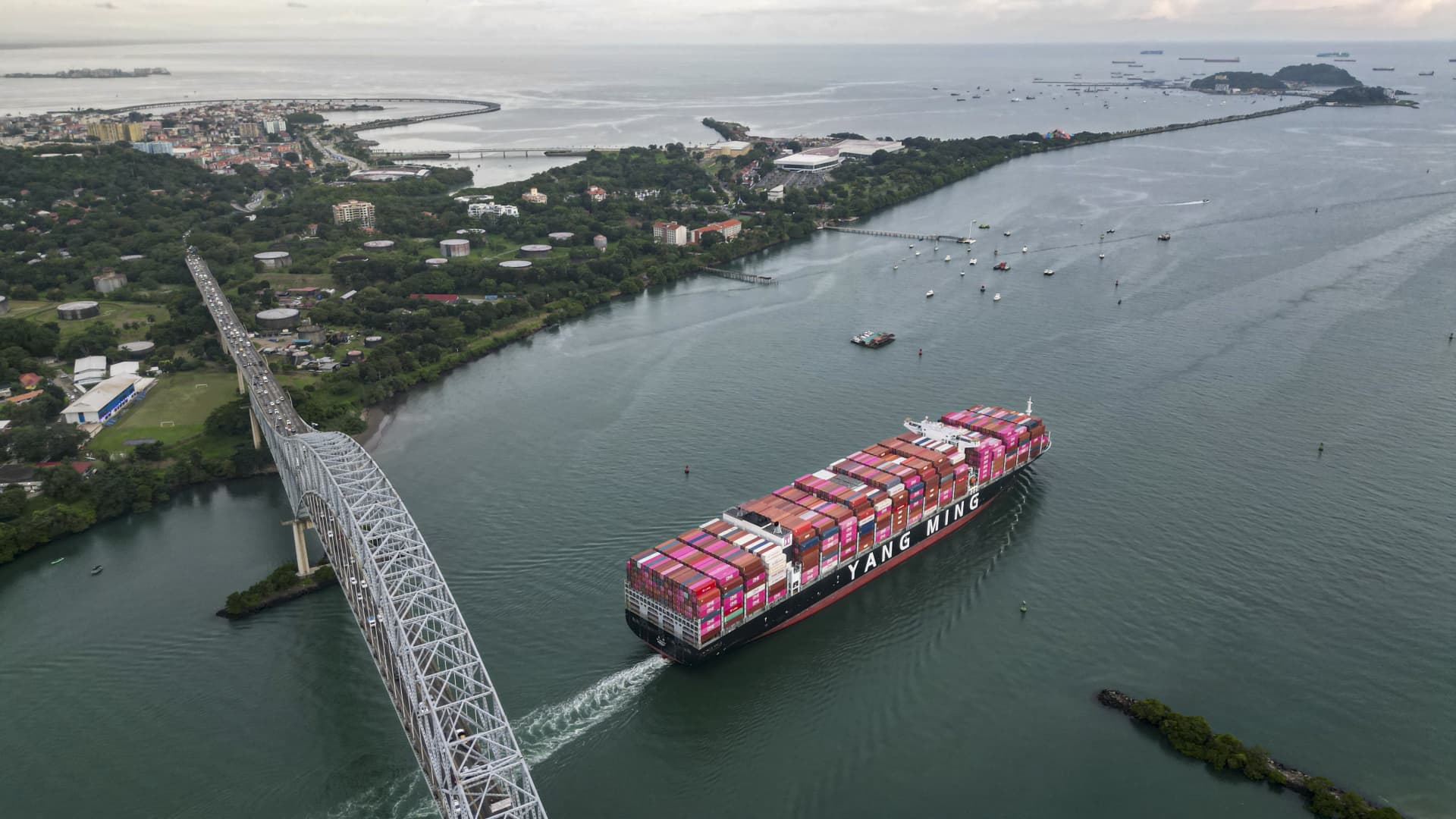
This aerial view shows the Taiwanese cargo ship Yang Ming sailing out of the Panama Canal on the Pacific side in Panama City on October 6, 2025.
Martin Bernetti | Afp | Getty Images
A simmering dispute over two container ports at either end of the Panama Canal risks becoming a geopolitical flashpoint between the world’s two largest economies: the U.S. and China.
It follows a contentious decision from Panama’s top court voiding a license of a subsidiary of Hong Kong-based CK Hutchison for operating two key terminals on the waterway, through which some 40% of all U.S. container traffic transits every year.
The ruling was seen as a major victory for the U.S., given that the White House has made blocking China’s influence over the global trade artery one of its top priorities.
China has sought to raise the stakes in recent days. In its strongest rebuke yet, Beijing warned on Wednesday that the Central American country “will inevitably pay a heavy price both politically and economically,” unless it changes course.
The Hong Kong and Macao Affairs Office of China’s State Council called the court decision “logically flawed” and “utterly ridiculous.”
In response, Panama’s President Jose Raul Mulino dismissed China’s threats, saying on Wednesday that he “firmly rejected” the statement from the Hong Kong and Macao Affairs Office.
Mulino said on social media that Panama was a “rule-of-law country” that respects decisions from its top court, noting that decisions taken by the judiciary were independent of the central government.
CK Hutchison, for its part, said Wednesday that it had taken Panama to international arbitration, adding it “strongly disagrees with the [court’s] determination.”
Analysts expect the fallout from the ruling to last for quite some time.
With questions lingering over the security risks posed by CK’s management of the ports and whether any mitigation measures are in place, it looks like “a simple contest for dominance in Latin America,” said Scott Kennedy, a senior advisor at the Center for Strategic and International Studies.
“The most likely scenario is a drawn-out legal fight in multiple jurisdictions, along with substantial political and economic pressure imposed by both Beijing and Washington,” Kennedy added.
Relations between the two superpowers deteriorated last year as President Donald Trump imposed sweeping tariffs on Chinese exports, drawing Beijing to tighten its grip on rare earth exports. Geopolitical tensions including Beijing’s stance on Taiwan, support for Russia war in Ukraine and U.S. military action in Venezuela and Iran have also weighed on relations.
China to pause Panama deals?
CK Hutchison had negotiated a $23 billion deal with a BlackRock-led consortium in March last year to sell its non-Chinese port subsidiaries. It later drew criticism from Beijing which described the deal as “kowtowing” to American pressure.
Chinese officials have sought to reshape the deal, demanding that it undergo China’s merger review process and have reportedly proposed state-owned shipping group Cosco to join the acquiring consortium.
In a sign of further escalation, China directed state firms to halt talks over new projects in Panama, Bloomberg reported on Thursday, and asked shipping firms to consider rerouting cargo through other ports.
China’s customs authorities also plan to step up inspections on Panamanian imports, including bananas and coffee, according to Bloomberg.
That said, chances of any response from Beijing propelling Panama to reverse course remain low, given Trump’s view of the canal as a strategic chokepoint, said Jack Lee, analyst at China Macro Group.
China’s response will likely be carefully calibrated and largely symbolic aimed at signaling disapproval rather than forcing a policy reversal, Lee said, adding that the Panama episode exposed Beijing’s vulnerability in safeguarding its economic interests in the region when challenged by U.S. pressure.
Maritime industry ‘chokehold’
China has ramped up investment in strategic infrastructure across Latin America, including a major deep-water port in Peru. The Port of Chancay, operated and majority owned by state-owned Cosco, is expected to cut shipping times by about half.
Analysts at the Foundation for Defense of Democracies, a Washington D.C.-based think tank, warned that the Chinese government appears to have “the maritime industry in a chokehold.”
FDD’s Elaine K. Dezenski and Susan Soh said in an article published Monday that China controls more than 100 overseas ports on every continent except Antarctica and manufactures more than 95% of shipping containers and 70% of ship-to-shore cranes.
China dominates the world’s shipbuilding orderbooks with nearly two-thirds of global orders flowing to Chinese yards in 2025, according to an industry report, citing data from maritime research firm Clarksons.
A cargo ship transits through Panama Canal Cocoli locks in Panama City on February 21, 2025.
Martin Bernetti | Afp | Getty Images
Meanwhile, around 40% of U.S. container traffic travels through the Panama Canal every year, which in all, moves roughly $270 billion in cargo annually.
Any expansion of Beijing’s maritime dominance, therefore, could put the U.S. and its allies at risk of the same dependency they face with critical minerals and rare earths, according to the FDD.
‘We need to support multi-polarity’
United Nations Secretary-António Guterres recently called out the U.S. and China’s power struggle, warning that global problems “will not be resolved by one power calling the shots.”
“We see — and many see in relation to the future — the idea that there are two poles, one centered in the U.S. and one centered in China,” Guterres said at a news conference on Jan. 29.
“If we want a stable world, if we want a world in which peace can be sustained, in which development can be generalized, and in which, in the end, our values will prevail, we need to support multi-polarity,” he added.