- A two-decade-long bird monitoring study in Spiti Valley finds that bird densities have declined most sharply in ungrazed steppe habitats, areas facing the least direct human disturbance.
- This points to broader stressors such as climate change operating beyond land-use change alone.
- The study underscores the importance of long-term, community-supported monitoring and maintaining landscape-level habitat diversity in high-altitude, multi-use regions like the Trans-Himalayas.
Before the sun rises over the jagged ridgelines around Kibber village in Himachal Pradesh’s Lahaul-Spiti district, 43-year-old Kalzang Gurmet is already on the move. On days when the monitoring site lies far from home, he leaves around five in the morning, walking across open steppe and rocky slopes for three to four hours. The early start matters. As the sun grows harsher, bird activity drops and sightings become fewer.
“Subah ka time sabse achha rehta hai,” he says in Hindi. (“Morning is the best time.”)
Kalzang Gurmet grew up in Kibber, studied history, completed a Master’s degree, and returned to the village. Since 2007, he has worked with the Nature Conservation Foundation (NCF), helping scientists document birdlife across one of the highest inhabited mountain landscapes in the world.
Over the past two decades, Gurmet has played a key role in data collection and fieldwork. Along with Tanzin Thinley and other local field staff, he has walked the same transects summer after summer, counting birds in terrain where elevations exceed 4,000 metres and the growing season lasts only a few months.
That continuity, the same places, the same methods, year after year, now tells a troubling story.
The insights are documented in a study published in Ecological Applications in which the NCF researchers reports that bird densities declined across habitats, but the only statistically significant decadal decline was in the ungrazed steppe, the habitat facing the least direct human disturbance. Ungrazed steppe refers to high-altitude grassland kept free from livestock grazing, where vegetation is allowed to grow largely undisturbed over long periods.
The study, which spanned 2002 to 2023, tracked changes in bird populations across Spiti’s diverse habitats, shaped by both local human activity and broader climate forces.
While the study tracked bird populations over two decades, not all years were fully sampled. The analysis is based on data from 14 years of surveys between 2002 and 2023.
“We found that bird populations declined and species composition changed even in the least disturbed habitat over two decades,” said Sidharth Srinivasan, the study’s lead author and a researcher with NCF, Mysuru.
For Gurmet, who is also one of the co-authors of the study, the declining numbers of once-familiar species is more than just data points. It’s a reflection of a landscape and a way of life changing before his eyes. “We grew up with these birds,” he says, “and seeing them fade away feels like losing a part of our heritage. I hope my children will know the same Spiti I knew.”
Four habitats, one landscape
The study followed bird communities across four habitat types, crop fields, grazed meadows, grazed steppe, and ungrazed steppe, within a roughly 16-square-kilometre area around Kibber village. Together, these habitats form the agropastoral mosaic typical of the Trans-Himalaya, where farming, livestock grazing, and wildlife coexist in close proximity.
Crop fields represented the most intensive land use. At the other end of the gradient lay the ungrazed steppe, a grazing-free reserve demarcated by the Kibber community in 1998. The reserve was created as part of a community-based conservation effort to increase blue sheep populations, an important prey species for snow leopards. Over time, it has become a rare patch where land use remained unchanged for decades.
Between May and September each year, coinciding with the bird breeding season, researchers and local field staff walked fixed transects across all four habitats. Using distance-sampling methods, they recorded bird species, numbers, and how far each sighting was from the transect line. After filtering out non-breeding and rare species, the analysis included more than 17,000 individual birds belonging to 44 species.

High numbers, fewer specialists
The results found that bird communities differed significantly across habitats.
Crop fields supported the highest bird densities, but those communities were dominated by generalist and commensal species such as house sparrows and hill pigeons. Habitat specialists, birds closely tied to steppe vegetation and structure, were largely absent or present in very low numbers.
“Traditional farming in Spiti still seems to host birds in high densities,” Srinivasan said. “However, some specialist species are absent or present in very low densities here. This is probably because of their habitat specificity and or diet, which agricultural landscapes might not provide.”
Farming in Spiti remains largely low-intensity. Pesticide use is minimal, and inputs such as organic manure and irrigation water are common. These conditions likely increase insect availability, which benefits generalist insect-eating birds. But the authors note that such landscapes do not replace the structural complexity of natural steppe habitats that specialists require.
Ungrazed steppe, by contrast, supported both high bird densities and the highest species richness, including habitat specialists such as Tibetan sandgrouse and leaf warblers. Grazed habitats consistently fared worst, with lower bird densities and fewer specialist species.
A troubling temporal signal
While spatial differences reflected land-use intensity, the most concerning findings emerged when the researchers examined change over time.
Comparing the early period of the study (2002–2010) with the later years (2016–2023), bird densities declined across all habitats. However, the decline was statistically significant only in the ungrazed steppe.
“This finding is worrying because it points to deeper, systemic pressures beyond land-use change alone,” Srinivasan said. “If birds aren’t doing so well in disturbed habitats, they might have the ability to choose to use other undisturbed habitats. However, if their populations are declining in undisturbed habitats, we might have to go beyond our conservation interventions.”
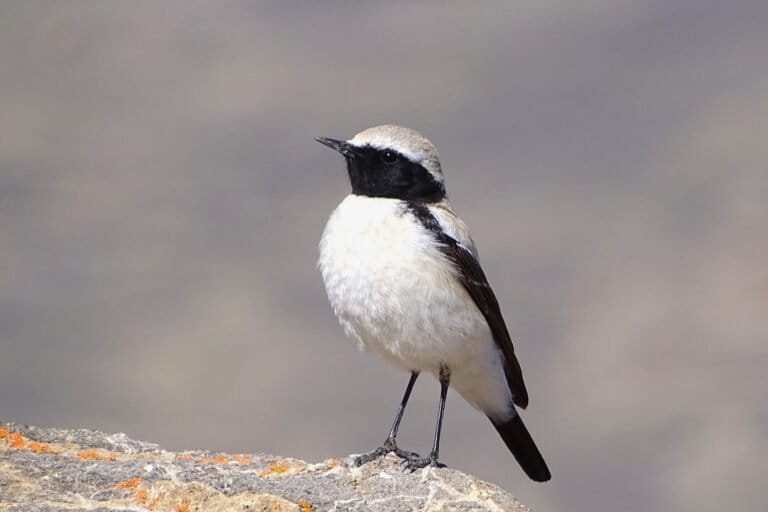
Several common insect-eating species, including black redstarts, desert wheatears, and leaf warblers, showed marked declines. One species, Hume’s lark, has not been detected in the study area since 2009, suggesting possible local extirpation.
Crucially, land use in the ungrazed steppe remained stable throughout the study period.
“The undisturbed habitat serves as a natural control site because land use remained stable and unchanged there,” Srinivasan explained. “Therefore, something else must be driving these changes.”

Climate stress on the roof of the world
The study cannot directly separate climate effects from land-use change in disturbed habitats, but the authors hypothesize climate change could be contributing, especially because the ungrazed steppe remained stable in land use.
Unlike land-use change, climate stress operates across entire landscapes. In Spiti, where elevations already approach the upper limits of habitable terrain, birds have little room to shift further upslope in response to warming.
“Climate change is known to make birds move their ranges upslope, tracking their historical temperatures,” Srinivasan said. “However, because the Spiti landscape already sits on the highest possible elevation on Earth, I wonder how birds here would adapt, if they do, to climate change.”
Year-to-year fluctuations in bird density were synchronised across all habitats, suggesting the influence of shared regional drivers such as weather. But long-term, on-ground weather data from the Trans-Himalaya remain sparse, limiting the ability to formally link these patterns to climate trends.
Similar studies in the Tibetan Plateau have shown that high-altitude birds are facing mounting pressures from climate change and land-use intensification. Spiti, while remote, is part of a wider pattern in the Trans-Himalaya, where the effects of warming are compounded by changing agricultural practices and infrastructure development.
A separate study from 2024 on Himalayan birds highlights that “birds and much of the flora and fauna in tropical mountain ranges are extremely temperature-sensitive and are responding to global heating rapidly.” This supports the recent findings in Spiti, where birds are already facing significant declines in both disturbed and undisturbed habitats due to climate and land-use pressures.

Rethinking conservation baselines
The findings challenge the assumption that protecting land from direct human use is sufficient to safeguard biodiversity.
“Continuous monitoring and teasing apart the mechanisms behind these declines are important next steps,” Srinivasan said. “Much needed from a conservation perspective.”
The study also cautions against framing conservation and livelihoods as opposing forces. Kibber’s agropastoral community has played a central role in maintaining both the landscape and the research.
“In 1998, they demarcated a part of their landscape as a grazing-free reserve as part of a community-based conservation initiative,” Srinivasan said. “Our on-ground team, who are from Kibber, have been walking these transects almost every summer for around two decades.”
Walking the same paths
For Kalzang Gurmet, the changes described in graphs and density estimates are felt on the ground.
As a child, he walked through grazing lands to reach school. There were ponds scattered across the landscape then, places where children played, and birds gathered. He remembers migratory birds appearing regularly. Some of those ponds have disappeared. Some of those birds no longer show up.

Today, he sometimes notices waterbirds in places where they were not seen earlier, while local species feel harder to find. He is careful not to overstate what he sees. “Maybe it’s because the weather is changing,” he says.
When unfamiliar birds appear, Kalzang photographs them and shares the images with scientists, discussing subtle differences in colour and markings. At the same time, village elders recall local names and histories tied to those birds, offering memories that stretch further back than formal surveys.
“Scientists tell us about the bird, and village elders share the history connected to it. Information comes from both sides,” Gurmet says, adding that many in the village worry the changes they are seeing may be linked to shifting weather patterns. While he does not believe the landscape is deteriorating rapidly, he remains cautious about the future. “If things are not managed, the damage will be substantial,” he says, pointing to what he sees as a growing use of chemicals in some fields, which he worries could worsen the problem.
Two decades after the first transects were laid, Kalzang still begins his mornings before sunrise, walking the same paths across the cold desert. What he sees along them has changed.
Read more: Decoding the lives of tiny birds in a changing world
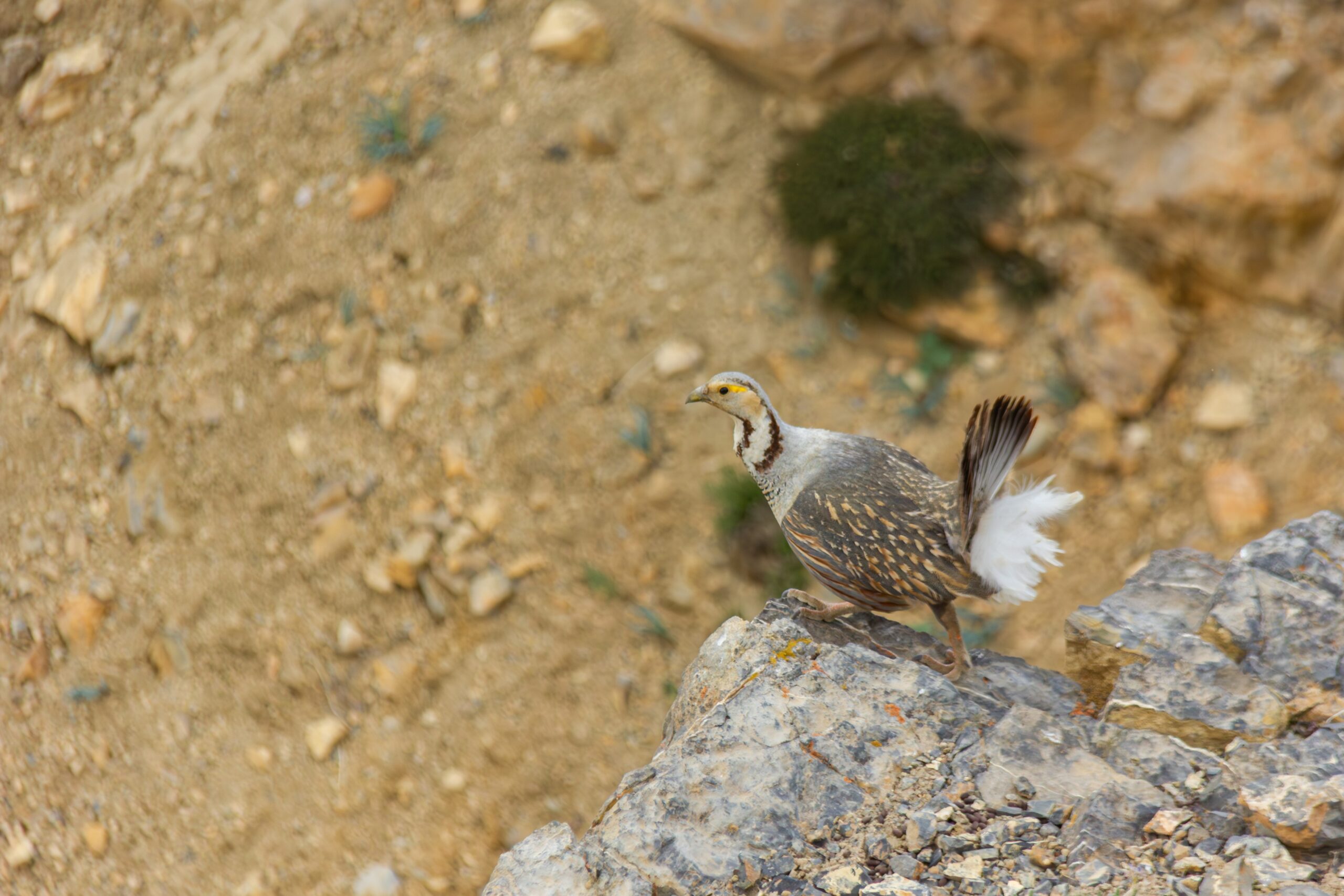
Banner image: A Himalayan snowcock. Image by Kalzang Gurmet/NCF.