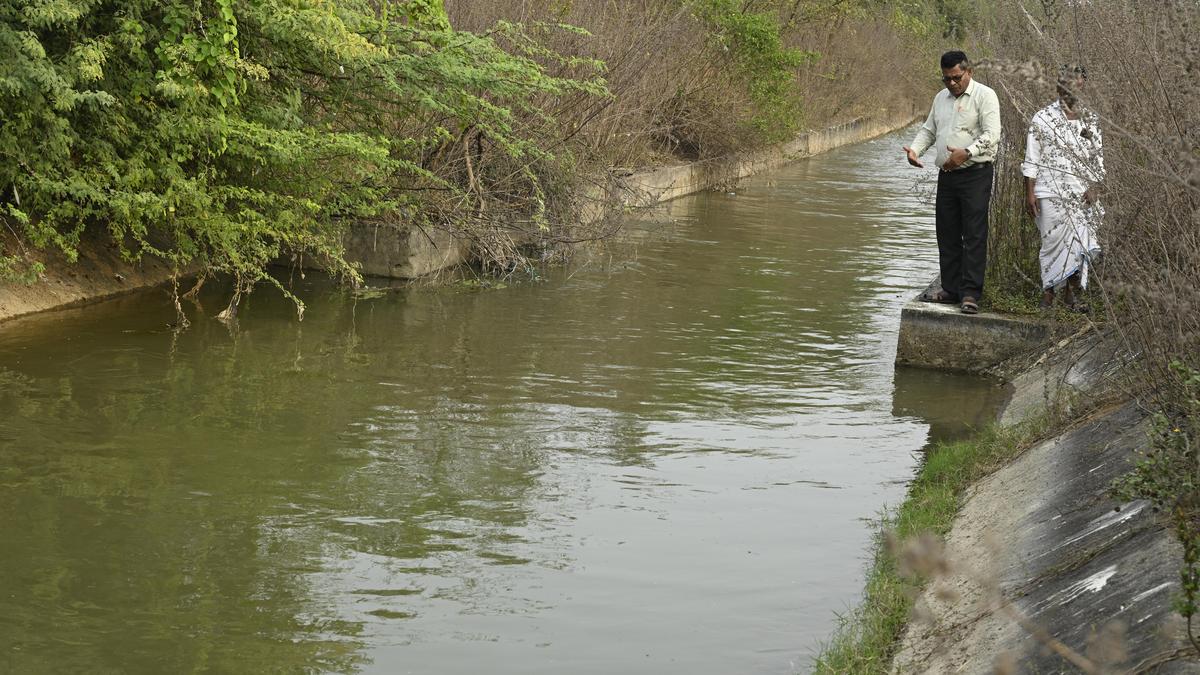
On the afternoon of January 29, Mustaq Ahmed, head constable of the Yedapally police station in Telangana’s Nizamabad, and Mohan, a constable, were questioning residents about a land dispute, when they received a call informing them that a girl had been washed away in the Nizam Sagar distributary canal. The waterway ran just a stone’s throw from the ARP camp in Yedapally mandal, off the Nizamabad-Bodhan National Highway 63.
Ahmed says they immediately kick-started their bike and set off. “When we reached the spot, we saw rescuers laying the body of the girl on the bund side,” he recalls.
The girl, sporting a glittery bindi on her forehead, seemed to be about 5-6 years old. Barring a contusion on her forehead, she did not seem to have any other injuries. The policemen observed that unlike in most drowning incidents they had probed, the body showed no signs of bloating. “She had died just a few minutes earlier. We felt guilty that we could not save her,” Ahmed says.
The duo made some quick inquiries. They found that an 18-year-old man, P. Pawan Kalyan, was standing near the small bridge over the canal and speaking to a friend on the phone when he noticed the girl being swept away in the canal.
“Kalyan said he shouted for help,” Ahmed says. “Venkatesh, an auto driver who was nearby, rushed to the spot on hearing him yell. By then, the girl had apparently been swept further away.”
Venkatesh did not give up. He rode his bike along the bund’s mud road and, after nearly 300 metres, jumped into the canal’s 3-foot-deep stream near a small gate. He caught the girl and pulled her out with the help of others. She was unresponsive and had no pulse.
The girl with the bindi
The police began to make inquiries to identify the girl. They sent notices to all the police stations under the Nizamabad Police Commissionerate to see if any complaints had been filed about missing girls, but none came up. They took the body to the Nizamabad Government Hospital. Then, they registered a case under Section 194 of the Bharatiya Nagarik Suraksha Sanhita, 2023, which mandates the police to inquire and report on cases of suicide, homicide, or suspicious, unnatural deaths.
While checking with nearby police stations, the investigators also shared the girl’s pictures and an audio message on WhatsApp groups, seeking help to establish her identity. Three days passed with no leads. The investigation seemed to have hit a dead end — until constable Sudheer received a call that provided crucial details.
Sudheer was the driver for the circle inspector, D. Vijay Babu, who was investigating the case. The caller, a close relative from Mukhed, a taluq headquarters in Nanded district, Maharashtra, contacted Sudheer claiming he knew the girl. He sent a photo, which showed a child who looked exactly like the one found in the canal, wearing the same clothes. The relative said the girl was from Mukhed, nearly 50 kilometres from Bodhan, and had been reported missing. He added that villagers were worried and had been discussing her disappearance.
The Bodhan police contacted the girl’s family. A few village elders and members of the family, including the girl’s mother Ankita, arrived in Bodhan and identified the body. The girl was Prachi, the older of the twin daughters of a hair salon owner, Pandurang Baburao Kondamangale. After forensic doctors performed an autopsy, which confirmed that she had died due to drowning, the police handed the body over to the family. As they prepared to return to Maharashtra, the Yedapally police began their work.
Alone at a canal
Although the autopsy confirmed drowning as the cause of death, the police remained puzzled as to how the girl had ended up at the canal alone.
The ARP camp, often mistaken by many for a defence or research facility, is a cluster of three villages. These grew around the Nizam Sugar Factory, established decades ago to process locally grown sugarcane. With irrigation from the factory’s canals, even remote areas are covered with lush green fields of paddy and other crops. The canal’s side bunds — overgrown with bushes and flanked by sprawling paddy fields — conceal the water distributary that runs just a few feet away, parallel to the road. It was strange for a girl of her age to have just wandered off there.
“We believed that someone had taken her up to the canal. Whether she slipped into the water or was pushed was the question,” says Bodhan Assistant Commissioner of Police, P. Srinivas.
The investigators began probing the case. When they found a lead, they brought Kondamangale to Bodhan. He said that his daughter had gone missing from January 29 and that he had approached the local police to trace her. Circle inspector Vijay quotes him saying, “We were hoping she would come home sooner or later.”
Despite the incessant probing, Kondamangale stuck to his story. That is when, the inspector says, the police finally presented the lead they had — CCTV footage. The video showed Kondamangale riding his bike in Bodhan with his daughter Prachi sitting pillion. Realising that his cover was blown, Kondamangale allegedly began to confess to his crime.
According to the investigators, Kondamangale left his salon with his daughter seated on the two-wheeler. Hours later, they reached the ARP camp. “He stopped at a secluded place. He carried the girl in his arms and walked towards the canal. He stood on the canal’s edge and dropped her into the water,” Vijay Babu says.
The police say they were horrified that Kondamangale had taken his own daughter’s life. The motive, however, was so shocking that they could hardly believe it. “He said he or his wife wanted to contest the panchayat (local body) elections. But the two-child rule of the Maharashtra government was a stumbling block for them because they had three children: twin daughters and a 3-year-old son,” says Nizamabad Police Commissioner, Sai Chaitanya.
The 2-child rule for panchayat elections was imposed by various State governments in the early 1990s, primarily as a population control measure. It was put in place to ensure accountability among local representatives.
“To reach his political ambition, Kondamangale decided to kill one of his children and chose Prachi,” the Commissioner says. Although Kondamangale had allegedly admitted to the crime, investigators still had several loose ends to tie up. They began probing his background, starting from his village of Kerur, 8 km from Mukhed.
Hungry for the post
Kerur’s nearly 3,000 residents are solely dependent on agriculture. The village has narrow streets, lined mostly with thatched-roof houses and a few concrete ones, and is surrounded by vast tracts of dry land. Some streets are dirty with overflowing drainage water, while a few have tiled pathways. The villagers claim that their sarpanch, 36-year-old Ganesh Ramachandra Shinde, was doing his bit to develop the village.
Panchayat elections are scheduled to be held in the village in the next 6 months. While, according to a lottery system, Kerur was under the ‘open category’ 5 years ago, which means that the seat for the sarpanch is not reserved for any specific social category, this time it is reserved for persons from Other Backward Classes (women). Kondamangale, who runs the hair salon in a rented commercial complex on the main road, lives in a rented house in Baralinaka of Mukhed. Since his family belongs to the OBC category, his wife was eligible to contest for the sarpanch post.
The house of the accused at Kerur village, Maharashtra.
| Photo Credit:
Ramakrishna G.
The police are not sure how the salon owner suddenly decided to enter politics. “At some point, Kondamangale began aspiring for either himself or his wife to become the sarpanch. He confessed that the sitting sarpanch, Shinde, was ready to support him if he chose to contest,” Vijay Babu says.
As per Kondamangale’s admission before the police, Shinde used to keep dropping by his salon and sometimes his house. He encouraged Kondamangale to field his wife as a candidate. “The second accused, Shinde, said he would spend ₹15 lakh for this and would take care of any problems and asked the first accused, Kondamangale, not to reveal his name to anyone,” states the remand report submitted to the local court.
Bolstered by Shinde’s support, Kondamangale felt he was inching closer to the seat of sarpanch. The only roadblock was the 2-child rule.
Vijay Babu says that initially, Kondamangale confessed he had considered giving up his 3-year-old son for adoption to one of his uncles. Since he had not obtained a birth certificate for the child, he thought this would allow him to bypass the two-child norm. But he dropped the idea, as hospital records listed his wife as the child’s mother, which, he believed, could cause problems for their political ambitions.
“He admitted during the interrogation that he and his relative went to the Mukhed municipal office to verify if he could give his son up for adoption. They even went to Pune to seek clarifications on the matter. We are verifying his statements,” says Vijay Babu. “Realising that the adoption plan was not the solution, he began exploring what other act could make him or his wife sarpanch and finally decided to kill one of his children.” The police say that inquiries with Ankita and other family members suggested that Kondamangale was particularly fond of Prachi, and she of him, which makes the case all the more perplexing for them.
Prachi’s twin sister, younger by just a few minutes, reportedly did not like sitting pillion on the bike. On January 29, the police say, Prachi did not go to school. When she arrived at the salon a little before noon, her father told her he would take her on a long ride and made her sit pillion on the bike. “He masked his face with a towel and left his mobile phone at the salon. This indicates that the murder was premeditated,” Vijay Babu says.
Kondamangale started from Mukhed towards Bodhan. Entering the Yedapally area, he followed the Nizam Sagar distributary canal, stopped at an isolated point, and dropped her into the water. “While she was screaming ‘Papa, Papa,’ he did not look back. He returned to the main road and then proceeded towards Maharashtra,” reads a sentence in the remand report.
When Ankita asked about the whereabouts of her child, Kondamangale apparently led her to believe that he had gone out on work and was not sure where she was. The couple approached the local police, requesting them to trace her. The investigators believe that the accused deliberately did not lodge a formal complaint with the local police. “Had he done that, a case would have been registered and they would have immediately found out about his ghastly act,” says an investigator.
On February 2, the police revised the charges to Sections 140(1) (kidnapping), 103(1) (murder), and 238 (destruction of evidence, providing false information) of the Bharatiya Nyaya Sanhita, 2023. They arrested the two accused and remanded them to judicial custody. Ankita, her daughter, and son have shifted to their relative’s house.
Support for the sarpanch
In Kerur village, Shinde enjoys a lot of support. Several villagers describe him as “innocent” and demand that he be set free immediately. When Yedapally sub-inspector, M. Rama, went to the village, the villagers gheraoed her, raising slogans that their sarpanch had been falsely implicated in the case.
“In the few years, our village, under the leadership of Shinde, has seen some progress. New drainage lines were laid. We are getting tiled internal roads,” says Venkat Shinde, a resident.
Another villager, Balaji, says, “We are not sure why Kondamangale killed his child. But we know that our sarpanch is not the type to abet a crime.”
Rajesh of Kerur, who runs a bookstore at Mukhed, feels, “Our villagers were already teasing Pandurag by referring to him as sarpanch saab whenever they met him. May be that went to his head and he resorted to this extreme step of killing Prachi.”
Some residents are upset that the case has tarnished the name of the village. Hanmant Baliram Shinde says, “This case is showing our entire village in poor light even though we did not do anything wrong.”
For the ARP camp sarpanch, P. Vinod Kumar, the complainant in the case, Prachi’s death is the most disturbing incident of his life. “Every time I pass by this canal, the horrible image flashes in my mind. For me and others of the village who saw it, we just can’t shake it off,” he says.
ramu.marri@thehindu.co.in