Twenty-seven miners have been killed and nine injured in a deadly explosion inside an illegal rat-hole mine of Meghalaya’s East Jaintia Hills district, according to the state government. The tragedy has again shone a light on the festering issue of illegal rat-hole mining in the Northeastern state.
The incident occurred in the remote Mynsyngat village located in the Thangsko area, around 22 kilometres from Khliehriat, the district headquarters of East Jaintia Hills on February 5 at around 11 in the morning.
According to Vikash Kumar, the District Superintendent of Police, the mines were located in a remote area, accessible only by four-by-four vehicles, which slowed down the rescue operations considerably.
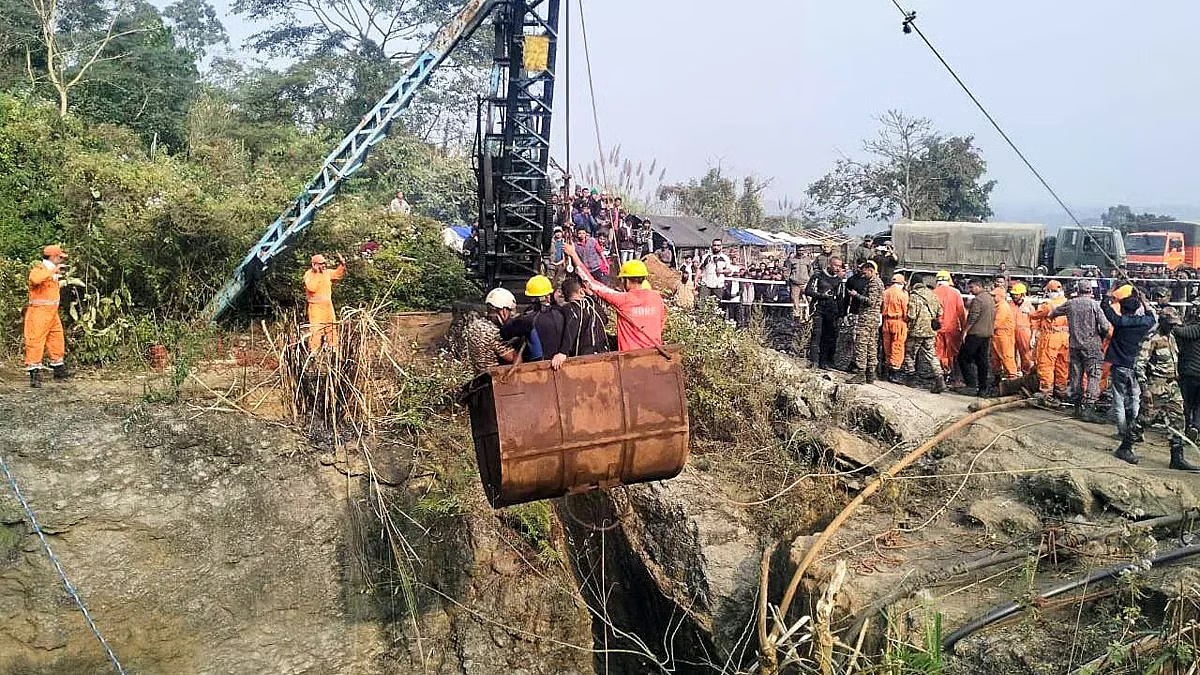
“The National Disaster Response Force (NDRF) and State Disaster Response Force could only reach by evening as it was suspected that several workers were trapped in two wells of the coal mines. They recovered 18 bodies from two mining holes. Around eight injured persons were first taken to the local community health centre in Sutnga and subsequently referred to higher medical centres,” Kumar said, issuing a statement to the local press on February 5.
The toll rose to 27 dead and 9 injured according to a statement issued by the state government at 1 pm on February 7. The injured are undergoing treatment for second and third degree burns in various hospitals across Meghalaya and Assam.
The slain workers belonged to various parts of Assam, Meghalaya and Nepal. According to an NDRF official, the operation was hampered by landslips in the mines mainly due to sub-surface water, while there were several rat-hole tunnels emerging from a central pit which was 100 metres deep. “We were looking for trapped miners in these tunnels, but we could only find the mortal remains of four workers from the tunnel by the end of the day [Friday],” the official told Down To Earth (DTE).
On February 5, injured workers told media persons that there could 70 to 80 workers trapped in these mines.
Legal cognizance
With the death toll rising, Meghalaya’s adjudicators and activists have questioned the Meghalaya government over recurring deaths in illegally operating mines in the state. Responding to the incident, Chief Minister Conrad Sangma, who claims to have repeatedly been telling mine owners to move away from the highly dangerous rat-hole mining method, ordered a comprehensive investigation of the mining tragedy. The courts, however, were least convinced by Sangma’s tenor.
On February 5, Justices Wanlura Diengdoh and Hamarsan Singh Thangkhiew summoned the Deputy Commissioner and Superintendent of Police for East Jaintia Hills District to appear before the High Court of Meghalaya. “The court is constrained to take judicial notice of these reports [related to recent mining disaster]. It is not understood as to how illegal coal mining is continuing in this area in spite of the reported loss of life of one person in an incident that occurred on January 14, 2026,” the judges stated on February 5 evening, taking suo motu cognizance as the news of the tragedy broke.
Facing heat, the state police arrested two mine owners.
The court-appointed committee to probe illegal coal mining and transportation in Meghalaya, led by former Justice Brojendra Prasad Katakey, also visited the spot.
Katakey was accompanied by Meghalaya government-appointed chairman of the Independent Committee on Illegal Coal Monitoring, Naba Bhattacharjee, who was also present at the site. “There were four rat-hole pits where the explosion took place. Someone set off a dynamite blast in the adjacent pit without informing the people working in the other pits. The people working the mine were unaware about the presence of a methane gas pocket, which was ignited by the blast. The dynamite blast occurred in a mine which was empty, but the ignition of the methane gas caused the devastation,” Katakey told DTE.
Deaths, foretold
Thangsko in East Jaintia Hills District was already in the news after a blast in a rat-hole mine on December 23 which caused the death of one worker on the spot, besides injuring two others. According to human rights and environmental activist Agnes Kharshiing, 34-year-old Ashok Tamang died on January 1 while another injured worker, a suspected foreign national, died in a Shillong hospital while undergoing treatment. “I shot off a letter to the Central Bureau of Investigation demanding a probe on January 8, which I later learnt was forwarded to the state police. However, just like many other deaths, the police and the district administration did not probe these deaths,” Kharshiing told DTE. The case was also transferred to the Meghalaya State Human Rights Commission, which is yet to complete its probe.
It wasn’t just Kharshiing who raised the alarm about the deadly blasts in the illicit rat-hole mines of Thangsko. Even Justice Katakey too informed the court about the deaths of the mine workers due to a blast and large-scale illegal mining in Thangsko in the 35th interim report on illegal coal mining in Meghalaya. “In my report, I had stated that two persons had died earlier in the area, followed by another recent death on January 14. The administration could have prevented these deaths if they acted,” Katakey told DTE.
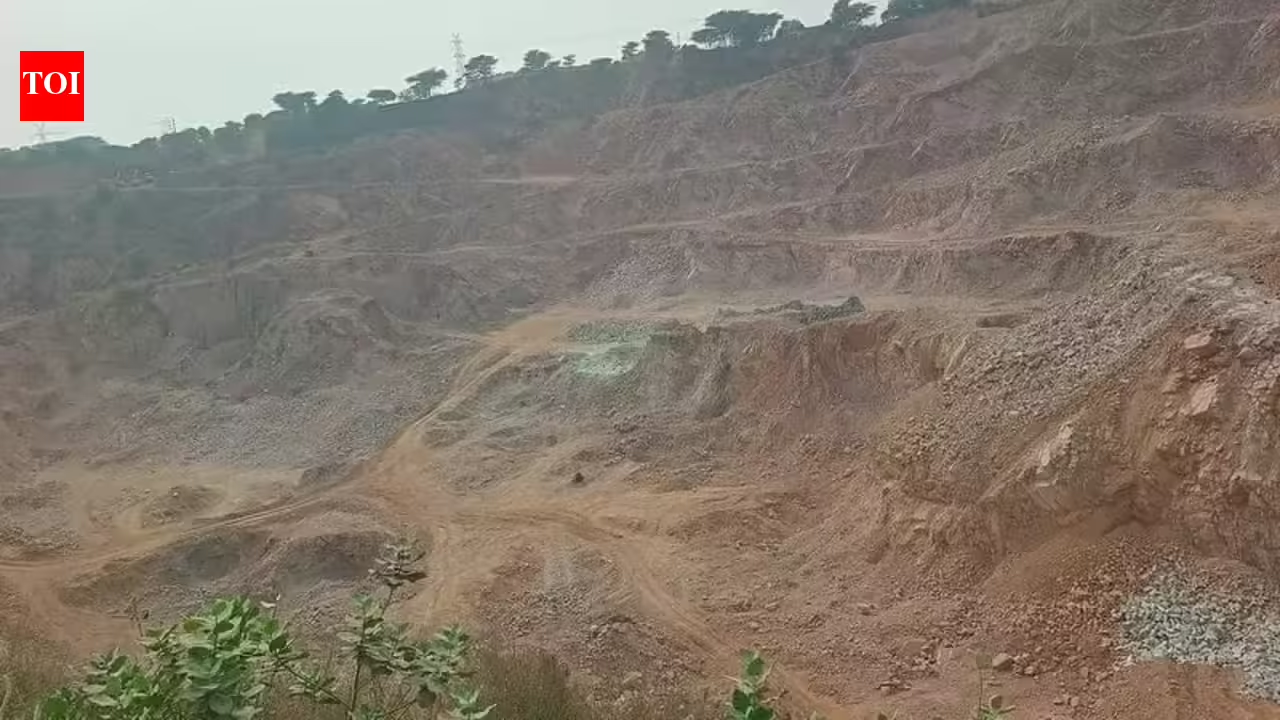
Katakey estimated that close to 25,000 illegal coal mines are operated in 360 villages across East Jaintia Hills district. “Each of these rat-hole clusters generate about 9 tonnes of coal. Although some measures have been taken against the illegal mines, our visit after the incident revealed massive stockpiles of freshly dug coal in East Jaintia Hills,” Katakey added.
In his preliminary report of May 23, 2022, to the Meghalaya High Court, Katakey indicated that except for notifying The Meghalaya Minerals (Prevention of Illegal Mining, Transportation and Storage) Rules, 2022, none of the directions issued by the Supreme Court and the National Green Tribunal (NGT) have been complied with by the concerned authorities. “Since 2022, not much has changed as illegal mining continues in the state with some changes which now has led to this situation,” Katakey said.
Whither livelihoods?
Kharshiing, on the other hand, noted that after the Supreme Court lifted the NGT’s ban on coal mining in July 2019, there is a demand for fresh coal from Meghalaya especially from Bangladesh. “Most of the illegally mined coal is being sold to Bangladesh. It is an open secret and yet the authorities failed to act on it,” the activist added.
Kharshiing and her colleague, Anita Sangma, were brutally attacked earlier in November 2018 by a mob in Lad Rymbai in East Jaintia Hills district, not far from the site of the current mining tragedy. The attack was followed by one of the worst tragedies in Meghalaya when 15 workers drowned in a rat-hole mine in the East Jaintia Hills at Ksan in December 2018.
Despite such incidents, which were reported to the courts as well as the Meghalaya government, CM Sangma in a recent statement in December 2025 expressed his inability to contain the menace of the rat-hole mining. Through a social media video, Sangma said the 200-year-old mining practice could not be undone easily as it may impact many livelihoods. Curiously, the state government, following Supreme Court orders, started the process of setting up ‘scientific mines’, which have been vehemently opposed by environmental activists.