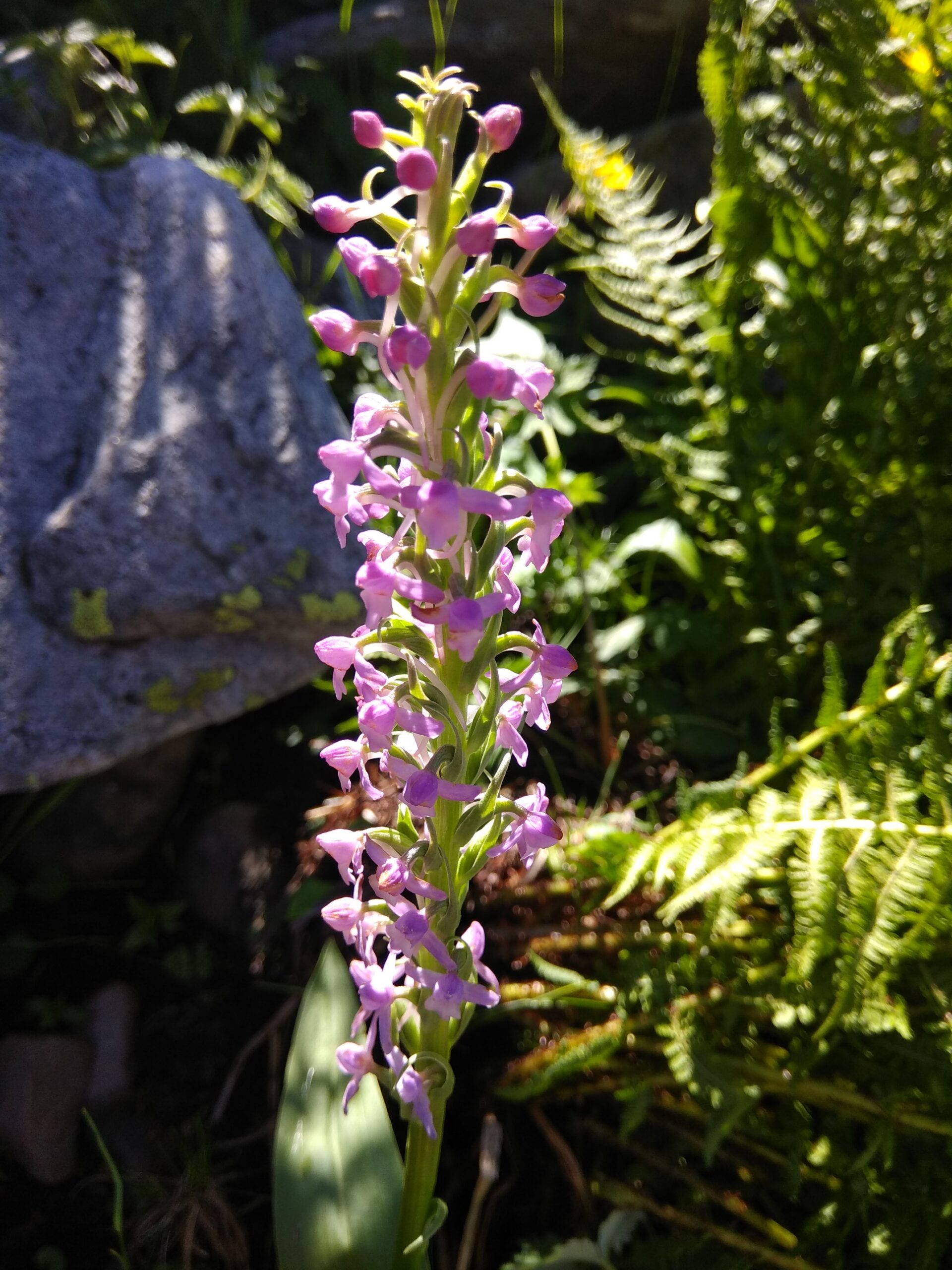
- A new study finds that climate change could reduce the suitable habitat of the marsh orchid in Jammu, Kashmir and Ladakh over the next 50 years.
- The endangered species is already under pressure from overharvesting and habitat degradation.
- Researchers say protecting high-altitude habitats and promoting cultivation of the marsh orchid outside the wild are crucial to prevent local extinction.
In the alpine meadows of the Himalayas, Dactylorhiza hatagirea — commonly known as the marsh orchid — has long been prized for its medicinal uses, its distinctive purple blooms attracting collectors and traders for centuries. However, this high-value herb, already endangered due to overharvesting and trade, now faces a largely overlooked threat: climate change.
A new study by researchers at the University of Kashmir warns that rising temperatures and changing rainfall patterns could shrink the orchid’s already limited habitat over the next 50 years, increasing its risk of local extinction, even if projected habitat losses appear modest.
Why orchids are vulnerable
Climate change, habitat loss, and overexploitation are among the leading threats to global biodiversity, with mountain environments expected to be especially vulnerable. Orchids are a highly specialised and sensitive group of plants, making them particularly vulnerable to changes in habitat and broader environmental conditions.
“This vulnerability stems from their narrow ecological niches, specific habitat preferences, and strong dependence on mutualistic associations with orchid mycorrhizal fungi, a fungi that lives in or around plant roots,” says Manzoor Shah, Professor of Ecology at the University of Kashmir. “They help plants absorb water and nutrients.”
He adds that many orchids also exhibit a high degree of pollinator specificity. Climate change–driven shifts in phenology — annual calendar events such as leafouts, flowering, fruiting, fall for different types of plants — may cause mismatches between flowering times and pollinator availability.
“Thus, the complex life cycle of orchids and their intricate interactions with fungi and pollinators make them particularly vulnerable to climate change and human activity,” Shah says. “Moreover, the decline in orchid populations often provides early warnings regarding ecosystem destruction before wider ecological degradation becomes more apparent.”
An endangered Himalayan medicinal plant
The marsh orchid, native to the Himalayas is listed as endangered by the International Union for Conservation of Nature (IUCN).
The perennial herb grows 40–60 centimetre tall, and is found in narrow pockets at altitudes between 2,500 and 5,000 metres above sea level, mostly on open grassy slopes and alpine meadows of Kashmir and Ladakh. Its purple to rose-purple flowers grow in dense spikes, making it attractive and easy to collect. This has also led to its overexploitation.
Known locally as hathajari and hathpanja in Jammu, salam panja in Kashmir Valley and angulagpa or wanglak in Ladakh, the plant has been used traditionally to treat various ailments, ranging from stomach pain, to respiratory and digestive issues, and for its purported libido-enhancing properties. The orchid contains active compounds such as dactylorhins.
“As for various pressures, widespread threats such as intense grazing, unsustainable harvesting, habitat degradation and limited public awareness have contributed to its population decline,” says Javaid M. Dad, researcher at the University of Kashmir. He notes that the anticipated climate change impacts are expected to endanger it further. “This is why we focused our research on the marsh orchid.”
Modelling the future under climate change
In a study published in the journal Folia Oecologica in 2025, Dad and his colleagues examined how future climate change could impact the orchid’s distribution across Jammu, Kashmir and Ladakh, using ecological niche modelling. An ecological niche is the specific conditions a species needs to survive and reproduce like temperature, soil, moisture, altitude, light, and interactions with other organisms.
The researchers assessed habitat suitability over the next 50 years under two representative concentration pathways (RCP): 4.5 and 8.5. RCPs are scenarios used by scientists to model future climate changes based on varying levels of greenhouse gas emissions.

“To improve accuracy, we combined results from four global climate models rather than relying on a single model.”
The analysis showed that distribution of Dactylorhiza hatagirea across the region was strongly related to precipitation. Currently, around 790 square kilometres provide a high potential habitat for it — Kashmir (274.1 sq km), Jammu (210.5 sq km), and Ladakh (305.6 sq km).
However, considering future climate conditions, these areas are expected to shrink. Under RCP 4.5, highly potential habitat is projected to decline by 4.2% by 2050, and 5.4% by 2070. Under the more extreme RCP 8.5, the decline would be 18.1% by 2050 and 8.7% by 2070.
“The shrinkage may be more obvious across tropical and temperate regions, while the species may gain new high potential habitat areas across cold arid areas,” the study says. “Although high potential habitat shrinkage for D. hatagirea appears mild, as it exhibits high habitat specificity and grows inherently slow, this insignificant shrinkage may enhance its risk of local extinction.”
Conservation implications and limits of modelling
Based on these findings, the researchers recommend protecting in-situ conservation in high-altitude ecosystems of the Kashmir Himalaya, as their habitat suitability may decline in the future. In-situ conservation refers to protecting a species in its natural habitat.
“The Pir Panjal and Zanskar ranges, where habitat suitability are likely to remain stable or improve, could support ex-situ measures,” says Irfan Rashid, an author of the study. “It is also important to address ongoing threats such as grazing, overexploitation, illegal trade, and unsustainable harvesting, and to promote cultivation using proper propagation protocols.”
Independent experts welcomed the study, but cautioned against the limitations of niche models.
Manzoor Shah, Professor of Ecology at the University of Kashmir, says that while it’s an important study on a key orchid species, niche models have limitations. “They cannot fully capture biological interactions such as pollinators and mycorrhizal fungi, which are important for orchids,” he says. “The study also recognises human pressures on habitats, but these factors could have been better incorporated into the models to make the predictions more reliable.”
Bilal Mir, a botanist who has worked extensively on the high-altitude plants of Ladakh, emphasises that the key strength of this study was that it showed contrasting regional responses from temperate and tropical Himalayan zones to cold arid Ladakh, which is directly related to its conservation.
“However, the model used in this study reflected climatic suitability rather than actual population persistence,” he adds. “It does not incorporate mycorrhizal dependence, dispersal limitations, change in land use/harvesting pressures, and has used only coarse climatic data for alpine microhabitats.”

Mir adds that altered rainfall patterns and rise in temperature are already reshaping the Himalayan alpine meadows by decreasing snow cover, changing treelines and snowlines to mountain tops, and changes in growing season are affecting the flowering, pollination and establishment of these seedlings.
“The warmer conditions favour low elevation vegetation to encroach alpine meadows, in contrast reduced snowpack and heavier rains destabilises fragile soils and stresses cold adapted plants,” he says. “These changes compress the favourable habitat of alpine orchids towards the top of mountains which makes them vulnerable to population decrease and local extinction.”
Saving a species before it disappears
Scientists say the first step in orchid conservation is comprehensive documentation of orchid diversity, followed by an in-depth scientific understanding of their biology and ecological interactions. “Such knowledge would provide a strong foundation for subsequent conservation actions,” says Shah. “Assessing their precise threat levels and conservation status in accordance with the IUCN regional guidelines is also important.”
Mir emphasises community-based cultivation and with ex-situ propagation, with strict protection of key alpine habitats, as one of the most effective conservation approaches to reduce the pressure on wild populations.
“Although India’s biodiversity and forest policies appear robust in theory, they are insufficient for climate-sensitive species as they rarely incorporate climate projections, range shifts, or species-specific vulnerabilities into their management strategies,” Mir says. “Many orchids remain vulnerable despite legislative protection because there are still significant gaps in long-term population monitoring, specific action plans for endangered medicinal plants, and ground-level enforcement against unlawful harvesting, particularly in remote Himalayan regions.”
Read more: Snow droughts intensify across the Hindu Kush Himalayas
Banner image: Dense spikes of purple flowers make Dactylorhiza hatagirea a striking sight in high-altitude landscapes. Image by Javaid M Dad.