Less than two years after the National Board of Wildlife (NBWL) approved electrification of a railway line in Assam passing through India’s lone ape habitat, Hollongapar Gibbon Wildlife Sanctuary (HGWS) in Jorhat, a male gibbon was found electrocuted to death on February 8 morning by local forest staff. Primatologists, local residents and wildlife biologists had warned that the mitigation measures to prevent electrocution of arboreal animals were not enough. According to the experts, the February 8 morning incident which killed the critically endangered Western Hoolock Gibbon poses a threat to the entire 20-odd square kilometre protected area where six primate species have thrived since 1997, when it was notified.
On October 9, 2024, the standing committee of NBWL approved the 25 KV electrification of the 1.65 kilometre-stretch of a railway line along with diversion of 9 hectares of forest land and a portion of the eco-sensitive zone. The proposal was recommended by Chief Wildlife Warden and Assam State Wildlife Board amid protests by environmentalists, wildlife protection groups as well as local residents citing increasing human-animal conflicts and forest fragmentation. Although the railway line existed for more than a century, of late due to increasing railway traffic, not just gibbons, but even other arboreal species like capped langur, Malabar squirrels, elephants and snakes have been killed inside as well as in the vicinity of the wildlife sanctuary by speeding trains.
Despite recommendations from the Wildlife Institute of India (WII) that called for long-term mitigation measures including diversion of the railway track outside the protected area, NBWL approved the project in which Indian Railways was to have provided mitigation measures like setting speed limits and canopy bridges for arboreal animals like gibbons to cross between the fragmented forest compartments of the sanctuary. On February 8 morning, however, the crossing for a male gibbon proved to be fatal as the 25 KV line instantly killed the male gibbon.
Increasing fragmentation
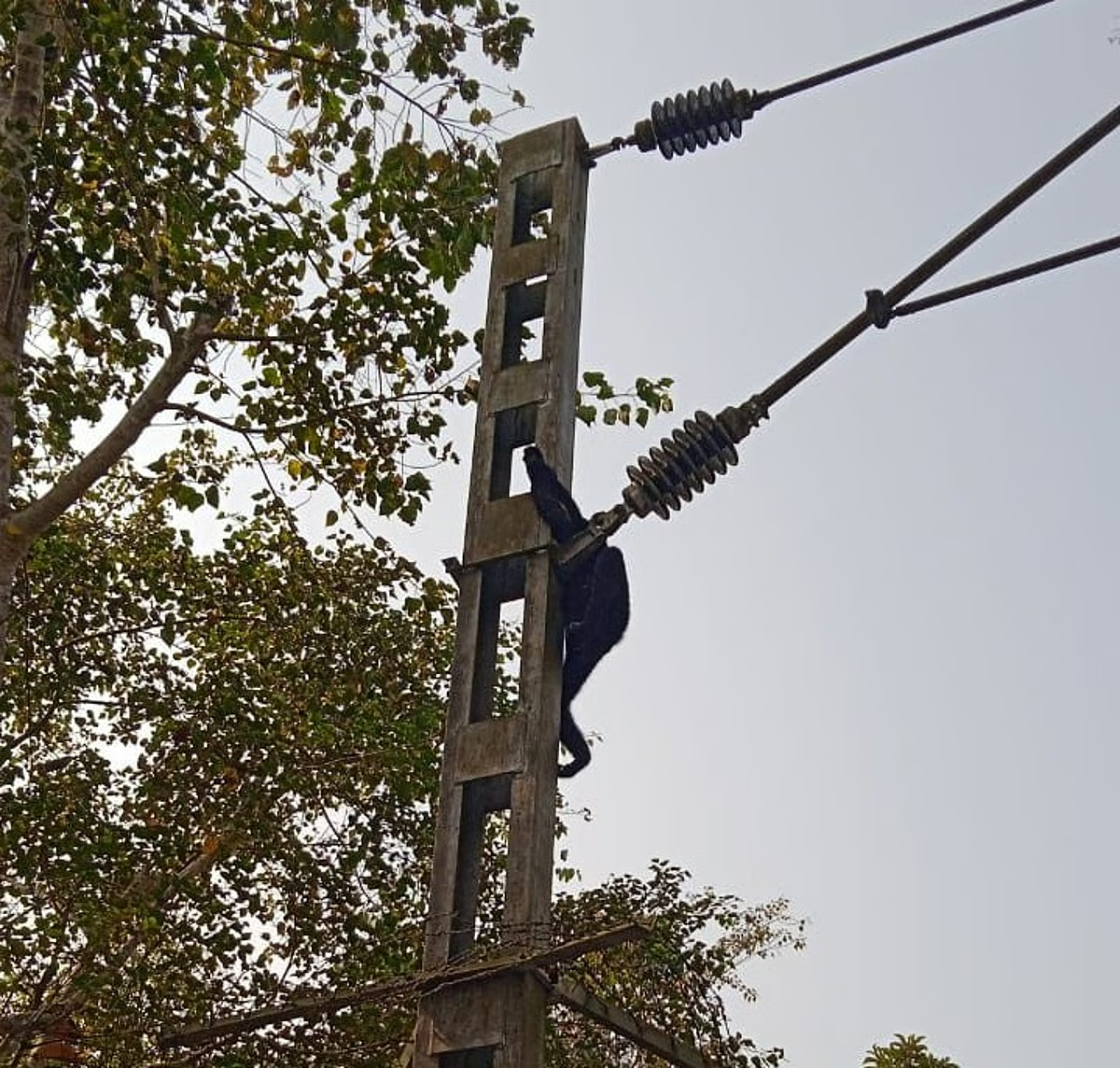
Confirming the incident, Monica Kishore, the Divisional Forest Officer (DFO) for Jorhat who also oversees the HGWS, told Down To Earth (DTE) that the gibbon avoided five canopy bridges that connect the fragmented compartments of the forests. “We are taking necessary steps to prevent any kind of mishap in future. We have installed camera traps to monitor the gibbons to ensure that they avoid the electric lines,” Kishore added. However, according to local people living near the sanctuary, a photograph circulating on social media captured the male gibbon attempting to cross the railway line before its ill-fated death. On being asked if the forest department was taking any legal steps under the provisions of the Wildlife Protection Act, Kishore said no such steps have been taken so far.
Mridu Pawan Phukan, a conservationist who has been long associated with the Gibbon Research and Conservation Centre for non-profit Aaranyak at HGWS to train newly inducted forest guards, said the incident happened 30 metres away from a newly built canopy bridge above the electrified line. “When the railways erected the electric poles, capped langur and even squirrels were using the lines to cross over instead of the canopy bridges. Also, due to earlier efforts of wildlife biologists working in the area, natural canopy bridges were built. When the railways acquired the forest land to erect the electric poles, they decimated the existing natural canopy bridges. The spot where the male gibbon crossed is where there was a natural canopy. This is what killed the ape,” Phukan told DTE.
According to senior primatologist, Dilip Chetry, who also runs a Gibbon Research and Conservation Centre for Aaranyak at HGWS, the protected area supports a population of 125-odd Western Hoolock Gibbons divided in four compartments. The railway line separates the first compartment in the north from the three compartments of forests in the south. “There are about four families in the first compartment,” Chetry said.
Being monogamous, the Western Hoolock Gibbon is known to go long distances to find mates. “Hearing the high-pitched calls of a female gibbon, young males have been known to cross from the first compartment to the others for mating,” Chetry added. He further added that the forest fragmentation in gibbon habitats can lead to small and isolated populations. “Factors like lack of genetic diversity can easily lead them towards extinction,” he warned.
Fail-safe mechanism?
Indian Railways, on the other hand, had deposited Rs 41.99 lakh with the Jorhat DFO in February 2024 for new canopy bridges ahead of the electrification. According to the mitigation measures as agreed by the railways in consultation with WII and the Assam Forest Department, the canopy bridges as well as the knots were secured and clamped/tightened using appropriate and high-grade fastening materials and techniques. As a fail-safe mechanism, safety nets will be installed below the main twin-rope bridge to prevent the species from accidentally falling off the bridges. As for any interaction with wild elephants, the railways planned intrusion detection devices, at the cost of Rs 3.04 crore over a 33-kilometre stretch covering HGWLS.
“The recent incident however shows that the mitigation measures were not enough. More importantly, seeing canopy bridges as a mitigation measure in itself is a mistake that the railways have made. The canopy bridges are a means to connect the fragmented compartments. It cannot be qualified as a mitigation measure,” added Chetry saying that these issues were pointed out to NBWL’s standing committee in a letter he wrote ahead of the approval. At present, the gap between the compartments is roughly around 30 to 40 metres. He warned that in future, electrification and possible doubling of the railway track will make these canopy bridges useless as the gap between the fragments can easily increase by 100 metres.
The WII report has already recommended long term measures to protect the Sanctuary. “Since the railway stretch within HGWS is small, the Indian Railways must think long-term and demonstrate its conservation vision by exploring all possibilities to reroute the existing line outside the sanctuary [and its ESZ] limits into the adjoining revenue and non-forest land. This will ensure that a balance between ecology and economy is struck and allow for the necessary doubling and electrification of such a rerouted line,” the WII recommended.