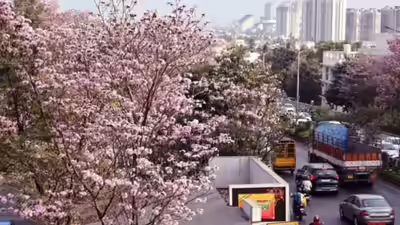
Bengaluru is unfolding its flair for drama as spring rolls in. It’s the months of February and March, when the city does what locals lovingly call a proper “clean up.” Overnight, streets turn magically pink, and during these a few fleeting weeks, the entire neighbourhoods are dusted in blush. Balconies double up as viewing decks. Morning walkers slow their pace. Even the famously chaotic Silk Board junction looks, dare we say, almost poetic.Predictably, social media follows. The annual #PinkBengaluru takeover is underway again in 2026.
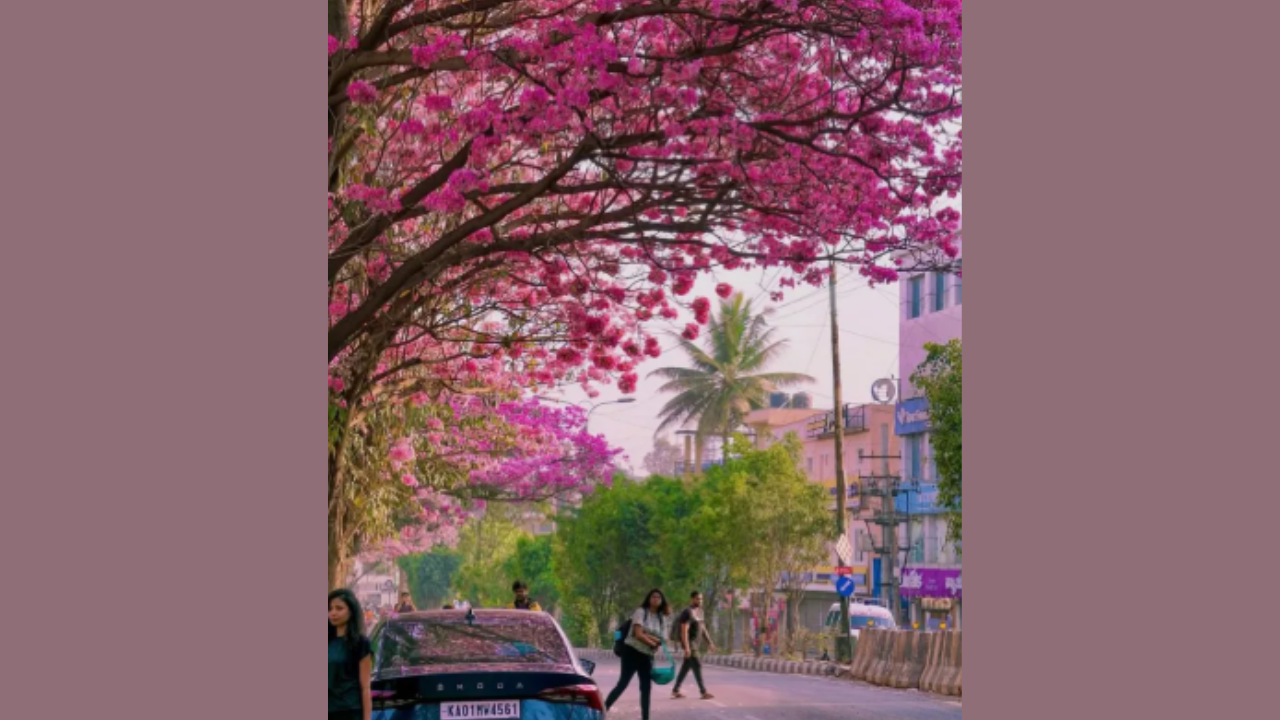
Picture credit: Instagram
Often mistaken for Japanese cherry blossoms, this rosy spectacle is courtesy of an exotic species called Tabebuia avellanedae, popularly known as pink trumpet tree or pink poui. Native to Central and South America, the tree produces clusters of trumpet-shaped blooms with flared petals and sunny yellow throats. By late November, the trees shed their leaves, standing stark and skeletal for weeks. Then, just as spring begins to tease the air, tight buds unfurl into explosions of fuchsia, baby pink, bubblegum and strawberry.And when they bloom, they are a sight to behold.Fallen petals gather in soft drifts along pavements and bylanes, turning concrete into confetti. Photographers scout their annual backdrops. Couples pose beneath cotton-candy canopies. Office-goers stuck in traffic glance up and momentarily forget the red signal. Read more: World’s 8 most stressful cities to live in and their biggest pressure points
The colonial roots of a spring obsession
The story of Bengaluru’s pink “cherry blossom” season dates back to the late 19th century. When the British established cantonments in the city, they brought with them a fondness for ornamental, neotropical plants to soften what they considered an unfamiliar landscape. The pink trumpet tree was one such import.During the reign of Maharaja Krishnaraja Wadiyar IV, the species found a powerful admirer. Taken by its dramatic flowering, the king encouraged its planting across the city, especially within Lalbagh Botanical Garden. European horticulturists John Cameron and Gustav Hermann Krumbiegel, who helped shape Lalbagh’s landscape, played a key role in introducing and nurturing these trees.Post-Independence, as Bengaluru leaned into its “Garden City” identity, municipal bodies continued planting tabebuias along avenues. The trees were valued not just for their dramatic bloom cycles but also for their drought resistance and tolerance to urban pollution. Ecologists point out that their profuse flowering attracts birds for pollination, while their winged seeds travel surprisingly far, twirling through the air before settling into new corners of the city.
The quiet architect of pink Bengaluru
A month before Yugadi, as Tabebuia trees burst into bloom, it is worth remembering a name that rarely trends on Instagram: Sethuram Gopalrao Neginhal.Between 1982 and 1987, the former forest officer led the planting of nearly 15 lakh trees across Bengaluru. His work quietly shaped the green canopy the city still enjoys today. What residents admire each spring as seasonal beauty is, in many ways, the result of foresight, administrative will and a deep love for urban ecology.His efforts did not just plant trees. They planted shade, cleaner air, colour and joy for generations. Every pink petal carpeting a Bengaluru street is, in part, a reminder that one person’s vision can alter the character of an entire metropolis. Read more: World’s top 10 tourism economies ranked, India on the list
Where to catch the pink wave in 2026
The best part about pink trumpet season? You don’t need a curated itinerary. Simply step out. Chances are, your neighbourhood is already blushing. That said, some spots promise especially dreamy scenes.
Cubbon Park
Cubbon Park remains a perennial favourite. Its sprawling greens provide the perfect contrast to blush-toned avenues, with pathways framed by arching pink canopies.
Ulsoor Lake and Benniganahalli Lake
The reflective waters of Ulsoor Lake and Benniganahalli Lake amplify the spectacle, doubling the pink in mirror-like stillness during early mornings.
Neighbourhoods awash in blush
Residential pockets such as Jayanagar, Indiranagar and Koramangala are currently drenched in colour. Even traffic-heavy stretches like Outer Ring Road, Silk Board, KR Puram Bridge and the 100-ft Road toward Koramangala are momentarily softened by tender petals lining their edges.Around landmarks like Vidhana Soudha, Manyata Tech Park, Yelahanka, Madiwala and Kengeri Railway Parallel Road, pink canopies stretch overhead, transforming the everyday commute into something far more cinematic.The bloom lasts only a few fleeting weeks. Traffic will return to being traffic. Deadlines will resume their tyranny. But for now, Bengaluru is looking up — at petals, at canopies, at a city that, despite everything, still knows how to surprise.If you’ve been waiting for a sign to take the longer route home, this is it.