
- A new study found chromium and lead in all fishing cat scat samples across four sites in the Sundarbans mangrove ecosystem in West Bengal.
- Rising pesticide use, fertilisers and plastic pollution in the Sundarbans are increasing heavy metal and microplastic loads in wetlands.
- Scientists warn that contamination in fishing cats signals risks to human health too, urging stricter effluent control, better sewage systems and reduced dependence on harmful agrochemicals.
Sixty-five-year old Lal Mohan Das started farming at the age of 15. For the last 50 years, he has been growing paddy every year. “Earlier we used to sow it and it used to grow. Things were easier at that time. Now, at every stage of growth in paddy, pests increase and then we have to increase the amount of pesticides. If we don’t use it, there will be no harvest,” says Das.
Sitting at a small tea shop run by his wife in Bhagabatpur village of West Bengal, in the Sundarbans region, Das talks about the increasing use of pesticides and fertilisers, and increasing plastic pollution in this mangrove ecosystem. In recent years, he has had to ramp up the use of fertilisers as the soil quality has depleted because of increasing salinity and the increase in pests because of climate change.
But this growing amount of pesticides, fertilisers and plastic waste is causing heavy metal and microplastic pollution in the waters flowing through the Sundarbans and draining in the Bay of Bengal.
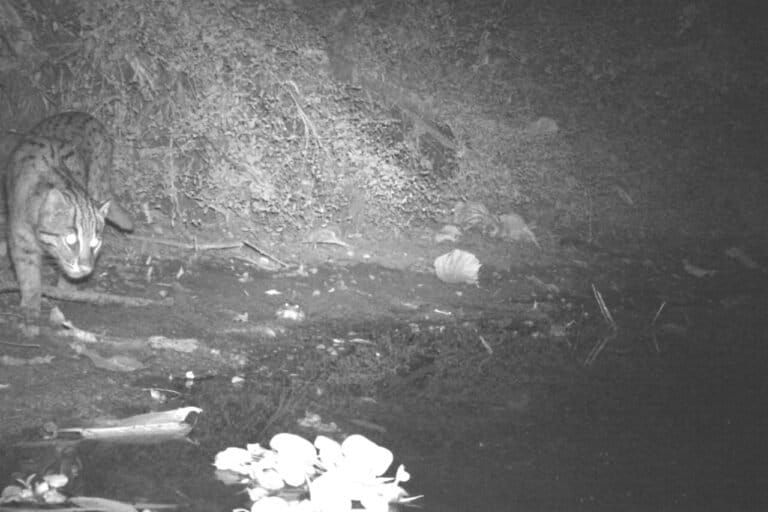
This fragile but polluted ecosystem is also the prime habitat of the fishing cat, the state animal of West Bengal. Unsurprisingly, the animal is being affected by the pollution in the waters, because of what it eats.
A recent study by Samrat Chakraborty of University of Calcutta revealed heavy metals and microplastics in the fishing cat. The study conducted between October 2024 and April 2025 spanned four critical mangrove sites in southern West Bengal — Henry’s Island, Lothian Island, Pakhiralay, and Patharpratima.
For the study, Chakraborty analysed 34 scat samples of the fishing cat from all the four locations and found the presence of chromium and lead in all the samples. The highest levels of chromium were found in samples from Henry’s Island (49.09%), followed by Lothian Island (25.25%), Patharpratima (14.54%), and Pakhiralay (12.72%). Lead was primarily found in samples from Pakhiralay (16.36%), with lower levels at Henry’s Island, Patharpratima (both 5.45%), and Lothian Island (3.63%).

“Heavy metals primarily enter the fishing cat system through its dietary intake. Being a piscivorous species, the fishing cat depends heavily on fish, crabs, and other aquatic organisms that bioaccumulate and biomagnify heavy metals from polluted wetlands,” Chakraborty told Mongabay-India.
“While direct contact with contaminated water can lead to dermal absorption (absorption through skin) to a smaller extent, the trophic transfer (transfer through food) through prey species remains the dominant pathway of heavy metal entry into their system. From our study the heavy metals are also witnessed from the fish, crabs, rodents and birds, all included in the dietary spectrum of the fishing cat,” he added.
Sources of heavy metals
Various studies have already shown the presence of heavy metals in the waters and sedimentation of Sundarbans of India and Bangladesh. The organic pollution here, from domestic sewage and industrial effluents, impacts water and sediment quality as well as biodiversity. Another study shows the presence and bioaccumulation of heavy metals in Sundarbans’ aquatic organisms such as fish, prawns and crabs.
Chakraborty’s research takes this discussion of bioaccumulation of heavy metals from aquatic organisms to their predators and lists some of the major sources of heavy metal contamination.
“Our study suggests that the probable sources of heavy metal contamination in the Sundarbans landscape include: Industrial effluents from the metropolitan cities discharged into rivers and via riverine systems that are carried downstream into the mangroves; runoff from agricultural fields that use fertilisers and pesticides containing metal residues; and domestic sewage and untreated waste that directly enters the wetland and pond systems of Sundarbans,” he said.
Shifts in farming practices contribute to pollution
The use of pesticides, fertilisers and herbicides in agriculture has increased in the Sundarbans over a period of time as the number of pests in this biosphere reserve, recognised as a UNESCO World Heritage Site, has increased. At least 45 species of moth are recognised in the Sunderbans, and at least 25 of them are recognised as pests that attack different crops including vegetables and paddy.
Deenanath Koel, a 70-year-old farmer from Pakhiralay island uses Urea and DAP (diammonium phosphate), a phosphorus fertiliser, for his paddy and vegetable crop as well as Hamla 550 brand of pesticide, as pest attacks have increased.
“Pest attacks are increasing with time. Our earlier pesticides don’t work properly. As we spray the medicine (pesticide) pests often migrate to other farms and do the damage there,” Koel explained.
Similarly, Vibhash Mistry, another farmer from the same island has also started using more pesticides but he attributes this change to the variety of paddy he has shifted to.
“Early we used to grow desi rice but since we have shifted to another variety, hybrid variety locally called ‘khorati dhan’, it needs more pesticide. We used Ferterra (an insecticide brand) and another spray to deal with pests and insects,” Mistry told Mongabay-India.

Impact on the fishing cat
Earlier studies from the Godavari delta in southeast India, on heavy metal toxicity in fishing cats, explicitly state that chromium (Cr), copper (Cu), and lead (Pb) concentrations in fishing cats were above threshold levels and “could affect the physiology and behaviour” of the species, describing these metals as having “devastating effects” on top predators and being strongly biomagnified through aquatic food chains.
“Multiple studies in Indian sewage-fed and deltaic wetlands (e.g. East Kolkata Wetlands, lower Ganga, Godavari estuary) show that lead (Pb) and chromium (Cr) accumulate in fish muscle and other tissues, often peaking in the monsoon when run-off from industrial/urban areas is highest,” Tiasa Adhya, a wildlife biologist known for her extensive work on the fishing cat, told Mongabay-India.
The data in Chakraborty’s study from West Bengal also showed a seasonal pattern. Chromium and lead levels varied significantly between winter and summer, suggesting dynamic pollution pathways influenced by rainfall, river flows, and possibly human activity.
“Because fishing cats are known to eat fishes and crustaceans apart from birds and rodents, they are exposed to metals that have already been concentrated in prey tissues. So even if water concentrations are moderate, the body burden in a fishing cat can become high over years of feeding in contaminated wetlands,” Adhya explained.
According to her, chromium and lead contamination are very likely to reduce the survival and reproductive success of fishing cats over time, both by directly damaging their bodies and indirectly by degrading their prey base and wetland ecosystems.

Pollutants in fishing cat could reflect human health risk
Since fishing cats eat many of the same fish and crabs that local people or even people in cities and abroad consume, they could be considered biomonitors for human exposure to pollutants and could mirror the effect of these pollutants on human physiology and health.
“We need to tighten effluent norms and enforcement for industries discharging into the Hooghly–Matla system, especially for lead, chromium and other priority metals. Make zero discharge of untreated effluent into rivers a non-negotiable. We also need to upgrade municipal sewage and solid-waste management in delta towns so storm drains and canals are not acting as direct conduits of untreated sewage and plastics,” Adhya said.
“For agricultural effluents, high risk agrochemicals and pesticides must be phased out. Low external outputs and indigenous crops and cropping patterns are known to be climate resilient and must be prioritised to achieve the twin objectives of health and sustenance,” she added.
Chakraborty also suggests strict enforcement of similar measures. However, he also emphasises the need for public awareness. “Capacity building among local residents and fisherfolk to reduce plastic use and adopt eco-friendly alternatives can reduce the pollution. Establishing strong waste disposal systems, eco-tourism guidelines, and awareness programs for visitors will also help. For this, hotel owners may take a token amount from the tourists and use the collective amount to have a clean-up drive within the habitats by community participation.
Read more: How excess rains and poor wastewater management send microplastics into city lakes
Banner image: A fishing cat with its prey in the Sundarbans. Image by Anirnoy via Wikimedia Commons (CC BY-SA 4.0).