President Trump is offering some indication about how long the war with Iran might last.
SCOTT DETROW, HOST:
War in the Middle East widened today with waves of attacks by the U.S. and Israel on Iran and Iran striking back on targets in the Gulf and as far afield as Cyprus. The Lebanese militia, Hezbollah, has also entered the fight, launching its first attacks on Israel in more than a year. NPR’s Jane Arraf has been following developments and joins us from Amman, Jordan. Hi, Jane.
JANE ARRAF, BYLINE: Hi, Scott.
DETROW: So much has happened in the past 24 hours. What are the most important developments?
ARRAF: Well, these attacks have both intensified and the targets have widened. And in a sign of the U.S. juggling military operations by allies that are not used to direct combat, Kuwait mistakenly shot down three U.S. fighter jets. No one was killed, but the Pentagon announced that six service members have died as a result of an Iranian attack Saturday. And President Trump has warned of more casualties. General Dan Caine, who’s chairman of the Joint Chiefs of Staff, said the U.S. had struck more than 1,000 Iranian targets in the first 24 hours of the war. Now, he and Defense Secretary Pete Hegseth spoke at a press conference earlier today. Here’s how Hegseth described the conflict area.
(SOUNDBITE OF PRESS CONFERENCE)
PETE HEGSETH: This is a big battle space with a lot of capabilities. That’s part of the reason why it’s such a threat to us.
ARRAF: Iran’s Red Crescent, which is the sister society of the Red Cross, said more than 555 Iranians had been killed, and that’s including more than 175 schoolgirls in airstrikes on their school, according to Iranian authorities. Some Iran-backed militias in Iraq also joined the fight. They launched airstrikes at U.S. forces in the Kurdistan region of Iraq. And Scott, that’s just three days into a war that Trump says could take four to five weeks.
DETROW: And I mentioned Lebanon. What’s going on there?
ARRAF: Well, that’s a country that emerged from war with Israel less than two years ago, and it looks like war again, but with an even potentially more dangerous twist this time. The militant group, Hezbollah, which is backed by Iran, fired into Israel for the first time in over a year in retaliation for the killing of Ayatollah Ali Khamenei on Saturday. Lebanese officials said Israeli counterattacks killed at least 52 people and wounded 149 others.
So here’s the thing – the Lebanese government agreed with the U.S. that Hezbollah would disarm, and now it’s saying it will arrest the Hezbollah members responsible for the rocket attack on Israel. So that raises the specter of Lebanese fighting Lebanese. And that’s in a country which has suffered years of civil war. Meanwhile, Scott, Iranian missile strikes on Israel have killed 11 people and forced hundreds of thousands into shelters.
DETROW: How are the Lebanese affected by all of this?
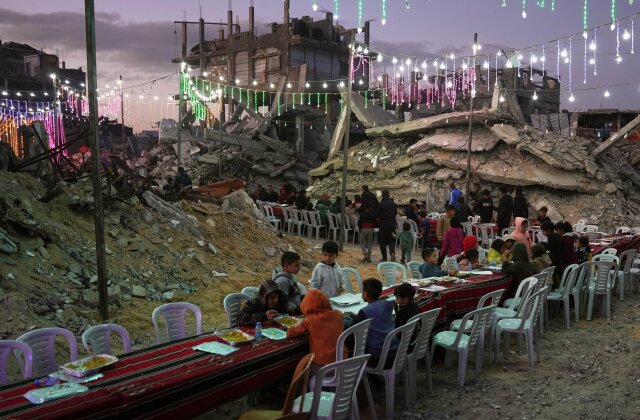
ARRAF: Well, there are tens of thousands of displaced here. The Lebanese government closed schools, turning them into shelters. Others evacuated, with residents evacuating Beirut’s southern suburbs as well as south Lebanon. NPR’s Jawad Rizkallah spoke with one man who said he left before dawn, as soon as he heard the Israeli airstrikes hitting Dahieh, the Beirut suburb where Hezbollah has a large presence.
UNIDENTIFIED PERSON: (Non-English language spoken).
ARRAF: He said it’s the second time he and his family had been displaced. The last time was two years ago, when the shelters were full, and they slept in the streets.
DETROW: And in the time we’ve got left, what should we think about the other repercussions that this has had?
ARRAF: Well, definitely higher oil prices – Iran has closed a key waterway to oil exports. Iran also attacked a major Saudi oil refinery today. There are hundreds of thousands of airline passengers stranded, some governments considering evacuations of their citizens, and it’s tarnished the image of the Gulf, which formerly had the image of an ultra-safe haven. So Scott, it’s upended a lot of things in this region.
DETROW: NPR correspondent Jane Arraf in Amman, Jordan, thank you so much.
ARRAF: Thank you, Scott.
Copyright © 2026 NPR. All rights reserved. Visit our website terms of use and permissions pages at www.npr.org for further information.
Accuracy and availability of NPR transcripts may vary. Transcript text may be revised to correct errors or match updates to audio. Audio on npr.org may be edited after its original broadcast or publication. The authoritative record of NPR’s programming is the audio record.