Andy Omer Gokce’s unconventional idea for a new school wasn’t met with immediate enthusiasm.
The former Silicon Valley resident saw technology surging forward in profound ways, even before generative artificial-intelligence models burst into the marketplace. Could the longtime educator build a learning environment, he wondered, where students honed AI and data-science skills? A friend who worked as a software engineer turned data scientist for a large retailer scoffed at the notion.
“His response to me was, ‘We can’t even do it with undergrads. How are you going to do it in middle school?’” Mr. Gokce says.
Why We Wrote This
Teachers are grappling with how to incorporate artificial intelligence into education. A handful of schools are structuring their programs around the new technology, including a charter school in Hawaii which offers a paradigm shift around AI’s role.
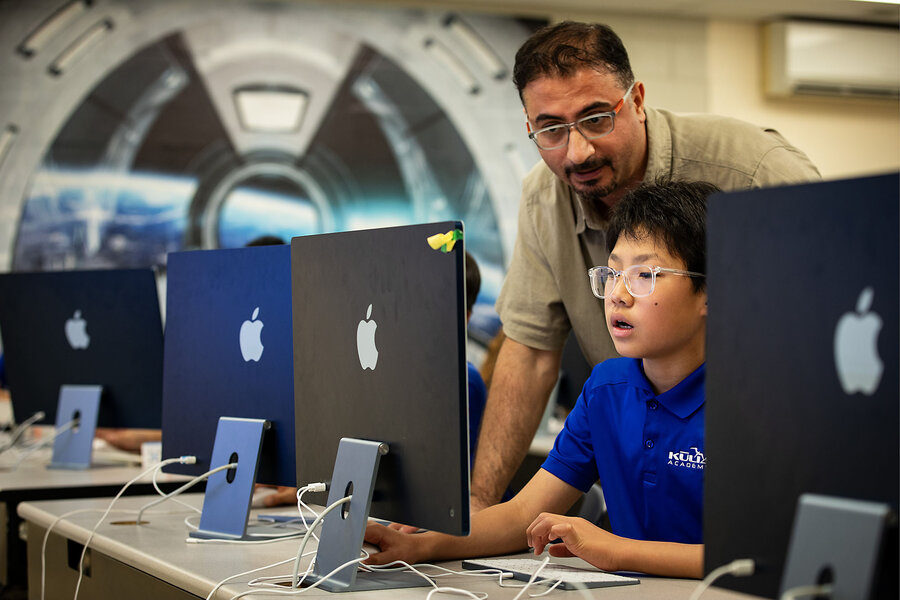
Fast forward to this year: A Honolulu classroom in a school Mr. Gokce helped start is filled with iMac desktops and the occasional Rubik’s Cube. What’s not allowed? Cell phones. (Even the tech-forward school doesn’t want students “to get lost in the computers,’’ as Mr. Gokce puts it.)
Kūlia Academy is changing how students view the evolving technological world in which they are growing up. The fledgling charter school – now in its second year – represents a paradigm shift in education. Instead of shying away from AI, the school is building the academic muscles its leaders believe students will need in the cognitive computing world. It’s one of a handful of educational institutes around the country, mostly charter and private schools, that are orienting around AI as a central aspect of learning and teaching.
At the Honolulu school, educators want students to think beyond feeding prompts to AI chatbots. It’s more about understanding the technology’s underlying building blocks – the data collection, the algorithms, and the computer systems backing it all up. In fact, Mr. Gokce, the school’s executive director, says students are not allowed to use ChatGPT and other platforms to generate code. He wants them to master coding languages such as Python, JavaScript, R, and C++.
“We want them to understand the logic – how the computers work,” he says.
Seventh-grader Atlas James toggles between two displays containing data-driven projects. His latest research focuses on educational attainment in the United States. He scrolls through a spreadsheet filled with rows upon rows of data.

Melanie Stetson Freeman/Staff
“Data is a really big part of the life we live today,” he says. “Nowadays, everybody’s on a phone, a computer, a tablet, and it’s important to understand both how our data is collected and used, and how to use data that we find in our everyday scenarios to better understand the world.”
In addition to the ban on cell phones for students, there is no homework. The school day is longer, with summer school required, along with more time for math and English language arts every day. Those aspects appear to be paying academic dividends. Kūlia Academy students posted the state’s top scores on Hawaii’s most recent standardized tests.
The education experiment comes amid a stock market juiced by AI enthusiasm and parallel worries about job extinction. Large-scale layoffs this year at companies such as Amazon and UPS have raised concerns about workforce automation, though experts have cautioned that AI innovations might be playing a more indirect role at this point. Still, the hazy outlook has triggered more discussion about the skills today’s students need to compete in tomorrow’s workforce.
“The people who might have a job in the future should have the AI skills,” Mr. Gokce says. “There is no escape. It’s coming.”

Melanie Stetson Freeman/Staff
Wading into AI learning
When ChatGPT debuted three years ago, it marked the beginning of a cognitive technology era, in which computers simulated human reasoning to an unprecedented degree. Most people had never interacted with digital platforms designed to mimic human thinking. Questions arose almost immediately, especially in the realm of education.
Would students ever write another essay on their own? Conversely, could machine learning models actually enhance student learning through tutoring or other tools?
Today, 33 states and Puerto Rico have adopted AI guidance or policies for K-12 schools, according to AI for Education, an organization pushing for teacher training and responsible adoption of generative AI in classrooms. Those frameworks vary widely, addressing issues such as data privacy, ethical use, professional learning, and classroom strategies.
“We need strong thinking skills in our young people, which includes a deep understanding of the digital world,” says Rebecca Winthrop, who leads Brookings Institution’s Global Task Force on AI in Education. “And it’s not necessarily a tools-first approach to AI literacy, but a conceptual and ethical grounding.”
But few schools have waded as deeply into AI learning as Kūlia Academy, which bills itself as the “first school in the United States to offer a comprehensive 7-year Artificial Intelligence and Data Science program.” This specialty charter school, now serving roughly 150 sixth and seventh graders from across Oahu, expects to scale up through 12th grade over the next six years.
Mr. Gokce, a former charter school leader in California, received approval from Hawaii’s State Public Charter School Commission to launch Kūlia Academy. He and other school founders built the AI and data science-focused program using curricula from Stanford University, the Massachusetts Institute of Technology, the University of California, Los Angeles, and AI4ALL.

Melanie Stetson Freeman/Staff
In some classrooms, that means students are learning to code or analyze data. But visitors will also find children practicing hula dances, playing string instruments, and conducting hands-on science experiments. Plus, for four hours each day, they are immersed in math and English language arts – two hours for each subject. All told, the regular school day runs from 8 a.m. to 4 p.m.
The approach lured Patricia Tobin out of retirement to teach English language arts. She says the school practices intentional cross-class collaboration. Students’ research projects in their AI data-science class, for instance, turn into English assignments when they are ready to report their conclusions.
The result, Ms. Tobin says, might be a TED Talk-style speech, a comic book, or a more traditional report.
“With two back-to-back hours, we can really take deep dives and incorporate that data science into the literacy development,” says Ms. Tobin, who originally moved to Hawaii with a job through a Johns Hopkins University program training teachers in literacy reforms. “They’re going to get so much more out of what they research if they’re at or above their reading level and understanding of math.”
And it’s not just students analyzing data. Teachers are, too. A wall in the staff lounge features photos of every student with colored tape indicating their progress in math and English language arts. The tuition-free charter school, which uses a lottery-based admissions process based on demand, pulls from a range of socioeconomic groups. School leaders say 52% of students qualified for free or reduced-price lunch this academic year.
The vast majority appear to be excelling. Kūlia Academy’s inaugural class of sixth graders logged the highest proficiency rates – 75% in math and 80% in English language arts – among all Hawaii middle and high schools on the state benchmarking tests, according to the school.
“The culture is that it’s cool to be smart here,” says Chris Teijeiro, whose son Hendrix is in seventh grade at Kūlia Academy.

Melanie Stetson Freeman/Staff
Student input
Do the consumers – the school’s sixth and seventh graders – agree?
The middle schoolers who spoke with the Monitor didn’t hold back. On the cool list: their blue uniforms, advanced classes, and fun electives. Not so cool, at least according to some students: summer school and the no-cell-phone policy.
“I really like that,” says Sana Cook, referring to the dress code,” because it makes everyone look neat and organized.”
On the academic side, Sana says she and her peers are doing math “way above our grade level” and diving into the complexities of AI data science and coding. “It’s really advanced,” says the seventh grader, “but it’s fun to do.”
That positive sentiment toward AI isn’t necessarily shared by other students, parents, and teachers nationwide. A RAND survey conducted earlier this year found that even as AI use is increasing among students and teachers, widespread skepticism remains. Forty-eight percent of middle school students, 55% of high schoolers, and 61% of parents expressed concern about AI use harming critical-thinking skills.
The caveat is that the survey question asked about AI use rather than AI learning – the latter of which Kūlia Academy is striving to do. Still, it’s a glimpse into the fraught public attitude toward the rapidly accelerating technology. More than half of the students surveyed also worry about being falsely accused of cheating with AI.
“The larger point is that we need to figure out what are the right ways of using AI that build skills instead of replace skills,” says Christopher Doss, a senior economist at RAND, a research organization.
That’s exactly what spurred Edwyna Brooks to move her sixth-grader son from a private school to Kūlia Academy.

Melanie Stetson Freeman/Staff
“It’s easy to pigeonhole [AI] as something that’s bad when you haven’t touched it, right?” she says. “… Broadening their perspective now will make it easier for them to adapt and use it as a tool instead of something negative.”
Ms. Brooks was among roughly a dozen parents who voluntarily showed up, some during their work hours, to chat about their children’s experiences. School leaders say this type of parent engagement isn’t uncommon. Two recent turkey potluck dinners – one for each grade – brought so many families to the school, cars filled the parking lot and lined neighboring streets.
Enrolling their children at Kūlia Academy, particularly when it opened last year, represented a leap of faith. It was an untested concept. But the parents shared similar motivations for taking that risk. They say their children were bored or not challenged enough in their previous schools. Others couldn’t shake the feeling that the education system wasn’t changing fast enough to keep up with the digital age.
Eileen James had been searching for a new academic home for her son, Atlas, whom she described as the “odd man out” at his former school. He was bullied and frustrated, she says, which led to behavior problems in the classroom. Now, Ms. James says her son has “found his people,” and, as a mother, she appreciates the innovative learning model.
“Who knows what education is going to look like in the future? None of us do,” she says. “It’s not going to look the way it does now.”

Melanie Stetson Freeman/Staff
How far will this model go?
Before long, Kūlia Academy could need more classrooms. It’s occupying a building in a working-class neighborhood that formerly housed a parochial school, but Mr. Gokce has already started scouting expansion locations. He has reason to be optimistic. Inquiries have increased in the nearly year and a half since the educators welcomed their first group of learners.
“We had twice as many applications last year,” he says. “And this year we’re expecting way more.”
Mr. Gokce envisions Kūlia Academy graduates leaving with a firm understanding of how AI and data science work. He hopes that at least half of the school’s students attend college and major in AI data science or similar fields. But the school’s founder also predicts that some will land jobs immediately after high school, recruited by tech leaders who value skillsets over degrees.
And if students pursue seemingly unrelated careers? That’s beneficial, too, he says, because they will be armed with knowledge to solve problems.
AI experts don’t foresee Kūlia Academy replicas popping up in every community, though.
Charles Fadel, chairman and founder of the Center for Curriculum Redesign, explains why using a car analogy. Most adults will learn to drive a car. But if you’re simply a driver – not a car designer or auto technician – do you really need to know how electrodes in a car battery work?
“Not every kid needs that,” Mr. Fadel says, referring to a deep understanding of AI and data science. “However, every kid needs to know how to be extremely good at AI literacy.”
It’s an education debate that likely won’t conclude anytime soon.

Melanie Stetson Freeman/Staff
Approaching AI with a youth mindset
Kelvin Frazier splits his time between teaching chemistry to college students at Chaminade University of Honolulu and math to middle schoolers at Kūlia Academy. A generational difference has stood out to him.
His sixth and seventh graders approach AI with curiosity, he says. They want to know the applications and inner workings of the technology.
“The college students? They’re more … ‘How can I find my easy way out of things?’” says Dr. Frazier, who holds a doctorate in physical chemistry from MIT.
Technological innovation and practical use are one aspect of responsible AI use. But as Kūlia Academy students point out, it’s also a matter of stewardship. That’s something they talk about frequently in their classes.
“You have to think about the bad things that AI can lead to, right?” says Bill Nguyen, a seventh grader. “The entire reason that AI can sometimes be bad is because of you. Yeah, that’s right – you,” he says, with a point of emphasis. “It uses data. AI only knows what it knows because of data.”