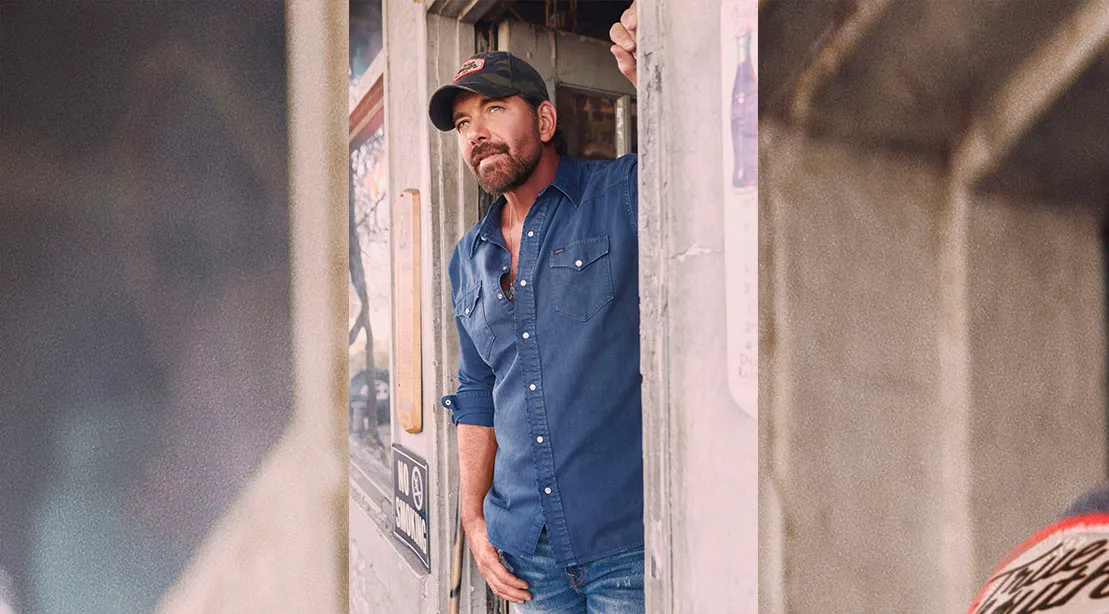
Nearly two decades after his hit “If You’re Going Through Hell” jumpstarted his rise to music fame, Rodney Atkins is finally going through the pressure-free stage of his career.
Sure, the challenge of making one more great single—followed by another—will always drive the ACM-winning artist. But with a wall decorated in platinum—four singles and a pair of albums—the stress of defending his brand of country storytelling, or his “non-traditional” attire, no longer looms over his shoulder.
These days, the Tennessee-born former college pitcher steps on stage with the same joy he once felt strumming honky-tonk hits for his Walters State teammates on baseball road trips. Music has become a full-blown family affair, with his wife, singer-songwriter Rose Falcon, regularly collaborating on both country and even Christmas projects.
The best part, he says, is that stepping up to the microphone still brings a rush of butterflies, just as it did when he opened for stars like Brad Paisley in the mid-2000s. “It’s more fun, but I still get nervous,” he says. “I think if I didn’t get nervous, I’d probably quit.”
With his recently released “Helluvit,” and new music and tour dates planned for 2026, Atkins is now placing even greater emphasis on his fitness. While the struggle to make it in the cutthroat world of country music has eased, new health concerns have surfaced. After his mother’s passing in early 2025, a significant spike in blood pressure served as a wake-up call to recommit to training. Although life’s game has changed, he says, training for longevity in both music and fitness requires the same discipline he once honed while running drills for baseball.
“When you have your health, you don’t think about it,” Atkins says. “But when something goes sideways like that, you quickly realize it’s everything.”
Doctors have now given the “Watching You” singer a clean bill of health—a blessing for the raspy-voiced vocalist who, even before this recent scare, was considered a “music miracle” by specialists. Decades ago, doctors discovered massive amounts of scar tissue on his throat from a childhood respiratory staph infection. “Technically you shouldn’t be singing, but you can, so obviously it’s not an issue,” Atkins recalls a specialist telling him.
Amazingly, the issue has never forced him to miss a concert in over 20 years—perhaps thanks to his regimented pre-show vocal warmup, which includes 20-plus minutes of training. Offstage, Atkins commits to a strict weight-training routine in his fully equipped home gym, ensuring he never skips a workout. That dedication helps him stay sharp onstage throughout his career.
“As long as I keep feeling this fired up for every show, I know I’m right where I’m supposed to be—and the best is still ahead,” he says.
From Fastballs to Vocal Precision
By choosing curveballs before crossing over to country music, Rodney Atkins joined a Nashville pitching fraternity that includes Brian Kelley and Brett Young. Atkins pitched for eastern Tennessee’s Walters State Community College from 1987 to 1989. Coming out of Powell Valley High as a star athlete, Atkins—who was originally recruited as a catcher thanks to his arm—soon realized how intense the college competition was.
“In high school, I was a baller,” Atkins says. “But at that junior college, it was a bunch of kids that were all drafted [by the major leagues]. They were all pro material, and what I came to realize is how good I wasn’t compared to these guys.”
Knowing he’d soon be relying on his voice rather than his pitching arm, Atkins brought his guitar on team road trips. The team bus, especially during long hauls, became his first true live stage.
“That’s kind of where I first started playing for other people, it was just the dudes on the baseball team,” he recalls. “We’d hang out, singing Hank Williams Jr. or whatever. It was a lot of fun, and that’s where I started playing in front of people and having fun.”
With baseball now on the back burner and his vocal cords becoming his calling card, Atkins quickly learned he couldn’t rely solely on natural talent; he had to train like a true singer.
Fortunately, Atkins never took up drinking, but substances such as caffeine eventually affected his performance. He’s now cut caffeine out entirely on show days. “I have more energy since I stopped—there was a time I was trying to get by on energy drinks,” he says. “Now, I cut out caffeine on show day, and I genuinely feel better for it.”
While the team worked drills on the field, pitchers’ primary workouts revolved around running. “I hated running—that’s your endurance, that’s how you can keep going and going. Your legs are everything.”
As his athletic conditioning improved, Atkins discovered that breathing techniques for sports differed entirely from those needed in singing. After struggling to catch his breath on stage, he sought a coach, who offered a clear diagnosis:
“You breathe wrong. You breathe completely wrong,” she said. With her help, Atkins developed a warmup routine built around diaphragmatic breathing—deep inhalations from the ribs and abs with controlled exhalations—which became his secret weapon for never missing a concert.
“I don’t care if I’m singing one song or a 90-minute show, I do my breathing routine for 20 minutes each night,” he says.
How Rodney Atkins Trains to Go the Distance—On Stage and Off
When Atkins hits the road in 2026, he can perform knowing his medical team has cleared him. After a severe blood pressure spike led to extensive testing—PET scans, MRIs, echocardiograms—he was relieved to learn everything was in working order.
“I had every test in the world, and I found out that all my parts are good,” he says proudly.
Doctors ultimately attributed the scare to stress, following his mother’s passing. “It wound up being just stress, some hormones that got out of balance, and lack of sleep—it really came down to the basics, which is wonderful.”
The stress—which, according to the Mayo Clinic, is a major trigger for health issues such as anxiety, depression, digestive issues, weight gain, and memory and focus problems—prompted Atkins to recommit to healthy routines.
This wasn’t the first health hurdle he’d faced. Before signing his first label contract, Curb Records required Atkins to get a physical for an insurance policy. That’s when doctors first discovered the potentially debilitating scar tissue that should have made singing impossible. Atkins, who was adopted, attributes it to a genetic condition. “The doctor asked what happened, and I recalled that as an infant, I was very sick. He said, ‘There you go.’”
Neither issue ever stopped him from being active. Today, he’s reconnected with his pitcher’s mindset. At this stage, his workouts are built around stamina-building legwork necessary for 90-minute sets—this time, without all the endless running required by baseball. “All we did was friggin’ run,” he recalls.
Training motivation also comes from advice given by country icon Keith Urban. “We have to stay fit like prime athletes, no matter what we’re doing,” he recalls. “Ever since then, I’ve made it a point to stay fit so we can go out there and crush it every night. You can’t do this for all these years and suck.”
Atkins now prefers the familiar confines of his home gym. The Smith machine anchors his setup, along with a preacher curl bench for biceps, and plenty of dumbbells for presses, curls, and squats. His personal trainer visits several times a week when Atkins isn’t touring, bringing along medicine balls and additional equipment so they can work out in the garage or driveway.
Lower body and abs are non-negotiables, despite how much he dreads them. “Core work, lots of legs—it’s the stuff you hate to do but always feel better after,” he admits. Paired with portion-controlled nutrition and lots of water, this routine keeps Atkins ready for showtime.
“It’s important, especially for a man my age, to push weight,” he says. “Free weights, core work, legs—it’s the stuff you hate, but afterward you feel great.”
The real struggle, Atkins admits, is getting consistently good sleep—almost impossible for an artist constantly on the road, whose workday doesn’t start until the music does. “My go time is 9 or 10 o’clock at night, and sometimes I’m up at 3 a.m. to catch a flight,” he says. “So I just try to get rest when I can. It’s hard.”
Rodney Atkins on the Secrets to Longevity in Country Music
Rodney Atkins considers himself unique in both philosophical and physical ways. The 2006 CMA New Artist of the Year’s longevity hinges on more than just building muscle at home—it’s also fortified by a never-give-in mindset. Looking back, he admits that some of his rebellious streak would be considered minimal by today’s standards. Atkins first turned heads by being one of the first to ditch traditional country décor, opting for a baseball hat over a cowboy hat.
“I caught a lot of flak because I wore a ball cap to events and on stage,” he recalls. “Back then it was either cowboy hats or no hats, and I got bad looks, especially on the red carpet. Now it’s kind of everywhere, but back then it was kind of crazy.”
His non-conformist attitude extended to his songwriting. While songs like “Watching You” and “If You’re Going Through Hell” eventually became platinum-selling life song anthems, music executives were pressing for more radio-friendly love songs. Atkins refused to become a cookie-cutter country artist.
“At first, my record label was questioning my song taste, because they wanted me to record love songs,” he recalls. “I’m like, everybody records love songs, so I started going in this direction of life songs. They were first like, ‘Are you sure this is what you’re into? Because these are not the easiest songs to get played.’”
The risk paid off, as radio stations began playing him more, leading to two platinum-selling albums and six No. 1 hits.
“I wanted to write about life—real things,” Atkins explains, a trait that’s kept his catalog relevant for over three decades.
The winning formula for living his best life post-50 wouldn’t be complete without family. Atkins credits his wife, Rose, for bringing out the best in his music and his life. The two just released a Christmas single, “Mary Had a Little Lamb,” as well as the love ballad “Marry Me Again.” He also recently featured his son, Elijah, in an updated 2025 reboot of “If You’re Going Through Hell.”
“She’s the secret to my drive. I think I’ve written the best songs I’ve ever written are with her,” he says with unmistakable pride.
There can only be one Rodney Atkins, and that’s the message he hopes resonates with a new wave of younger fans and artists. “Find your own voice,” he says. “Don’t try to be the next someone—be the first you. There is a Morgan Wallen, and he’s the best Morgan Wallen ever. But you got 30 other dudes that are just trying to do what he does, so it’s very important to separate yourself somehow, and that takes a minute. That’s the only way to last.”