- Maharashtra is conducting immunocontraception trials in leopards to reduce human-leopard conflict by temporarily limiting their reproduction.
- In Junnar, landscape changes, especially the spread of sugarcane that serves as shelter for leopards, have increased human-leopard overlap.
- While some experts see birth control as a necessary last resort, others argue that better data, habitat management, and targeted conflict prevention are more effective long-term solutions.
In November last year, after months of deliberation, the Ministry of Environment, Forests, and Climate Change (MoEFCC) approved the Maharashtra government’s proposal for leopard population control in the state. Although other states have proposed similar interventions, Maharashtra is the first state in the country to trial birth control in leopards to potentially mitigate increasing human-leopard interactions.
The state forest department will implement the programme according to the proposal presented by the Wildlife Institute of India (WII). While the proposed population control method has been widely reported as “sterilisation”, Bilal Habib, WII scientist, who led a long-term study in Junnar, clarifies that it is, in fact, immunocontraception — “a temporary vaccination which will prevent these animals from breeding for the next two to three years”. Unlike sterilisation, a permanent, one-time procedure, immunocontraceptive vaccines stimulate an animal’s immune system to temporarily prevent it from fertilising offspring.
The chosen site for the pilot programme is Pune’s Junnar forest division, where negative interactions between humans and leopards are resulting in a rising number of human deaths and injuries. Since 2021, 22 people have died, another 42 have been injured, and 16,593 cattle have been killed from leopard attacks, according to compensation records obtained by Mongabay-India from the Junnar forest division. During the same period, the department has distributed about ₹190 million in compensation.
Surrogate leopard habitats
The Junnar forest division covers about 5,826 sq km in the northern part of the Pune district, including the subdistricts of Junnar, Ambegaon, Khed and Shirur. Situated on the eastern side of the Western Ghats, Junnar comprises vast human-dominated agricultural landscapes dotted with intermittent dry, deciduous forest patches. The development of irrigation infrastructure projects, such as the Yedgaon dam and the Kukadi irrigation system, provided surplus water to the region, sparking a boom in sugarcane cultivation.
“There were fewer leopards in this landscape before sugarcane cultivation started,“ Nikit Surve, leopard researcher at the Wildlife Conservation Society-India, says. Leopards, considered the most adaptive of the big cats, are nocturnal, requiring cover during the day to hide. “Sugarcane, within two-three months of planting, can easily hide a whole leopard family,“ Surve adds.
“Human-leopard conflict in the Junnar forest division has a documented history of over two decades,” says Yogesh P. Badhe, assistant professor at the Savitribai Phule Pune University. “Between 2001 and 2010, conflict was persistent but it was relatively moderate and spatially clustered. However, since 2012, both human attacks and livestock depredation have shown a marked increase.”
A conflict trend and hotspot analysis co-authored by Badhe reveals an increase in livestock attacks between 2015 and 2019, from an annual average of roughly 274 rising to 643 attacks. The compensation records from the Junnar forest division shows significant escalation in the years since, with 6,844 livestock deaths recorded in 2024 alone.
WII has worked in Junnar for the last six years, and as per their estimate, the density of leopards in Junnar — 6.75 animals per 100 sq km — is equivalent to that of the Tadoba-Andhari Tiger Reserve but they are unsure how widely the population is distributed.
Badhe says that the rise in negative interactions is a reflection of the landscape transformation and increasing human-leopard spatial overlap in the region. “Habitat degradation and fragmentation in the western hilly belt, which historically supported wild prey, has meant that, over time, leopards have adapted to this mosaic of farms, settlements, and riparian corridors. The sugarcane fields have provided the cats a surrogate habitat that offers year-round dense cover and access to easy prey in the form of livestock, primarily goats,” he says.

No other way
Immunocontraception has been successful among the managed felid populations in African game reserves. Giovanna Massei, Director of the Botstiber Institute for Wildlife Fertility Control in Europe says fertility control or birth control can be a viable management tool even for free-living wildlife. Massei cites a study conducted in Utah, U.S., which found that surgically sterilising wild coyote populations reduced sheep predation.
The study demonstrated that surgical sterilisation did not disrupt social or territorial behaviour in coyotes. Without pups to provision, depredation rates significantly reduced, and sterile coyotes functioned as “biological placeholders” that defended their territories.
Massei, however, emphasises that the use of fertility control applications to mitigate human-wildlife conflict largely depends on the species and the context. “[Conservation] managers should establish whether and why fertility control for this species, in this context, is the best method to mitigate human-wildlife conflict,” Massei says.
According to WII’s Habib, immunocontraception may be the only solution left to potentially mitigate conflict in the region. “In the last 25 years, we have tested everything: removal, capture, barriers, fox lights,” he says.
When the WII team captured and collared 15 leopards, believed to be individuals in conflict, between 2020-2025 and released them “far away from Junnar”, all of them returned in three to nine months. “Once collared, we realised these animals were not involved in conflict. Over the next year, none of these individuals was responsible for human deaths,” Habib shares.
Changing leopard dynamics
From their research, WII scientists identified that there are territorial leopards with home ranges, and young, dispersing animals who are looking to establish territories. The young ones are forced to move away from occupied territories, resulting in increased interactions with humans, Habib explains.
When the department set up cages near conflict sites to capture the animals in conflict, the young leopards remained elusive, and it was the individuals with established territories that got caught instead.
Leopards start dispersing around the age of two to three years and become fully equipped to establish their own territories around four or five years, once they are experienced enough to navigate human-dominated landscapes, according to Habib. Removing established, territorial animals creates openings that younger, less experienced individuals quickly occupy, increasing the likelihood of conflict. “You end up with a population dominated by younger animals, which drives more conflict.”
To address this, Habib emphasises the need to prolong the tenure of existing animals while limiting reproduction. The aim is to retain stable individuals without encouraging an influx of younger ones. Reducing a female leopard’s lifetime reproductive output — from around 20 cubs to five or six — could, over time, lower population pressures and conflict.


Birth control in animals
The proposed method for birth control in leopards is GonaCon-B, a Gonadotropin-Releasing Hormone (GnRH)-based immunocontraceptive vaccine widely used for population control in ungulates in the U.S.
GnRH is a primary regulating hormone of reproductive function in animals, which has long been recognised as a potential target for the control and management of fertility in female animals.
Habib shares that the GnRH vaccine has been tested on captive tigers, and on lions both in captivity and in the wild. However, Mongabay-India could only find evidence of GonaCon-B use in free-ranging ungulates such as white-tailed deer, bison and feral horses and cattle. Whereas GnRH agonists such as deslorelin implants, which shuts down GnRH receptors through overstimulation, have been in use for decades for population control in big cats in zoos and reserves.
As of now, the ministry has given permission for five leopards to be captured and taken to the Manikdoh Rescue Centre in Pune for trials. However, the WII proposal mandates that the animals should be vaccinated, collared and monitored in the field, and not at a rescue centre, says a source. Mongabay-India could not independently access the proposal.

A significant conservation challenge
Surve questions claims of an increasing leopard population in these landscapes. “A mere rise in sightings due to better technology does not necessarily mean numbers are increasing,” he says.
Surve, who studies leopard ecology in Mumbai’s Sanjay Gandhi National Park (SGNP) for his doctoral thesis, compares conflict dynamics in Mumbai and Junnar: “Mumbai has around 20,000 people per sq km along the periphery of SGNP, whereas Junnar likely has 500–1,000 people per sq km. Mumbai has a density of 26 leopards per 100 sq km, and even if we assume Junnar has six to seven, how is it that Junnar shows greater conflict potential?” He argues that population control is justified only when a clear surge in animal numbers is established.
As a way forward, Surve advocates a more considered, long-term approach such as establishing accurate population estimates and trends, and understanding their relationship with conflict. He also emphasises awareness and capacity building across stakeholders beyond the forest department. “It is not just one department that can solve this issue; you need to rope in all major stakeholders,” he says.
Badhe, who has studied human-leopard conflict trends in Junnar, calls for a shift towards prevention-based management informed by geospatial analysis. “Instead of dispersing resources across 600 villages, prioritise the 200 high-incidence villages. Increase vigilance during the monsoon and early evening, when most leopard attacks occur,” he says.
Habib stresses the urgency of mitigation, pointing to a recent leopard sighting as far east as Sholapur in Maharashtra. “In my lifetime, I would never have imagined a leopard in Sholapur,” he notes. “Down the line, we may have so many animals in agricultural fields that it becomes difficult to manage their population.”
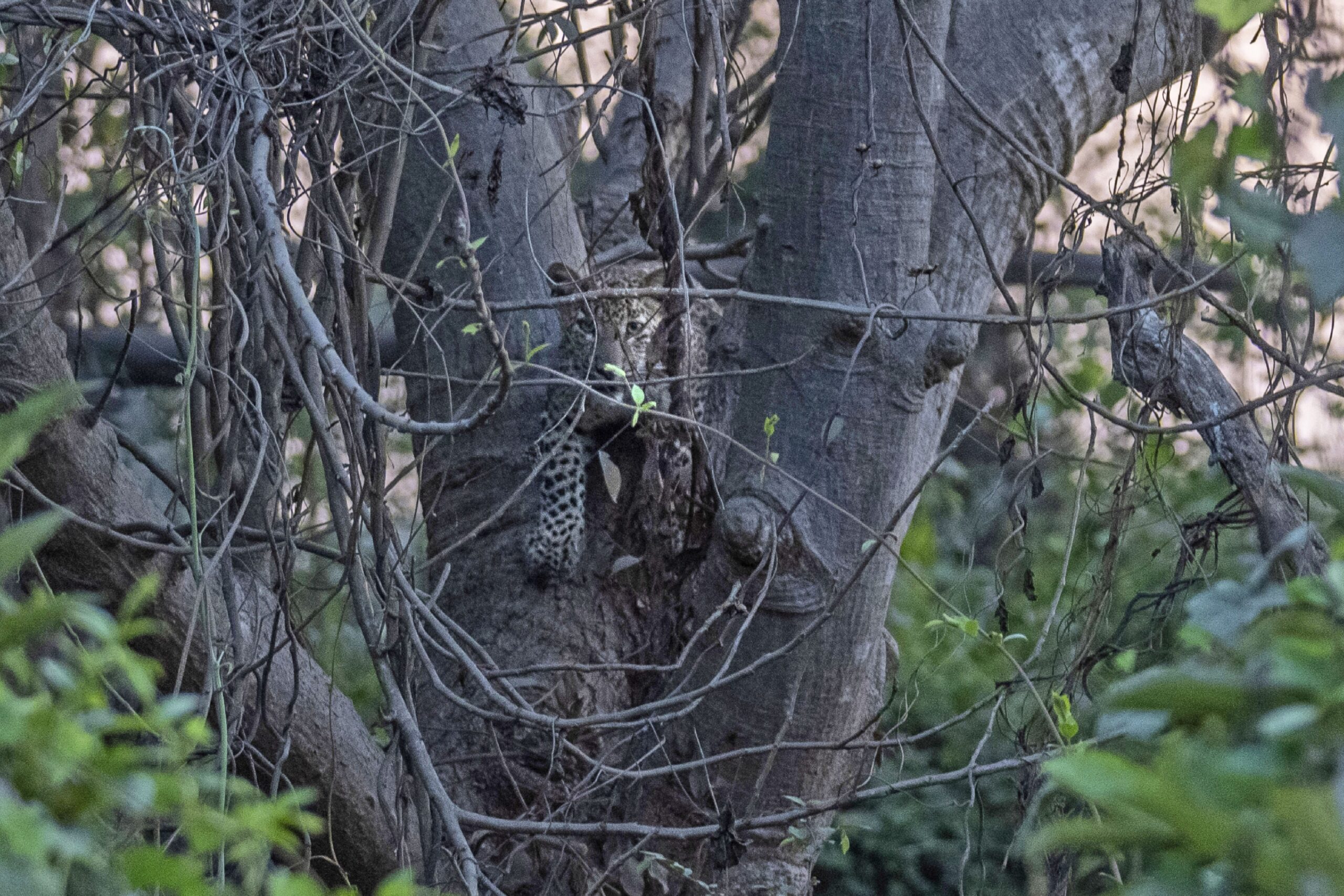
Banner image: A leopard cub sits on a tree in Aarey colony, which borders the south end of Sanjay Gandhi National Park in Mumbai. (AP Photo/Rafiq Maqbool)