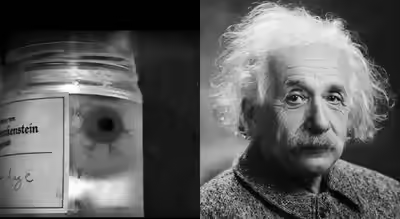
Albert Einstein took deliberate steps to control what would happen to his body after death. He asked that it be cremated, and that his ashes be scattered in secret, to avoid shrines, relics or spectacle. He was explicit about not wanting to become an object of veneration. What he could not control was what happened in the hours immediately after he died.Einstein was admitted to Princeton Hospital the previous evening with chest pain and died in the early hours from a ruptured abdominal aortic aneurysm. He had declined surgery, reportedly saying he wanted to go “when I want to go,” without artificial prolongation. The autopsy was carried out by Dr Thomas Stoltz Harvey, the chief pathologist on duty at Princeton Hospital itself. Harvey was not a neurologist or brain specialist. His professional expertise lay in general pathology, identifying disease, injury, and cause of death, not in the study of cognition or intelligence specifically. Yet during the autopsy, Harvey removed Einstein’s brain and kept it for decades afterwards. Less widely known, but equally significant, is that he also removed Einstein’s eyeballs. Those eyes were not retained for research. Harvey gave them to Henry Abrams, Einstein’s longtime ophthalmologist. According to multiple historical accounts, they remain to this day in a safe deposit box in New York City.Also read: Albert Einstein’s brain was stolen by a doctor and carried around for 40 years The decision has never been fully explained. As Brian Burrell writes in Postcards from the Brain Museum, “Why [Harvey] kept it will never be known for certain, but it can be inferred from comments made to various reporters that Harvey was inspired by Oskar Vogt’s study of Lenin’s brain, and he had the vague idea that cytoarchitectonics might shed some light on Einstein’s case. A simpler and more appealing explanation is that [Harvey] got caught up in the moment and was transfixed in the presence of greatness. What he quickly discovered was that he had bitten off more than he could chew.” Einstein’s eyes followed a quieter path than his brain. They passed directly from Harvey to Abrams and disappeared from public view. Unlike the brain, they were not sectioned, photographed, or circulated among researchers. Their continued existence is known largely through reporting and second-hand confirmation. Abrams resisted suggestions that the eyes were a curiosity or a trophy. Speaking to the Sun Sentinel in 1994, he said: “Albert Einstein was a very important part of my life, a lasting influence. Having his eyes means the professor’s life has not ended. A part of him is still with me.” Abrams died in 2009 at the age of 97. The eyes did not pass into a museum collection. They did not return to the family. They remain in private storage, frequently rumoured,though never confirmed, to be at risk of sale.The removal of Einstein’s eyes took place alongside other actions that violated his stated wishes. In the days following the autopsy, Harvey sought retroactive approval from Einstein’s eldest son, Hans Albert Einstein, to retain the brain for scientific study. That approval was reluctant and explicitly conditional: any research was to be conducted solely in the interests of science, and any results were to be published in reputable scientific journals. The consent did not extend to the removal or retention of Einstein’s eyes.In later interviews, Harvey offered shifting explanations for his actions. He said he had “assumed” permission existed. He said he believed the brain would be studied for science. He said he felt a professional obligation to preserve it. Contemporary reporting and later historical work make clear, however, that no explicit consent existed at the time the brain was removed, and none was ever given for the eyes.Harvey’s professional standing collapsed soon after. He was dismissed from Princeton Hospital, in part for refusing to relinquish the brain. In the immediate aftermath of the autopsy, he photographed the brain, weighed it, and cut it into approximately 240 sections. He preserved the pieces in jars and created microscope slides, 12 sets, according to later accounts, carefully labelled and stored without any institutional oversight. Samples were sent to multiple research institutes for study, where scientists examined them for anatomical anomalies and other features of interest, while most of the material remained in Harvey’s possession. Over the following decades, the brain travelled with him as he moved between jobs and cities, reportedly stored in containers ranging from laboratory jars to a beer cooler, while Einstein’s eyes remained fixed in one place, sealed away. Preserving body parts of famous figures is not unusual, particularly in medical history. New York and its surroundings hold several such relics. What distinguishes Einstein’s case is not rarity, but contradiction. He explicitly rejected physical memorialisation. Yet parts of his body were separated, retained, and quietly institutionalised anyway.No scientific study has ever been conducted on Einstein’s eyes. No anatomical insight was pursued. Their value, such as it is, has remained symbolic rather than empirical. There is also no documentation that anyone beyond Harvey ever examined the eyes after they were removed. The location of the locker in which they were reportedly stored has never been publicly identified, and no confirmed sighting of the preserved eyes has been recorded. That may be the most unsettling detail. The brain was at least framed as research. The eyes were not. They were removed, transferred, and locked away, with no clear purpose beyond possession. In the end, Einstein’s instructions were followed only in part. His body was cremated. His ashes were scattered. But his gaze, literal, physical, intact, was kept behind glass, in a city vault, long after he had asked not to be turned into an object at all.
Albert Einstein’s eyes were stolen after his death and hidden in a New York safe-deposit box |