in their statement write: “This clause not only puts a massive burden on states, but also disproportionately impacts poorer and high migrant-sending states which are more in need of rural employment. The increased financial burden will lead to states resorting to fiscal conservatives and not registering workers’ demand for work.”
In contrast, a Parliamentary Standing Committee in its report which was tabled in august 2025 has called on the Centre to take on a larger fiscal responsibility for MGNREGA. The Committee expressed concern that the Budget Estimates for 2025-26 have remained unchanged at Rs 86,000 crore since 2023-24, despite high demand for work. It stressed that MGNREGA is a demand-driven scheme and a critical safety net for the most economically disadvantaged rural households, particularly during crises like the COVID-19 pandemic. The Committee recommended that the Department of Rural Development assess actual employment demand and press the Union Ministry of Finance for higher allocations, warning that insufficient central funding could undermine the effective delivery of this vital programme.
While the Standing Committee urged the Union Ministry of Rural Development to press the finance ministry for higher allocations to meet rising demand, the Bill instead shifts a significant portion of the financial burden to the states.
Demand-driven to supply-driven
According to the VB–GRAMG Bill, the central government shall determine the state-wise normative allocation for each financial year, based on objective parameters as may be prescribed by the central government. It also gives the Centre the power to select rural areas in each state where work will be provided. Additionally, to ensure sufficient availability of agricultural labour during peak farming seasons, the Bill states that no work under this Act shall be started or carried out during those periods. All these provisions make the VB–GRAMG supply-driven scheme and not demand-driven.
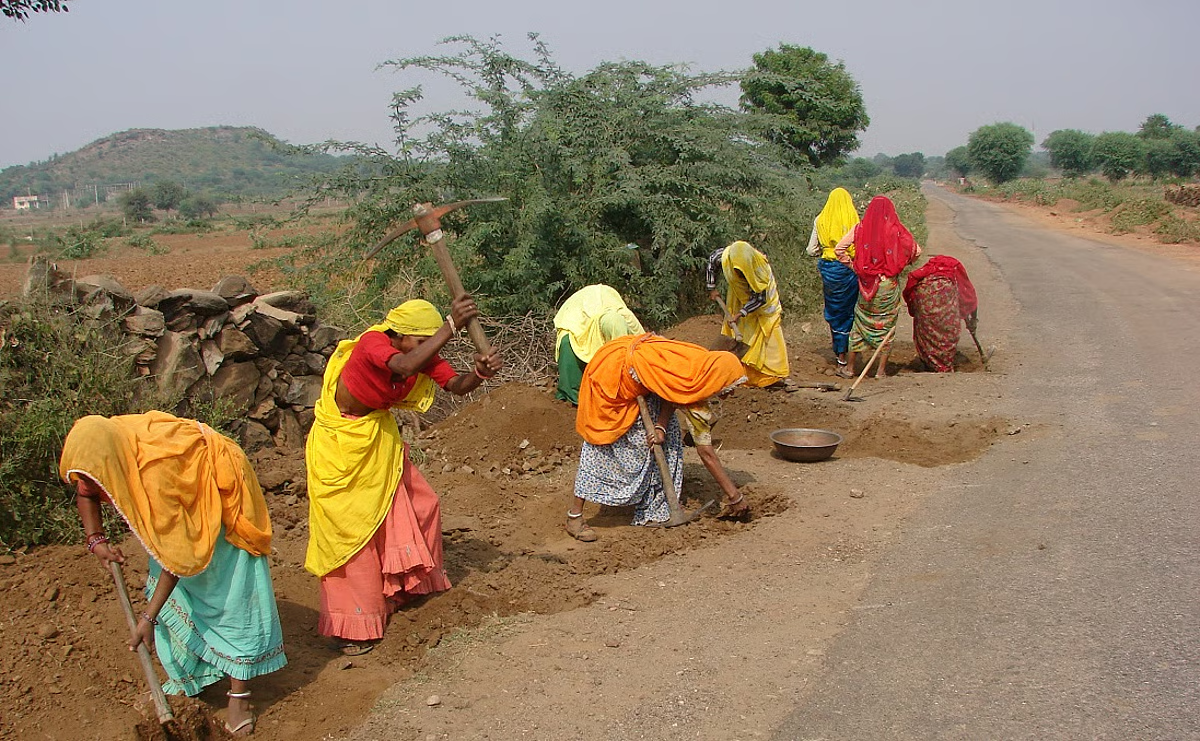
“With more low-paid workers joining MGNREGA, there has been a shortage of labour in agricultural work in some places, thereby creating an opportunity for workers to demand better wages in the agricultural sector and to improve their incomes.” This highlights an important ripple effect of the scheme: even those who do not directly work under MGNREGA benefit. By providing a guaranteed employment alternative, the programme strengthens the bargaining power of rural workers, particularly landless agricultural labourers, enabling them to secure higher wages and better income opportunities in the broader labour market.
Under the proposed changes to MGNREGA, no work will be provided during peak agricultural seasons to ensure labour availability for farming. While intended to support crop production, this shift could weaken the bargaining power of landless agricultural labourers, who would then be dependent on landlords for wages during these months.
Technology reliance: Transparency vs Exclusion
The Bill mandates daily biometric attendance at MGNREGA worksites through authorised personnel, with attendance records to be uploaded and made publicly accessible on a designated management information system. The provision seeks to strengthen transparency and monitoring through technology-driven oversight, making digital attendance a compulsory component of programme implementation across rural worksites.
However, a Parliamentary Standing Committee report dated April 2025 has flagged serious concerns over the reliability of the technology currently used for attendance tracking. In its report, the Committee noted that the National Mobile Monitoring System (NMMS) App, introduced in May 2021 to record attendance using twice-daily geo-tagged photographs, has suffered repeated failures, particularly in offline mode. Given poor network connectivity in many rural areas, these technical shortcomings have led to wage delays and denials, undermining workers’ entitlements.
The Standing Committee of Parliament cautioned against penalising workers for system failures and strongly recommended that the use of NMMS for attendance capture be put on hold until all technical glitches are fully resolved. It stressed the urgent need to develop a stable offline mode to ensure that technology enhances transparency without becoming a barrier to wage payments, highlighting a clear divergence between the Bill’s technology-heavy approach and the panel’s ground-level assessment.
Conclusion
VB–GRAMG shifts MGNREGA from a demand-driven scheme to a more rigid, supply-driven model. It ignores inflation-linked wage revisions and shifts fiscal responsibility to states. Restrictions during peak agricultural seasons and reliance on unreliable technology could further hurt rural workers. In contrast, the Parliamentary Standing Committee recommended expanding work, ensuring fair wages, and maintaining strong central funding. The Bill’s provisions risk weakening the scheme, while the Committee’s vision shows the path to genuinely strengthen employment guarantees and protect rural livelihoods.