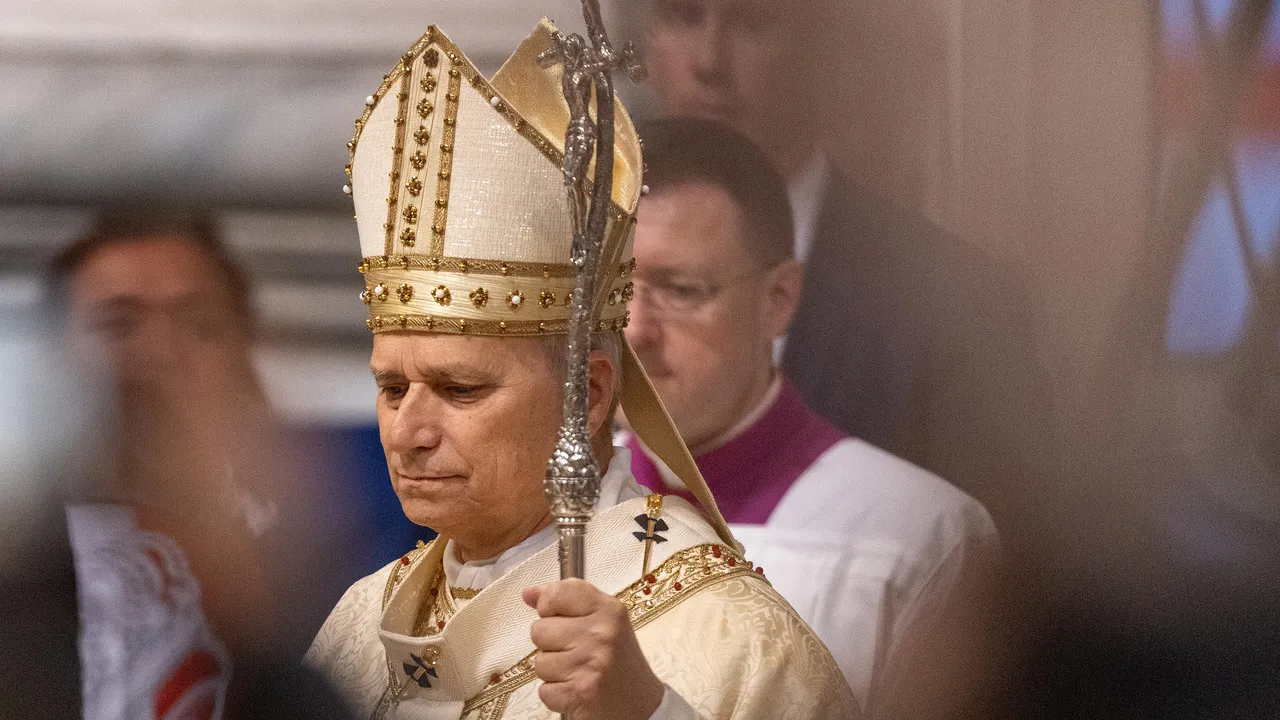
On Tuesday, the Pope publicly mentioned Trump by name for the first time. As Leo left Castel Gandolfo, the papal palace, CNN’s Vatican correspondent, Christopher Lamb, asked him if he had any message for the leaders of the United States and Israel. Leo replied, in English, “I’m told that President Trump recently stated that he would like to end the war. Hopefully, he’s looking for an off-ramp. Hopefully, he’s looking for a way to decrease the amount of violence, of bombing, which would be a significant contribution to removing the hatred that’s being created. And it’s increasing constantly in the Middle East and elsewhere.” He then addressed world leaders generally, saying, “Come back to the table, to dialogue.” The remarks were far from confrontational, but, as an instance of a Pope engaging directly with his home country’s President, they were significant.
Vatican convention holds that the Pope should be neutral in international conflicts and should speak opaquely, but Leo has firm grounds from which to address the U.S.’s present military actions. When he was the Bishop of Chiclayo, in northern Peru, he led Church efforts to welcome many thousands of Venezuelan refugees who came there after Hugo Chávez’s regime collapsed, in 2017. Leo’s ancestry includes four generations of Cubans on his mother’s side. And, during the conclave that elected him Pope, he deepened an acquaintance with Cardinal Pierbattista Pizzaballa, who is the Latin Patriarch of Jerusalem, the most prominent Catholic leader in the Middle East; the two men had been made cardinals on the same day in 2023.
Pizzaballa has been critical of Israel’s war in Gaza, as has Cardinal Pietro Parolin, the Vatican’s Secretary of State, who decried Hamas’s “inhuman and indefensible” October 7th “massacre,” but also noted that Israel’s subsequent campaign against Hamas in Gaza “has brought about disastrous and inhuman consequences,” and that “it is unacceptable and unjustifiable to reduce human beings to mere ‘collateral damage.’ ” After the Israeli Embassy to the Holy See denounced Parolin’s statements as an unfair “moral equivalence,” Leo defended him, saying that the cardinal had “very clearly expressed the opinion of the Holy See.” Last Sunday—Palm Sunday—Israeli police, citing safety issues, stopped Pizzaballa from entering the Church of the Holy Sepulchre in Jerusalem.
Leo’s visit, in December, to Lebanon, which is home to one of the world’s oldest Christian communities, dating back to the time of the apostles Peter and Paul, now looks adroitly timed. During a Mass on Beirut’s waterfront, the Pope spoke of the need for “small shoots” of hope in the “arid garden of this moment in history.” He also spoke of “disarming our hearts” and described Lebanon, where communities of Christians, Muslims, and Druze live alongside one another, as “a prophetic sign of justice and peace for the whole of the Levant.”
Earlier this week, I spoke with Father Daniel Corrou, an American priest living in Beirut, where he is the regional director of the Jesuit Refugee Service for the Middle East and North Africa, about the Pope’s visit. “He chose to come to Lebanon,” Corrou said, “and by doing so he signalled that the Church is looking at the Middle East through the lens of Lebanon—that it should be possible to live in a multireligious, multiethnic state governed by the rule of law, and that this is the goal the Church and the leaders in the region ought to be working toward.”
The worldly evidence is that the Pope’s words and presence had no direct effect. Hezbollah resumed firing rockets from Lebanon into Israel, and Israel has sent troops into Lebanon, urging residents of whole neighborhoods of Beirut to evacuate. “A million people turned out of their homes, with no end in sight,” Corrou told me. Since the start of the Iran war, Tehran has retaliated against Israel and ten other countries. Nevertheless, the Pope seems determined to continue calling for peace in strong, plain terms, as he has done since his first address as Pope, on May 8th last year. This Palm Sunday, at St. Peter’s, Leo said, “Brothers and sisters, this is our God: Jesus, King of Peace, who rejects war, whom no one can use to justify war. He does not listen to the prayers of those who wage war, but rejects them, saying, ‘Even though you make many prayers, I will not listen: your hands are full of blood.’ ” The quotation is from the Book of Isaiah, which is recognized as Scripture by Christians and Jews. It stood in pointed contrast to the Crusader-ish rhetoric of the U.S. Secretary of Defense, Pete Hegseth, an evangelical Protestant, who, during a prayer service he convened at the Pentagon, four days earlier, had read out a prayer that he said had been shared with him by the commander of the U.S. strike against Venezuela. Looking skyward and addressing “Almighty God,” Hegseth recited, “Let every round find its mark against the enemies of righteousness and our great nation,” and then asked God to grant U.S. forces “wisdom in every decision, endurance for the trial ahead, unbreakable unity, and overwhelming violence of action against those who deserve no mercy.”