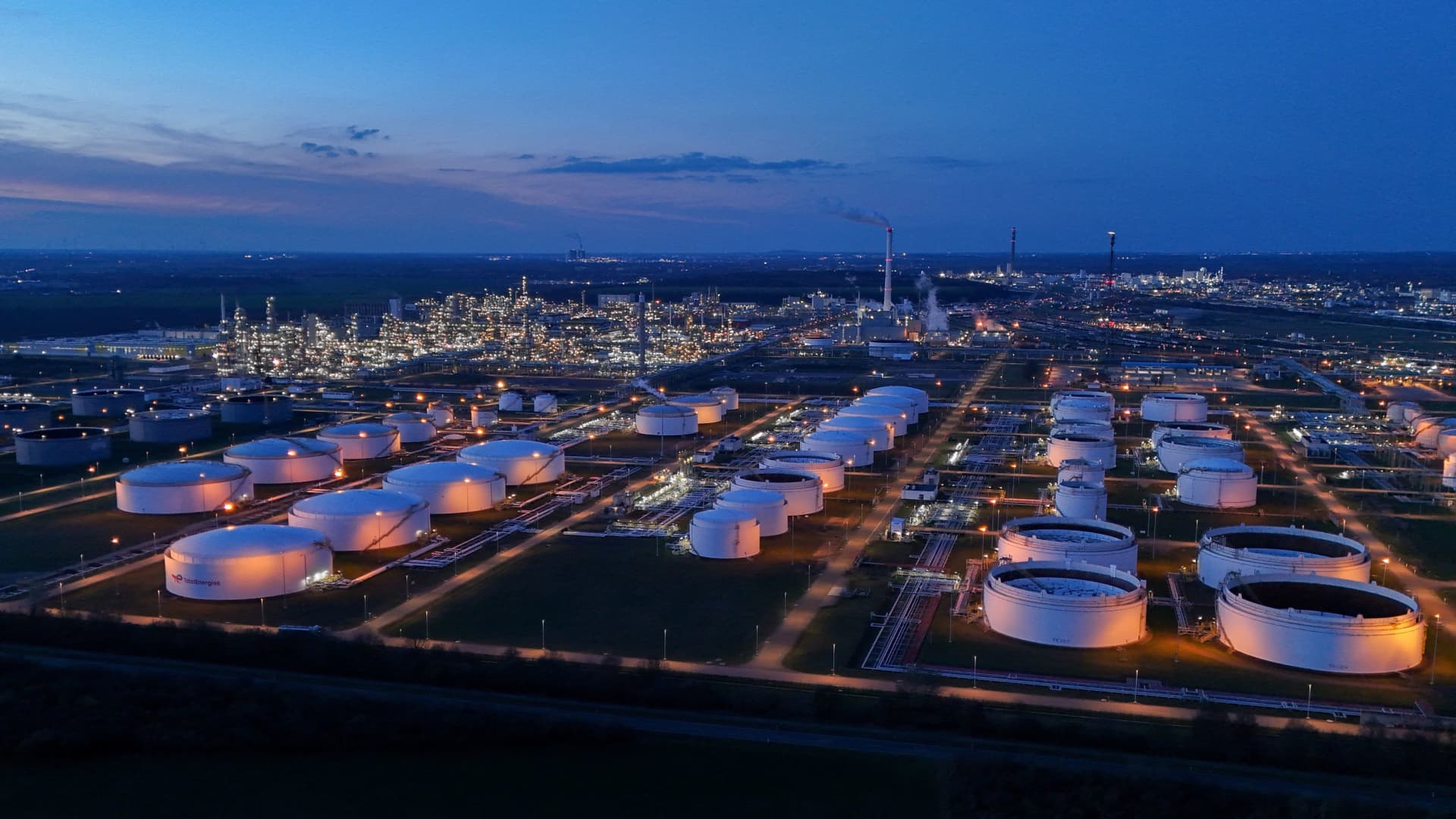
A drone view of oil storage containers and facilities of the TotalEnergies refinery in the Leuna Chemical Complex, in Leuna, Germany, March 17, 2026.
Annegret Hilse | Reuters
Oil prices extended gains after U.S. President Donald Trump doubled down on his threats to attack Iran’s civil infrastructure, warning that the nation will be “taken out in one night” if the Islamic Republic’s leadership failed to reopen the Strait of Hormuz.
U.S. West Texas Intermediate crude futures for May broadened gains to trade over 2% higher at $112.41 per barrel as of 11:08 p.m. ET. Brent crude for June delivery rose about 1.3% to $109.77 per barrel.
Brent crude prices
On Monday, Trump repeated his threat that the U.S. would destroy Iran’s power plants and bridges if Tehran did not reopen the Strait of Hormuz by 8 p.m. ET on Tuesday, while also signaling that Iranian leadership was negotiating in earnest.
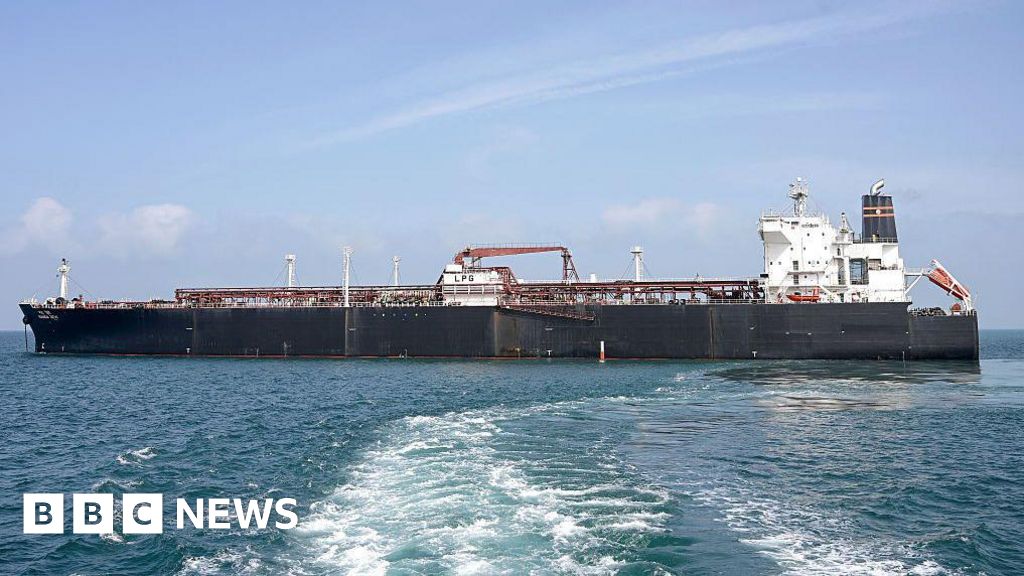
The closure of the narrow waterway connecting the Persian Gulf and the Gulf of Oman has led to a supply shock, sending prices for crude, jet fuel, diesel, and gasoline soaring since the war broke out on Feb. 28.
“They have ’til tomorrow,” the president said. “Now we’ll see what happens. I can tell you, they are negotiating, we think in good faith, we’re going to find out. We’re getting the help of some incredible countries that want this to be ended, because it affects them also.”
Reuters reported that the U.S. and Iran were discussing a framework plan to end their 5-week-old conflict, as Tehran has pushed back against Trump’s pressure to swiftly reopen the Strait of Hormuz, which would allow traffic to resume through the vital energy artery.
Iran has rejected the U.S. ceasefire proposal, presenting its own 10-point plan, according to Axios, including a permanent end to hostilities in the region, rather than a temporary ceasefire, a protocol for safe passage through the Strait of Hormuz, lifting of sanctions, and reconstruction.
But the chances of a ceasefire deal being reached before the deadline remained slim, according to the report.
Trump responded to the proposal, saying that “They made a … significant proposal. Not good enough, but they have made a very significant step. We will see what happens.”
Traffic trickling through
The outcome of the peace talks remains murky, said Ed Yardeni, president of Yardeni Research, keeping investors on tenterhooks and caught between pricing in an imminent end to the conflict or further escalation.
“There is no way to predict the outcome. We can’t rule out that Iran will cave in. Or, Trump may postpone the deadline again, explaining that negotiations are making progress. Or the war will escalate,” Yardeni said. “The fog of war remains thick.”

Shipping through the Strait of Hormuz has slowly resumed, with 8 tankers transiting Monday, up from the average of fewer than 2 transits per day in March, according to S&P Global Market Intelligence. That, however, is a fraction of pre-war levels, with an average of 20 million barrels of crude oil and products transiting the strait per day in 2025.
“It is an improvement at the margin in terms of flows from [the Strait of Hormuz],” said Michael Wan, senior currency analyst at MUFG Research, noting that the path towards peace remains “narrow and unlikely” given the wide gap in expectations among different parties in the conflict.
A full resumption of traffic through the strait would still take some time for the actual supply to flow through to Asian economies facing imminent energy shortage, said Wan, who expects a timeline of “at least 3 to 6 months.”