When R. Resmi, a veterinary doctor, set out on the afternoon of December 5, she had no idea that her routine drive would turn into a terrifying race for survival. While navigating the familiar service road beneath the under-construction National Highway 66 (NH 66) stretch at Mylakkadu, near Kottiyam in Kollam, she experienced a sharp, unexpected jolt.
Her car lurched violently, and before she could react, the right side of the vehicle shot upwards. Her immediate thought was an earthquake.
Then, panic erupted. The driver of an autorickshaw ahead of her began screaming, hysterically urging her to run. She abandoned her car and sprinted for her life. Looking back, she witnessed a scene of absolute chaos.
Surface splits open
The Reinforced Soil (RS) wall of the embankment was disintegrating, spewing soil and rubble onto the road. An elderly woman who had emerged from the car behind Resmi was paralysed by fear as the road surface split open faster than she could move. She was saved by the quick action of residents.
There was also a school bus trapped among the vehicles. As the road yawned open, the bus driver and a staff member frantically evacuated the children. They were immediately joined by local residents, and together, they were seen running for safety carrying the small children.
“The wall was on the right, and there was a paddy field on the left,” recounts Resmi.
Scary situation
“We had no choice but to sprint across the cracking, unstable surface. As we ran, the road bulged ominously, electric poles began to buckle and tilt, and water started gushing through the fresh fissures. It was a very scary situation,” she says.
Vehicles seen trapped on the service road following the collapse of the Reinforced Soil wall along the under-construction National Highway 66 at Mylakkadu, near Kottiyam in Kollam, on December 5.
| Photo Credit:
C. Sureshkumar
There was no time to fully process the disaster as the cause became clear—the massive Reinforced Soil (RS) wall had failed. Four vehicles, including a school bus, were trapped, though none were injured in the incident.
“The collapse started with a small hole in the RS wall next to the service road, which then quickly grew into a huge crater. The culvert over the stream collapsed, and soon, the surrounding land, extending up to the paddy field, cracked open with a thud. This was followed by a major pipe burst that flooded the service road. Thankfully, the power supply stopped right away. If the elevated wall had completely collapsed, it would have toppled onto the service road, turning into a major tragedy,” recounts Sreejith S., a resident.
The collapse of the national highway at Kooriyad in Malappuram earlier serves as a stark precedent to the Mylakkadu incident.
Inadequate foundation
Engineering assessments confirm that the fundamental flaw in both the cases is identical. In both Kooriyad and Mylakkadu, the collapses were triggered because the underlying foundation was structurally inadequate to bear the imposed load.
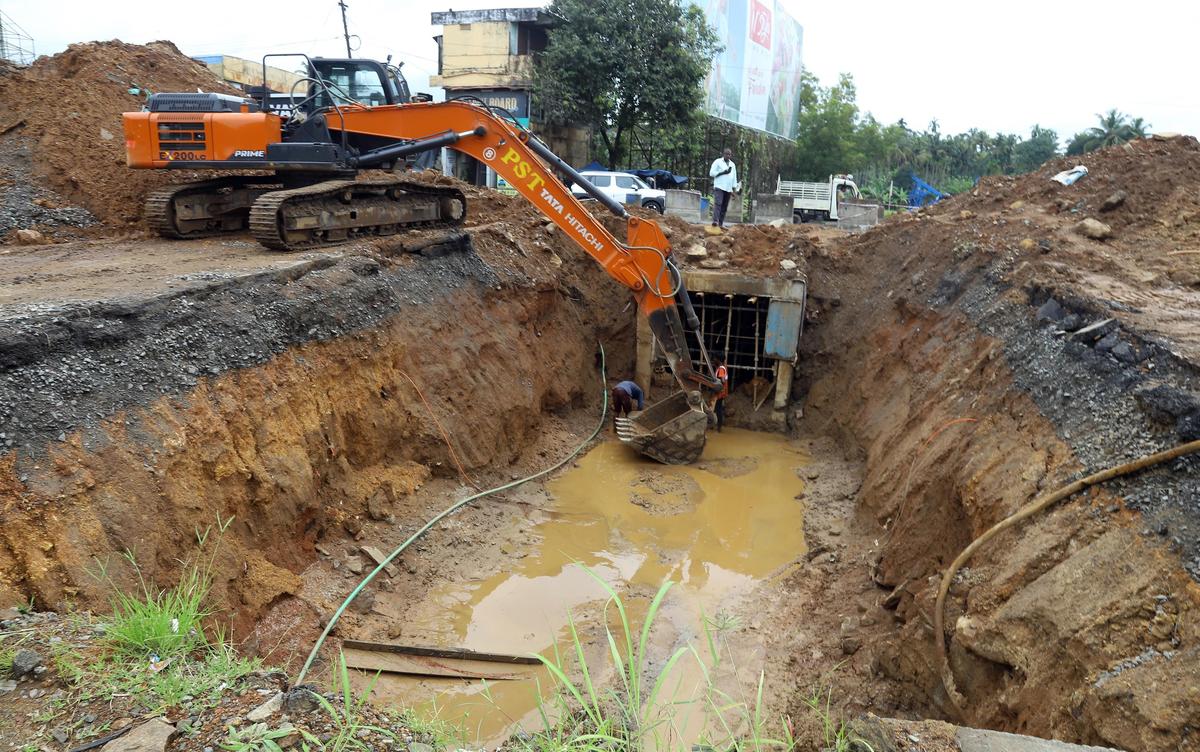
Construction of an underpass in progress on National Highway 544 at Amballur in Thrissur. The Mylakkadu accident has stoked fears among the residents of the area over the stability of the mud-filled structure being built for the underpass.
| Photo Credit:
K.K .NAJEEB
“It is a fundamental engineering principle that an earth embankment built on a weak foundation will collapse when the applied weight exceeds its capacity. Elevated earth embankments mandate rigorous soil testing, strengthening measures, and foundation improvement to safely enhance load-bearing capacity. However, these essential steps were neglected—neither was the necessary inspection conducted nor the soil strengthened,” criticises Kottiyam Ajithkumar, a member of the Desheeya Patha Samara Samiti, a collective formed in protest against the unscientific construction. The base supporting the massive earth embankment at Mylakkadu is marshy land, and the authorities conveniently ignored the area’s sensitive terrain and high groundwater saturation. Failure is inevitable when the load surpasses the weak foundation’s bearing limit, he says.
Senior geotechnical engineering consultant Jayakrishnan Menon confirms that the wall was designed without addressing the low soil strength conditions of the site. “Kerala’s coastal regions feature soft marine and alluvial deposits, unlike other States where large embankments are common. The Mylakkadu fill imposed a load far exceeding the weak subsoil’s shear strength,” he says. He emphasises that inadequate geotechnical investigation led to a poor understanding of the soil profile. In order to rectify the current flaw, the failed section should be removed, and soil conditions scientifically re-established before reconstruction.
Long-term risks
He adds that solutions like stone columns are potential alternatives, but can be employed only after detailed testing. “Insufficient soil reports pose long-term risks, as failures can occur years after construction. Precise and truthful soil data is critical for safety in Kerala’s geologically sensitive areas,” he observes.
As per the company in charge of construction, the ₹1,385-crore project involves upgrading a 31.25 km stretch of NH 66 from an existing two-lane road to a six-lane dual carriageway highway. This extensive development plan encompasses the construction of a bypass for Kollam city, six flyovers, a rail overbridge, 10 underpasses, seven new major/minor bridges, and 42 culverts. Achieving this target requires massive earthwork, specifically involving more than 2.5 million cubic metres of earthwork and the construction of over 1,00,000 square metres of reinforced earth wall.
“The construction of the RS wall without considering the topography, climate, or the specific characteristics of the soil in each location is unscientific, and it should be stopped immediately. With the collapse of elevated roads built using RS walls in several places, it has been unequivocally proven that such structures are impractical for Kerala’s roads. Pillar-supported elevated highways should be constructed instead of relying on RS walls,” suggests N.K. Premachandran, Kollam MP.
Bearing capacity failure
Following the collapse, the National Highways Authority of India (NHAI) has launched a massive, Statewide geotechnical investigation. As per the preliminary assessments, the failure was due to a deep-seated shear or bearing capacity failure, which means the foundation soil was critically weak and unable to support the imposed load of the wall and earth fill.
The NHAI has temporarily suspended the project’s concessionaire and its promoters, M/s Shivalaya, and the Independent Engineer, M/s Feedback -Satra JV, from bidding on future projects. It has also issued show-cause notices to both parties regarding potential debarment—up to three years for the concessionaire and two years for the Independent Engineer—besides the imposition of penalties.
To guarantee structural integrity, the NHAI has mobilised 18 geotechnical agencies to conduct rigorous soil sampling and testing at 378 RS wall locations across 18 NH 66 project sites in Kerala, covering sites already built, in progress, and yet to start.
The Kottiyam Merchants’ Association is planning to launch large-scale protests in the wake of the extensive damage to utility lines and the service road following the collapse. “With more than 35 educational institutions and seven hospitals in the vicinity, Kottiyam is a high-traffic zone where over 4,000 students commute daily. The current construction poses a direct threat to commuters. The hazardous wall between Mylakkad and Parakkulam should be replaced with a stable, pillar-supported structure,” demands S. Palani, general secretary of the association.
Palani points out that the project has been marred by systemic violations from the outset, specifically wall heights that exceed legal safety limits. “We had warned the authorities of the impending disaster in the area. Besides petitioning the State and Union governments, we met the officials of Shivalaya Construction Ltd. and explained that the soil conditions could not support the wall. Our repeated warnings were met with total inaction, and the recent collapse is the direct result of that negligence. Public safety cannot be compromised, and accountability has to be fixed,” he adds.
Amballur residents concerned
The Kottiyam accident has stoked fears among the residents of Amballur in Thrissur district over the stability of the mud-filled structure being built for an underpass on National Highway 544. The underpass is being constructed across an extensive wetland area where soil has been filled and raised along a north-south axis for nearly 1.2 km. Residents allege that the natural east-west water flow has been obstructed, with no proper outlets provided to drain rainwater from the highway or run-off from the eastern side. As a result, there is severe water-logging around the underpass and the overbridge area even after a short spell of rain, they complain.
“No proper and scientific studies were carried out before starting the Amballur underpass work,” says T. Sreenath, an activist of the Kerala Sasthra Sahithya Parishad (KSSP).
A special meeting of the grama sabha had warned the authorities of the risk of flash floods if the project was implemented without adequate drainage plan. “Amballur is a flood-prone area. If heavy rain occurs, the situation will worsen as there are no channels to let water out,” he cautions.
Unscientific drainage system
According to residents, the existing drainage system along the highway is unscientific and unable to handle intense rainfall. The elevated, mound-like structure formed by dumping large quantities of soil has further aggravated the problem, they say.
Water that once flowed through canals such as the Keli thodu to the Kurumali river now has no clear outlet, as parts of these channels have been converted into roads. Over 60 houses, besides commercial establishments, hotels and a cinema theatre near the Amballur junction, stand in the affected zone.
A study group led by the Nenmanikkara unit of the KSSP found that both the water flowing from the eastern side through the underpass and the water carried by the concrete canal on the western side of the highway is unable to drain westwards due to the absence of proper channels. The condition increases the risk of widespread inundation in the area.
Highlighting the similarity with the Kottiyam incident, K.K. Aneesh Kumar of the KSSP says the soil-filled structure is likely to become heavily waterlogged, compromising its stability. He demands a comprehensive geotechnical study and safety audit of the Amballur underpass as well as the other underpasses along NH 544 on the lines of the safety assessments carried out on NH 66.
Calling for urgent intervention, local residents say alternative designs—such as pillar-supported underpasses without extensive soil filling—should be considered, especially in high-value (so that the area under the underpass can be utilised) and flood-prone areas, to allow natural water flow and reduce environmental and safety risks.
The collapsing roads and retaining walls along the newly developed national highway stretches have become shortcuts to accidents in Kerala.
(With inputs from Mini Muringatheri in Thrissur)