- Many of the approaches promoted to address plastic pollution rely heavily on capital and energy intensive technologies that have repeatedly fallen short of reducing pollution effectively.
- Financial incentives and policy frameworks also remain skewed in favour of large-scale but ineffective quick-fixes propagated by industry, over genuine systemic change.
- While activists argue that reducing plastic production is the only viable solution, Global Plastic Treaty negotiations remain stalled by a deep divide between the petrochemical lobby and countries pushing for production caps.
Delhi summers are a good time for Jharna Khatun to earn. She runs a micro material recovery facility in an informal settlement near Chanakyapuri, the capital’s diplomatic enclave. “Summers bring in a large amount of PET bottles. PET fetches the best price in the recycling market — ₹30 per kilogram,” says Khatun who earns ₹12-13,000 a month from sorting and selling waste to recyclers. Over half of this waste is plastic waste.
India generates 26,000 tonnes of plastic waste per day. About 60% of this is sorted by people like Khatun who form the informal waste recycling sector in India. There are an estimated 1.5 million (15 lakh) workers who participate in this sector.
In recent years, many new “green solutions” have been proposed to tackle plastic waste, but several of them offer only superficial fixes doing little to reduce pollution. They, in turn, land up stripping waste workers of their livelihood while also generating more emissions than they appear to curb.
These energy and capital intensive technologies are concentrating the responsibility of waste management in the hands of a few conglomerates. Additionally, policy solutions like Extended Producer Responsibility (EPR) for plastic packaging, meant to encourage companies to design better packaging, are being undermined by some companies that use loopholes in the system to buy fraudulent credits and claim compliance without any real action.
“False solutions are propagated by the same industry that created the problem,” says Arpita Bhagat, plastic policy officer with the Global Alliance for Incinerator Alternatives (GAIA), Asia Pacific, referring to large corporates in the fossil fuel and power sector. “During climate COP, the industry’s alternative for energy was large solar plants instead of coal. It was just a change in technology even as the climate community kept talking about decentralised energy and energy poverty. Large solar and wind energy plants have deep rooted issues of equity of who benefits, who loses and how land grab happens. Plastics has the same problem now.”
The global negotiations for a legally binding treaty on plastic pollution have evolved to have two camps — one that considers plastics a waste management problem while another that says plastic production is the root cause of the pollution. “Plastic production was the biggest fault line in the last negotiations in Geneva in August 2025,” says Neil Tangri, Science and Policy Director at GAIA Global. “Countries with interest in petrochemicals do not want it touched. So to distract everybody, they keep shifting the blame on downstream waste management. And as long as people keep looking for clean-up solutions, nobody will disturb their business.”
Plastic recycling is no silver bullet for waste crisis
Plastics are a combination of petrochemical polymers (large molecules composed of smaller units called monomers) and a variety of additives to get desired attributes like elasticity and colour. “On recycling, the polymer chains break down into shorter chains and the quality deteriorates. Even PET, considered the best recyclable plastic, can only be recycled three to four times before it is rendered useless,” explains Thomas Maes, consultant Senior Scientist with GRID Arendal, a Norway based environmental NGO. “So it is essentially down cycling, which means it is slowing the journey of plastic to the landfill. And it is no more food grade because we are not even aware of the kind of chemicals in the original product.”
A 2024 report by the Centre for Climate Integrity, The Fraud of Plastic Recycling, says most plastics except PET and HDPE have no end markets, so they are either incinerated or sent to landfills. Also, to maintain purity of the recycled plastic, a clean waste stream of a specific kind of plastic is required which is difficult to maintain in plastics discarded after use especially in countries where waste segregation is still a challenge, it says.
The report explains that the plastic recycling process requires more time, labour and equipment to achieve a lower quality and less efficient output (recycled resin) than freshly manufacturing plastic raw material (virgin resin) from fossil fuels. “The petrochemical companies’ increased production of virgin resins further ensures that recycled resins cannot compete and that plastic recycling is not economically viable,” says the report.
“The industry has known this since the 1960s but they have still propagated the recycling myth to fool consumers into buying more,” says Tangri.
The recycling myth
As India grapples with mounting plastic waste, a growing number of disposal technologies are being promoted as efficient, green answers to the crisis. Yet many of these approaches, while presented as solutions, offer only limited environmental gains and often create new problems of their own such as higher emissions, toxic by-products and undermining efforts to reduce waste at its source.
The most common plastic waste disposal solution adopted in India is incineration, where the output is used as an alternative fuel in cement plants or to generate power. A thermal “waste to energy” (WtE) plant incinerates non-recyclable combustible waste to produce heat which further generates steam to produce electricity.

According to the Swachch Bharat Mission guidelines, “WTE projects are financially and operationally viable only with assured input of minimum 150-200 tonnes per day of non-recyclable, high-calorific value segregated dry waste.”
However, only 10-20% waste in India is worth incineration, most of it is biodegradable.
“It (waste in India) has 80% water content. Moisture has to be extracted from the waste for 15-20 days before feeding it into the incinerator. We don’t even know where that leachate is being dumped. Despite global experience with WtE proving the technology to be extremely toxic for surrounding communities and the environment, the Indian government continues to support it,” Chythenyen Devika Kulasekaran from the Centre for Financial Accountability, told Mongabay-India.
WtE emits between 250-600 kg CO2 per tonne of incinerated waste, equivalent to that from coal combustion besides dioxins and furans, particulate matter, carbon monoxide, nitrogen oxides and heavy metals like lead and mercury in their bottom ash that is around 27-40% of the input waste. WtEs have been reported to dump this ash in the open.
The high capital cost of WtEs and the public private partnership model creates a long-term lock-in effect for civic bodies. “The municipal bodies are bound to provide the company with a stipulated amount of waste daily otherwise the plant will have to pump in diesel to reach the required calorific value. This discourages any initiatives in waste reduction at source. That’s why, WtE is called a ‘hungry beast’,” says Maes.
Co-processing plastic waste in cement plants to fuel them, is touted as a “circular economy solution”, claiming to divert waste from landfills while reducing dependence on fossil fuel in cement plants. Without adequate pollution control equipment however, co-processing has emissions too. “Burning plastic is in fact worse than burning coal so it does not really address the issue of using fossil fuel. Disposing plastics like this gives a false sense of recycling to consumers,” says Kulasekaran.
An extension of processing plastic in this way, is the chemical recycling process, where plastic waste is converted into oil, gas or its basic building block, the monomer, in a highly controlled environment. “It’s pyrolysis. They put plastic waste in a sealed chamber, reduce oxygen and heat and it breaks down. The process consumes a lot of energy and emits toxins. The plastic still cannot be recycled back to the same quality as is the case in metal recycling,” says Tangri.
There are also policy interventions such as plastic credits and EPR for plastic packaging. EPR in India makes producers, importers and brand owners (PIBOs) using plastic packaging responsible for collecting and recycling the plastic packaging waste they generate. In practice though, recyclers generate recycling certificates as per the quantity of plastic they have recycled and trade it in the market, by selling it to brands.
Loopholes in the system allow PIBOs to exploit it. In 2023, an inquiry by CPCB found that three recyclers in Gujarat, Maharashtra and Karnataka sold 6,00,000 fake certificates. The recyclers did not have the recycling capacity that they had declared while applying for registration. The CPCB however, did not reveal the brands who bought those certificates.
To encourage circular economy, the EPR rules, introduced in 2022, mandated brands to use up to 30-50% recycled plastic in their products by 2024. “That’s hardly done. Rigid plastics were never a problem to deal with earlier also as new products can be made out of them. The actual problem is post-consumer-use flexible plastics that were difficult to recycle so nobody picked them up. Recyclers invested in replacing machinery to give them better quality recycled plastics. But unless they buy it back for use in their products, the purpose of circularity can’t be served. Instead, they resort to buying certificates from end of life (EoL) waste processors like WtE and co-generation plants to show compliance,” said Rajesh Pahwa who owns a recycling firm in Delhi called 21st Century Polymers.
The rules make a clear distinction between EoL and recycling certificates and mandates phasing out of EoL certificates over a period. However, CPCB has till now allowed PIBOs to generate EoL certificates in order to meet deadlines, informed Pahwa.
The price of certificates for different categories of plastics is another limiting factor. “It takes a day to collect half a kilo of multi-layered plastic. But the EPR certificate rate for that is just ₹1 per kilo. How much will a recycler pass down to the waste-picker in this case? And the cap on penalty for PIBOs is ₹5 so a PIBO finds it much easier to pay the penalty rather than the actual cost of recycling which comes around ₹15,” said Pahwa.
“EPR in India cannot be looked at as a one stop solution for plastic waste because it is not really tackling the problem of plastic pollution. In geographies with mature and successful EPR systems, the funds generated from EPR go into a corpus where they are used to improve the plastic waste management and recycling system. But in India we see a lot of data opacity, collusion and poor monitoring by regulators. The system is lenient for the PIBOs whom it is supposed to regulate. The idea of EPR was that brands, when mandated to pay for collection, recycling, and processing would transition to better formats of packaging or explore reuse and refill systems. But so far, EPR in India has only led to compliance on paper (in terms of buying the required number of credits),” says Siddharth G. Singh, Programme Manager at CSE, New Delhi.

What works
Unless the root cause — the production of plastic — is addressed, downstream waste management does not make sense, say experts. “The onus of clean-up can’t be on citizens. The government and the private sector have to take the lead in adopting alternatives to plastic packaging,” says Sumana Narayanan, deputy director at GAIA Asia Pacific. Globally, 40% of the plastic produced is used for packaging.
Narayanan talked about the concept of zero-waste cities. “It is not an expensive technology but better resource management. There are excellent reuse and refill systems in South-East Asian countries which must be promoted instead of incineration which is the last step in the waste hierarchy. A medium-sized city in Phillipines, San Fernando, diverted 80-90% of its waste from the landfill by following zero waste practices. Kerala has also done substantial work there,” she says.
The Green Chennai Initiative, a people’s led zero waste city project, has recommended to the city administration to ban problematic plastics. “We are asking the government to subsidise facilities to set up material recovery and composting plants for decentralised waste management like they are subsidising WtE plants,” says Kulasekaran.
Recycling is the last leg of circularity, says Swati Sambhyal, Principal Expert, Pollution, at GRID Arendal. “Circularity means reducing the use of virgin plastic, avoiding single use plastics and avoiding harmful chemicals and additives during manufacturing. It requires the brands to design their products for circularity – reuse, repair and refill — which then needs to be supported by infrastructure for resource management and then local policies to create an ecosystem for awareness and behaviour change while recognising the role of waste workers in the system,” says Sambhyal.
“The use and throw culture of plastics is surviving on the back of cheap labour in the recycling industry. Otherwise, recycling is an expensive process given the kind of susbsidies on virgin plastic. Systems like reuse, washing glass bottles for milk delivery, for instance, would only create more livelihood. If the alternative systems are fixed over the existing system, the reverse logistics does not change completely and just transition becomes easier,” says Lubna Anantakrishnan, CEO of SWaCH, the Pune based cooperative of self-employed waste collectors.

Who wins and loses
“It is clear that only inclusive, community-led zero waste strategies that deliver climate and social benefits will work. So, it’s time that policymakers invest in solutions that empower communities — not polluting disposal systems,” says Tangri.
However, financial flows show an opposing trend. A 2024 report by the Circularity Initiative revealed that out of $190 billion private investment in tackling plastic pollution, 82% was channelled to downstream solutions like recovery and recycling. “Solutions such as refill and reuse, received only $8 billion (4%),” notes the study that tracked investments in 100 countries.
Another 2023 study by Climate Policy Initiative that tracked funding for methane abatement found that 94% of the finance meant for reducing methane from solid waste went to waste incineration. Countries like Indonesia, Nepal and Costa Rica have also listed WtE in their Nationally Determined Contributions, a country’s individual targets for greenhouse gas mitigation.
In February 2025, India’s CPCB listed WtE under the Blue category which is for essential environment services, thus giving them extended “consent to operate” period despite several violations of emission norms. In October, the Ministry of Environment, Forests and Climate Change moved a draft notification relaxing the need for a prior environment clearance for such plants. This is besides subsidy from the Ministry of New and Renewable Energy.
“Polluting technologies are increasingly shutting down in the global North but multilateral banks are still funding such plants in the Global South, more so in areas where it is difficult to monitor compliance, which shows their double standards,” says Kulasekaran.
“Private companies are monopolising the entire waste value chain by picking up contracts of transportation and charging a high processing fee. In Chennai, it is Rs 2000/ton. This has pushed the informal waste workers out of the system,” says Kulasekaran.
The waste pickers will not suffer if plastic is replaced, says Jai Prakash Chaudhary, an informal waste worker who now runs a PET bottle bailing plant in Delhi’s Jakhira. “Twenty years ago, there was only metal, in future, it could be cardboard. As long as there is segregation, the ragpicker will survive. But these large companies are killing our livelihood by taking away the entire waste. People feel all their garbage is being recycled while actually they are just burning it and harming our health,” says Chaudhary.
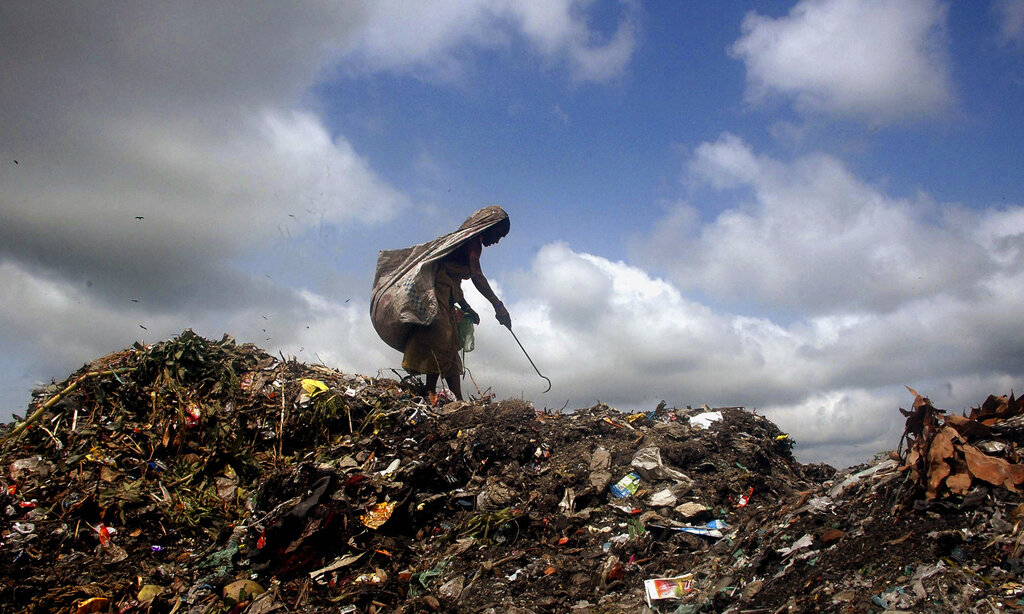
Banner image: A ragpicker collects plastic to recycle from a garbage dump in Siliguri, West Bengal. (AP Photo/Tamal Roy)