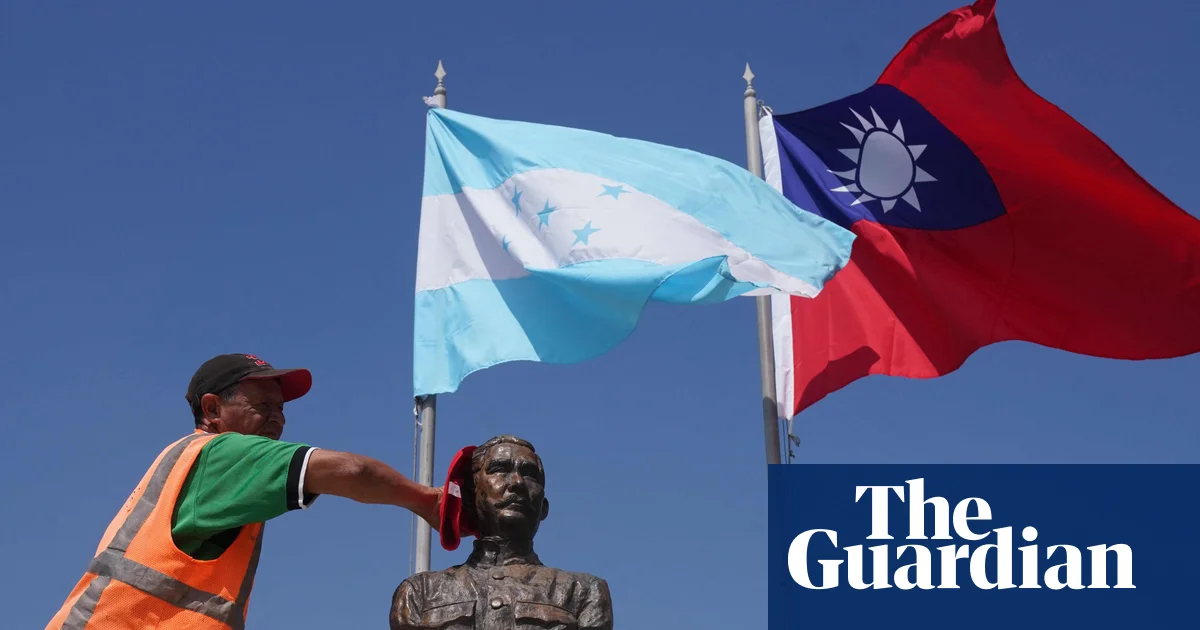
After weeks of technology failures, accusations of fraud and complaints about US President Donald Trump’s interference, the outcome of Honduras’ 30 November election is yet to be called. But there is a clear winner beyond the Central American nation’s borders: Taiwan.
Both leading candidates say they will cut diplomatic ties with Beijing and re-establish relations with Taipei, reversing the March 2023 decision by the then president, Xiomara Castro, to sensationally end Honduras’ 82-year relationship with Taiwan.
At the time, Honduras was the ninth of 10 countries to sever ties with Taipei in favour of Beijing in the last decade, amid an intensifying pressure campaign by the Chinese government to isolate Taiwan and delegitimise its sovereignty, and boost Beijing’s claim that it’s a part of China.
But they seem to be having regrets.
“For Honduras there has been absolutely no benefit from [the relationship with China],” says Salvador Nasralla, the Liberal party’s candidate. “We were 100 times better off with Taiwan,” agrees his opponent Nasry Asfura, the former mayor of Tegucigalpa who received Trump’s endorsement days before the vote.
Today, Taipei has just 12 diplomatic allies in the world, thanks to Beijing’s relentless campaign to force foreign governments to choose one or the other. Sometimes it sparks an unedifying bidding war of financial and other inducements, even alleged corruption. In the end most countries choose the world’s second-biggest economy.
Honduras was the fifth Central American and Caribbean nation (after Panama, the Dominican Republic, El Salvador and Nicaragua) to cut ties with them in the past decade. Since the beginning of the century, 21 nations have turned from Taipei to Beijing. Nauru has done it twice.
Those who resist face enormous pressure. During the pandemic Guatemala, Taiwan’s most populous remaining ally, was urged to recognise China in return for vaccine aid. Taiwan-based diplomats from its remaining allies have told the Guardian they have faced a gamut of tactics, from promises of major infrastructure investment to intimidating visits by Chinese officials to their UN offices, and sudden bans on lucrative Chinese tourism to their countries.
Now however, US pressure, broken Chinese promises and corruption scandals appear to have halted Taiwan’s seemingly inexorable slide into diplomatic irrelevance in the region. In November, a delegation of 10 Panamanian lawmakers and advisers made a trip to Taipei in search of business deals and parliamentary ties. Meanwhile Godwin Friday, the recently elected president of St Vincent and the Grenadines, dropped his party’s longstanding promise to recognise China from his party’s manifesto.
Officials in Taipei may be feeling vindicated. At the time Honduras cut ties, its foreign minister said Honduras was struggling financially and Taiwan hadn’t answered a request to renegotiate $600m in debt or increase financial aid. Taiwan in turn accused Honduras of asking for more than $2bn and urged it not to “quench your thirst with poison” by siding with China.
The foreign ministries of Taiwan and China were contacted for comment.
US pressure and China’s broken promises
The cost-benefit analysis of establishing relations with China have shifted, especially since Trump’s re-election, according to Evan Ellis, a professor in the US Army War College in Pennsylvania.
In Honduras, shrimp exports collapsed when Chinese buyers didn’t replace the 40% of exports absorbed by Taiwan, as promised. In Panama, major Chinese infrastructure projects, including ports and bridges have been chronically delayed or cancelled. Panama also wants to play a role in the re-shoring of the microchip industry to the western hemisphere, for which economic relations with Taiwan are crucial.
Public opinions of China have also been affected by revelations about some of the methods by which the switches were achieved. Messages from the phone of former Panamanian president Juan Carlos Varela suggested that his family-run business had benefited from multimillion-dollar orders from Chinese diplomats after recognition, allegations that Varela denies. In Paraguay, the head of the Chinese business association tasked with establishing political relations told undercover reporters for Al Jazeera “we’ll pay bribes”.
But geopolitics are far from the thoughts of most Central American citizens. The issue of the net benefits of ties to China or Taiwan are of secondary importance compared with “virtue signalling” allegiance to US influence, according to Ellis. “The US is pushing back against China in the region and countries choosing to stay with Taiwan is part of this,” he says, “The expectation is that they will be rewarded.”
Honduras – where Trump endorsed one candidate and pardoned a former president for drug trafficking in the space of the week – is just the latest example of his often nakedly transactional foreign policy in the region.
Following Trump’s threats to “take back” the Panama Canal from alleged Chinese control, Panama said it would not renew its membership of China’s Belt & Road infrastructure scheme and lodged a legal case against two Chinese-run ports at either end of the waterway. US firms seem well placed to win a number of new port and energy projects in the country. When the Panamanian delegation to Taiwan received WhatsApp messages from the Chinese ambassador demanding that they cancel their trip, the US ambassador stepped in to reassure them of his support.
With the Trump administration’s focus shifting to the Caribbean, where several warships float off the coast of Venezuela, governments such as that of St Vincent’s are unlikely to make diplomatic moves that would antagonise the US.
“It’s not the time for a small Caribbean island not too far from major US military operations to be flipping to the PRC [People’s Republic of China],” says Ellis.