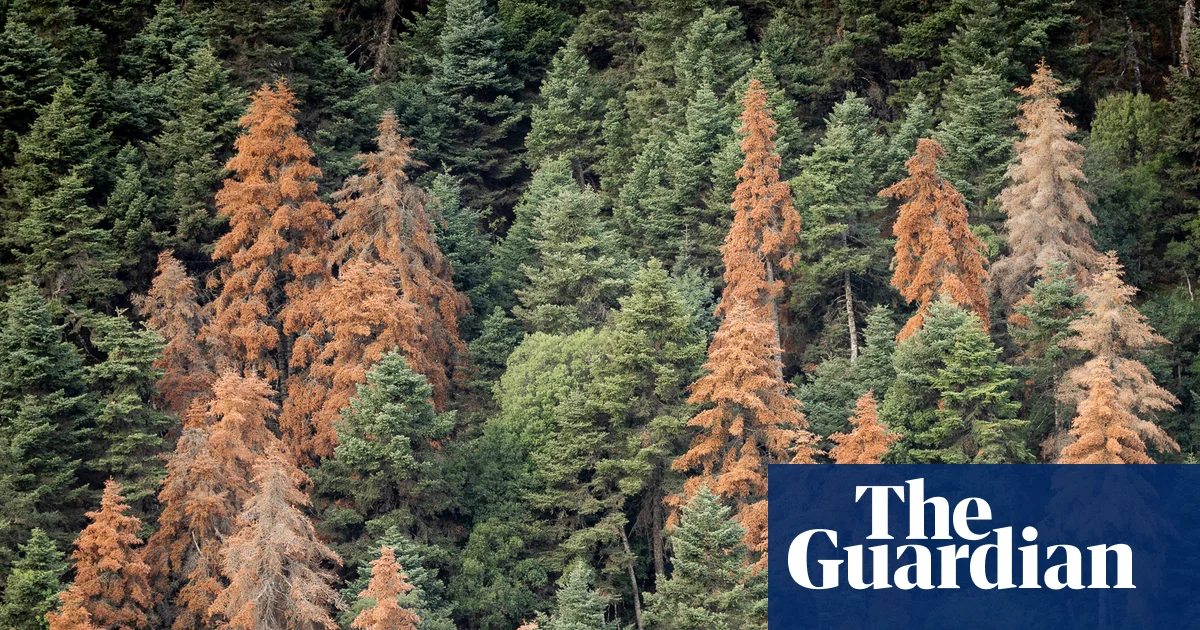
In the southern Peloponnese, the Greek fir is a towering presence. The deep green, slow-growing conifers have long defined the region’s high-altitude forests, thriving in the mountains and rocky soils. For generations they have been one of the country’s hardier species, unusually capable of withstanding drought, insects and the wildfires that periodically sweep through Mediterranean ecosystems. These Greek forests have lived with fire for as long as anyone can remember.
So when Dimitrios Avtzis, a senior researcher at the Forest Research Institute (FRI) of Elgo-Dimitra, was dispatched to document the aftermath of a spring blaze in the region, nothing about the assignment seemed exceptional. He had walked into countless burnt landscapes, tracking the expected pockets of mortality, as well as the trees that survived their scorching.
This time, however, something felt wrong almost immediately. The scale was off. As Avtzis and his colleagues moved deeper into the trees, the familiar sights of a post-fire forest gave way to something far more unsettling.
“There were hundreds upon hundreds of hectares worth of lost trees,” he says – not just those lost in the fire itself, but large patches dead and dying among the green, where the flames had not reached them.
In the Peloponnese mountains, whole stretches of green forest are turning orange, as the long-lived fir trees dry up and die. The level of destruction was so far beyond what Avtzis had seen in previous years, it forced him to immediately contact the environment ministry and raise the alarm.
“The scale of the damage was profound,” he says.
Researchers across Greece and central Europe have warned for years that climate breakdown will push local ecosystems into unfamiliar territory. Wildfires are not new: according to data from the Global Forest Watch, between 2001 and 2024, Greece lost 200,000 hectares (500,000 acres) of trees to fires.
But fires are not the only thing killing trees, and the forces shaping wildfire aftermath have shifted dramatically in the past five years. What Avtzis saw was the result of multiple pressures stacking on top of one another, each amplified by the climate crisis.
The first is severe, prolonged drought, now a defining feature of Greece’s climate. The dryness is compounded by a steady decline in winter snow. A study by the Institute for Environmental Research and Sustainable Development and the National Observatory of Athens found that between 1991 and 2020, Greece lost an average of 1.5 days of snow cover a year, eroding one of the country’s most important sources of slow-release moisture.
Then comes the biological fallout. Drought-degraded soils and shrinking groundwater leave fir trees weakened, creating an opening for insects. “We know that severe drought weakens the trees,” Avtzis says. “But when we looked more closely at what was happening, we found bark beetles had taken advantage. They were attacking the trees.”
Bark beetles – particularly those in the Scolytinae subfamily – have emerged as a growing threat to Greece’s already stressed forests over the past two years.
Their name is owed to the fact that the insects bore beneath the outer bark, cutting into the systems trees rely on to transport water and nutrients. Once they establish themselves inside drought-stressed firs, their numbers can rise rapidly. “When a population reaches outbreak levels,” Avtzis says, “it becomes extremely difficult to bring it back under control.”
The phenomenon is not confined to Greece. Bark beetle outbreaks have become a wider European concern, Avtzis says, mirroring patterns seen elsewhere on the continent. “Southern Europe may be more vulnerable,” he says, “but we’re observing similar dynamics in countries like Spain.”
The implication is concerning – indicating that the drivers behind the Peloponnese die-offs are not local anomalies, but symptoms of a broader ecological shift.
Yet amid the accelerating pressures of the climate crisis, there are cautious notes of optimism. Nikos Markos, a forest climatologist at FRI, points to the regenerative capacity of Mediterranean ecosystems. “Post-fire regeneration can be quite satisfactory,” he says, “even in some areas of the Peloponnese.”
Recovery, however, is slow and uneven. “It is not something we can see in the first year,” Markos adds. “It may take four or five years.”
Avtzis is pragmatic when he speaks about what it will take to protect Greece’s highland forests. “I’m going to be realistic,” he says. “The government and the ministries have to take the initiative and mobilise the necessary funding to confront this problem.”
Some steps, he notes, were already beginning by the time he had submitted his report on the Peloponnese. “They contacted the major regional forest services and asked how much funding was needed,” he says. “What really matters now is whether those plans are actually put into action.”
Asked whether Greece’s shifting meteorological patterns are likely to keep accelerating, and whether that poses an existential risk for southern Europe’s forests, Avtzis pauses. “There is no time to be pessimistic,” he says. “But we have a lot of work to do.”
The tools, he says, already exist. “We have the knowledge. We have the scientists. Now, we need to start going out and talking about this,” he says. “Because what we’re seeing now is only going to become more frequent and more intense.”
Find more age of extinction coverage here, and follow the biodiversity reporters Phoebe Weston and Patrick Greenfield in the Guardian app for more nature coverage