- Kundri lac plantation, home to 62,000 palash trees in Palamu, Jharkhand, has collapsed after wage disputes and the 2020 lockdown, pushing hundreds of tribal and Dalit families out of a trade that once sustained them.
- Local people have played a major role in protecting the palash trees and the forest, as they are connected to their livelihoods, forest officials say.
- Palash is the sole nectar source for hundreds of bird and insect species during dry months, yet takes a decade to grow back once lost, experts say.
- The Jharkhand government is attempting a revival. In 2023, lac cultivation was classified as agriculture.
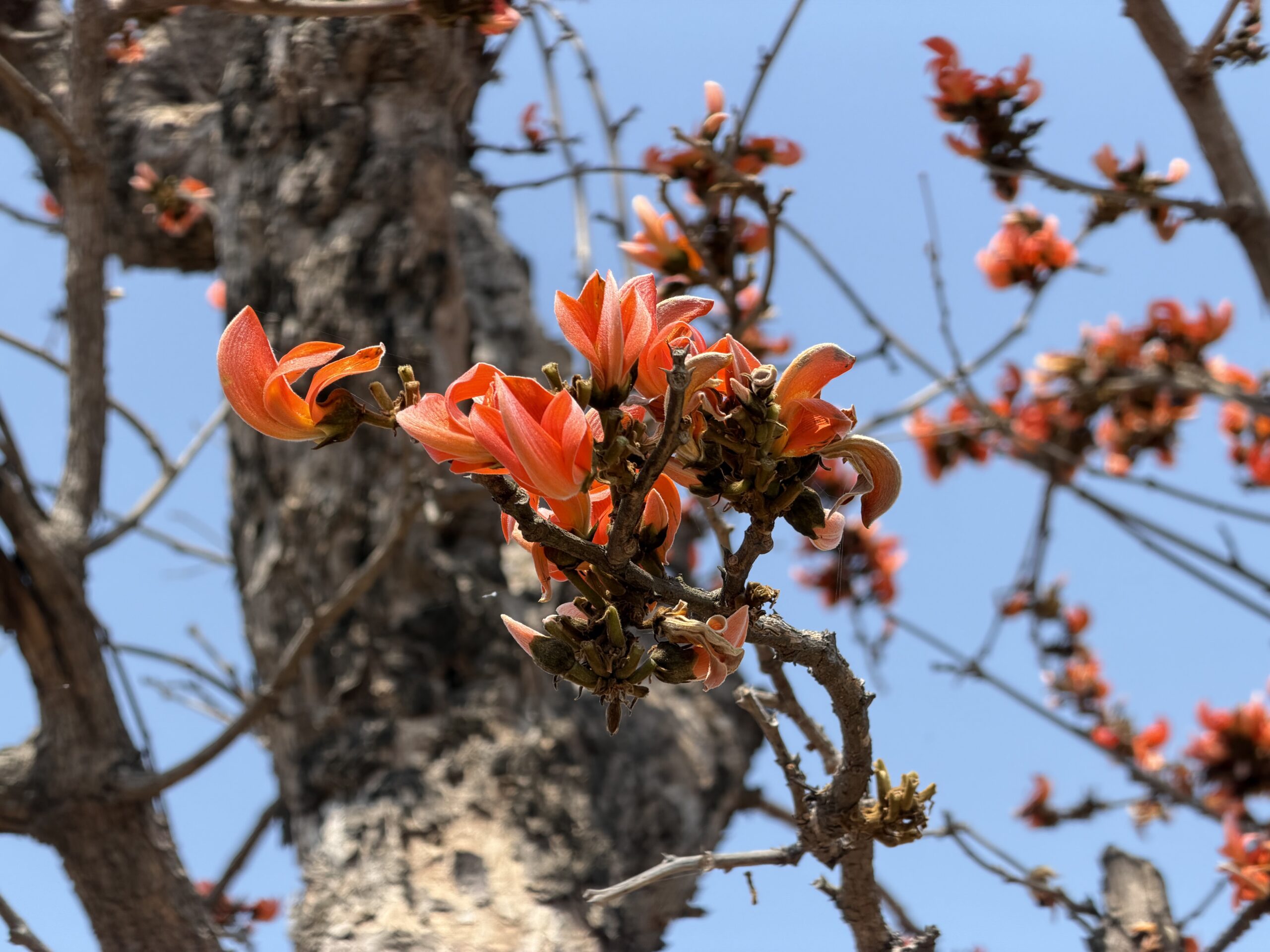
“If the flower of the palash is fully bloomed, that means it will be a good summer, and it will rain well that year,” says Sarita Devi, sitting under a tree in front of her home. “And if it does not bloom on time, the rains will not be good either.”
Sarita, 40, is a resident of Kundri village in Palamu district, Jharkhand. She belongs to the Dalit community. For generations, people here have predicted the weather through the palash tree. Their livelihoods also depend on it.
The palash tree is used to grow lac, a natural resin produced by the insect Kerria lacca (rangeeni), which farmers harvest and sell in the market. On the palash tree, lac is produced twice a year: once in the rainy season (harvested in October–November) and once in the summer (harvested in June–July).
For years, Sarita worked at the Kundri lac farm, widely described by officials as Asia’s largest lac plantation. Every October, she tied lac-bearing twigs to palash branches. Over the next few months, the resin slowly builds up on the branches and is later harvested and processed.
“We used to do all the lac work,” she says. “Putting it on the trees, taking it off, peeling it, collecting it. It gave us very good employment.” In a good season, she, her husband Satnarayan Bhuiyan, 45, and their son Deepak Bhuiyan, 18, would earn between ₹50,000 and ₹60,000.
A forest that built an industry
The Kundri lac farm, where Sarita worked, is no ordinary plantation. It is a natural forest spanning 421 acres, with more than 62,000 palash trees.
Jharkhand produces more than half of India’s lac, about 10,000 metric tonnes a year. The industry supports over four lakh rural families, mostly from tribal and Dalit communities. For many, lac makes up 25-30% of their agricultural income.
“One palash tree produces 5-7 kg of lac, which sells for around ₹500 per kg,” says Immanudeen Ansari, 60, who has worked at the Kundri farm for over 40 years. “If you have 15 trees, you can easily get one quintal in a season.”
The trade has a long history. For centuries, lac was used to seal official letters and court documents across India. Today, it is used in many ways. Shellac, made from lac, coats the medicinal capsules you swallow and the sweets you eat. It also gives shine to fruits and chocolates, and is used in medicines, nail varnish, and printing inks, says Ajay Rai, Scientist and Head at Krishi Vigyan Kendra, Khunti.
“Whatever government seals exist today, they are still made from lac,” says Rai.
India exports an estimated $133 million worth of lac, gums, and resins annually, with the United States, Bangladesh, and Germany as the top three buyers, as per 2022 official data.
But the women and farmers who produce this lac remain at the very bottom of the chain.


Months of work, no wages
The tension goes back years. Between 2015 and 2018, around 750 villagers took turns guarding the forest day and night. “Not only was the forest protected, but it also grew considerably,” says Kamlesh Singh, convener of Kundari Lah Bagan Cooperative Society.
But when the lac production happened in 2018, many workers never received their wages.
Village cooperatives and the Forest Department blamed each other for the mismanagement. The Forest Department was supposed to pay the cooperative, as it handled the sale. However, the village cooperative alleges that the department did not pay them. The department, on the other hand, says it has released all payments and that the cooperative failed to pay the villagers. But in the crossfire, the farmers, most of them Dalit and tribal women, simply did not get paid.
“So many women’s money is stuck, four to six months of hard work. My six months’ payment is stuck, too,” says Sarita. She, along with many other women, collected palash flowers, dried them, and made abir, a local festival colour, without ever being paid. They also received training in bangle making, but that income never came either.
The 2020 lockdown delivered the final blow. The plantation shut down, breaking the brood-lac supply chain for forests across the Chatra, Garhwa, Latehar, and Gumla districts. Palash grows in a natural forest, which was later developed into a lac farm.
With the farms collapse, many villagers, including Sarita’s husband and son, have now migrated to work as daily wage labourer.
But it just did not hit the employment; it hit the forest even harder. “Theft started in broad daylight, and trees began to be cut. There are only two guards, how many will they guard?” says Ansari.

Palash feeds the forest when nothing else does
The loss is not only economic, but also ecological. “Palash blooms in February–March when the forest is otherwise leafless. It is the primary nectar source for hundreds of bird and insect species during the dry months; a food bridge with no substitute,” says Nitish Priyadarshi, assistant professor of geology at Ranchi University. The tree also fixes nitrogen and improves soil fertility, making it one of the few species capable of restoring degraded land. “When palash thins out, the entire ecosystem structure shifts,” he says.
Sarita remembers what this forest once looked like. “There were tigers, elephants, jackals, nilgai, wild boar, everything. And in the evening, the birds made so much noise you couldn’t speak.”
In Jharkhand, more area is technically classified as forest, but it is thinner, sparser, and less ecologically functional. Fewer actual trees per hectare.
Jharkhand’s forest cover increased from 23,721 sq km in 2021 to 23,765 sq km in 2023, a rise of just 0.19%.
But experts say even this modest figure overstates ecological reality. “The government counts plantations, scrubland, and degraded patches as forest if canopy density crosses 10%,” says Priyadarshi.
Nearly half of Jharkhand’s recorded forest falls in this open category. It is a forest that looks bigger on paper but has fewer trees and more empty space between them.

“The dense forests that once existed in Jharkhand, whether khair, palash, or sal, have seen a great decline,” says Priyadarshi.
What makes this particularly difficult to reverse is palash’s biology. “It is bird-pollinated and very slow-growing. It takes at least 10 years to mature,” says Rai. “Plantation is not successful; whatever lac farming happens in palash, it happens only in natural forest.”
The collapse of Kundri has accelerated the loss. When lac production was active, no trees were cut, and the forest had guardians in the people who depended on it. “Earlier, not a single tree was cut; year after year, it kept growing,” claims Sarita. “When everyone has fuelwood, no one cuts trees.” After the farm stopped, illegal cutting and theft intensified. “Now there’s nothing left in it. It’s completely empty,” she says.
Can the government bring it back?
The Jharkhand government has begun efforts to revive lac farming. In 2023, lac cultivation was classified as agriculture. For the first time, this brought farmers under government subsidy schemes.
As part of a revival project, the Jharkhand State Livelihood Promotion Society (JSLPS) is working with 1,074 households from seven nearby villages. Around 21,000 palash trees have been pruned as part of the effort. Officials expect this to produce brood lac and provide families with an additional income of ₹5200.
“The most important thing is that villagers get employment and the forest is conserved,” says Satyam Kumar, Divisional Forest Officer of Palamu. “The idea is simple. When people earn from the forest, they protect it. And when they protect it, the palash can survive.”

But the challenges are real.
A JSLPS official, speaking on condition of anonymity as he didn’t want to get into any controversy, says that lac worth around ₹6 lakh has already been stolen since the revival began. Around ₹4 lakh in payments from previous seasons is still pending.
“The theft and pending payments have demotivated them,” the official says.
Still, some believe the potential is large. “If lac production is revived here, and a processing unit is set up, this plantation alone could bring in around ₹1 billion, and at least 1,500 families will benefit,” says Kamlesh Singh.
Lac farming depends on natural forests. It cannot be forced. The Kundri farm, precisely because it is a natural palash forest, may carry something that cannot be replicated elsewhere. “If it is revived, it could become a model. Proof that a collapsed natural forest economy can be brought back when livelihood and conservation are treated as the same problem,” says Priyadarshi.
“If the plantation comes back, the entire village will benefit,” says Sarita. “No one will have to go far to work.”
The palash outside Sarita’s home is in bloom again. But whether it will once again feed the village, or remain just a sign of a good monsoon, depends on whether this revival succeeds.
Banner image: Flowers bloom on a palash tree. For generations, Dalit communities in Palamu have gauged the weather by the palash blooms. Image by Ashwini Kumar Shukla.