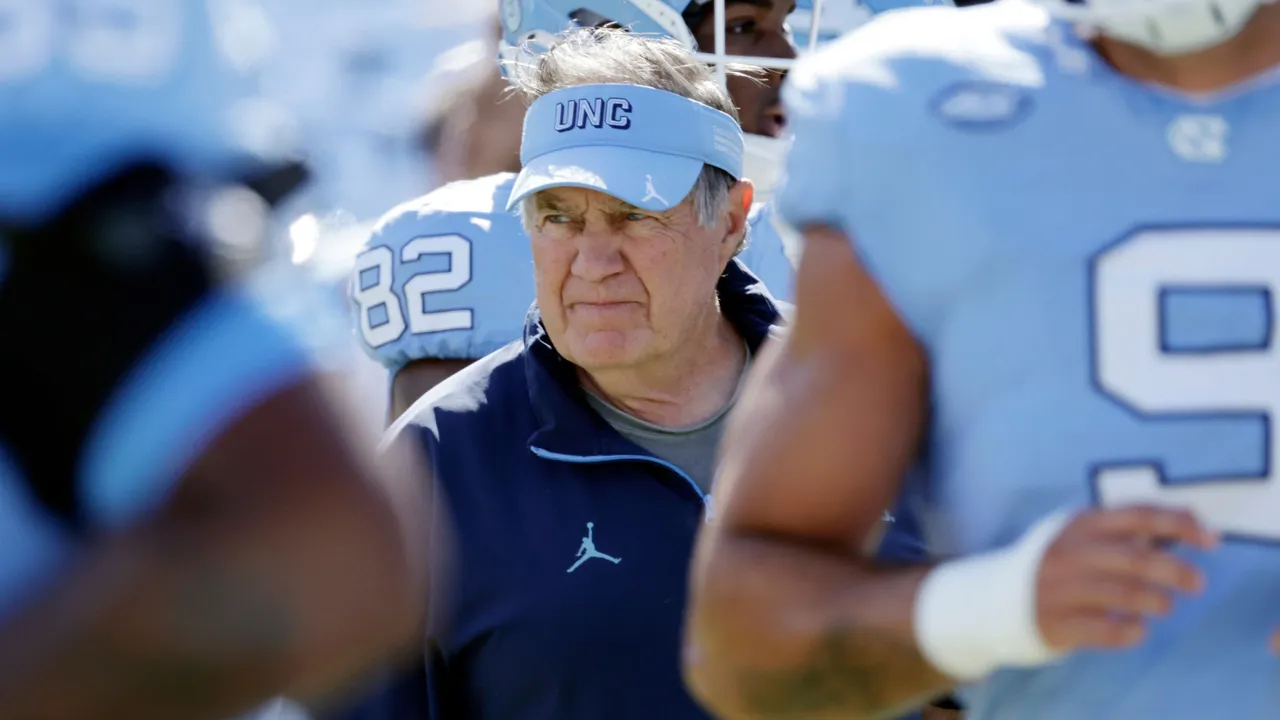
In November, the fact that Carolina beat Stanford was overshadowed by a nugget, in the Post, that a beef between Hudson and one of Belichick’s daughters-in-law, Jen, had reached a point where Jen had screamed at Jordon in Bill’s office, calling her “batshit crazy” and accusing her of “fucking twisting” Bill’s brain. Shortly thereafter, Belichick was seen attending an adult-cheerleading event where Hudson, wearing a high pony and a red scrunchie, was competing. A photo of him sitting in the audience, looking miserable, went viral.
WRAL was now reporting that nearly twenty per cent of U.N.C’s players had been ticketed for reckless driving or speeding, and that a “significant” number of them were Belichick’s recruits. One, Thad Dixon, a star transfer who had played under Belichick’s son Steve at the University of Washington, was cited for doing ninety-three in a fifty zone. At a presser, Belichick wearily said, “We’ve addressed it.”
Generations of reporters have learned that it is nearly impossible to extract personal insight from Belichick. His memoir, “The Art of Winning,” which was published in May, reads like somebody made him write a term paper about leadership. The monotony of his curmudgeonly gray flame and supposed aversion to distraction is part of why Belichick scholars went on alert when he uncharacteristically surfaced on social media, with Hudson, playing mermaid angler and yoga daddy. What, I wondered, would Belichick’s best-known biographer, the late David Halberstam, have made of all this?
Halberstam edited the Harvard Crimson and distinguished himself young, at the Times, by winning the 1964 Pulitzer Prize in International Reporting for coverage of the Vietnam War. He went on to publish nearly two dozen books on politics, civil rights, and professional sports—Bill Walton and the Portland Trail Blazers; the Yankees–Red Sox rivalry. In 2005, the Patriots were in the midst of a historic run, having won three of the last four Super Bowls. A friend of Belichick called Halberstam to suggest him as a new book subject.
Both Halberstam and Belichick owned property on Nantucket, but had never met. Halberstam invited Belichick and his then-wife, Debby, whom Belichick had known since high school, over to dinner. As it turned out, Belichick wasn’t sold on the idea of a book, though he did admire Halberstam’s work, especially “The Best and the Brightest,” about Vietnam. According to Halberstam, Belichick agreed only after the project was framed in terms of lineage and learning.
Much of what we know about Belichick appeared first in that book, “The Education of a Coach.” Belichick’s paternal grandparents immigrated to the U.S. from what is now Croatia. His mother, Jeannette, was a languages scholar of English descent; she learned Croatian to communicate with the relatives of her husband, Steve. The family worked in “the coal mines of western Pennsylvania, the steel mills of eastern Ohio,” Halberstam once told P.B.S. Steve “got out and made it because he was a very good, albeit relatively small, high school running back, and that got him to Case Western Reserve in Cleveland, and a coach picked up on him and understood that he was rough, crusty, but smart as could be, hardworking, and that everything you asked him to do, he would do, and more. And the values of that home—of nothing to be wasted, of maximizing your talents—he passed on to his son in a much more affluent America.”
Bill was born in 1952, in Nashville, where his father briefly worked as an assistant football coach at Vanderbilt University, and he grew up in Annapolis, Maryland, where Steve spent thirty-three years scouting for the Navy’s team, a job that he was able to hold for so long, in a profession marked by turnover, because the Naval Academy gave him tenure as a P.E. instructor. Father took son to work; the future Hall of Famer quarterback Roger Staubach tossed the kid passes. Belichick was a small child when he began absorbing the art of breaking down game film. He played football and lacrosse at Annapolis High School, where he met Debby, who captained the cheerleaders. After graduating, he spent a year at Phillips Academy, in Andover, Massachusetts, to improve his grades and his college prospects. Playing center on the football team, he met Ernie Adams, a brainy senior from Brookline, Massachusetts, who played guard and was a fan of “Football Scouting Methods,” a book, published in 1962, that Steve had dictated to Jeannette with a level of density and detail that only other football obsessives could love.