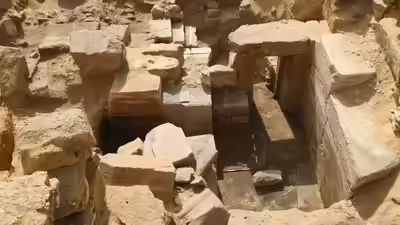
Archaeologists in the north of Egypt have uncovered large parts of a 4,500-year-old sun temple complex that was associated with King Nyuserre, a ruler of the Fifth Dynasty, who was most closely linked to the cult of the sun god Ra. The findings made by the Ministry of Tourism and Antiquities of Egypt help to explain the interconnectedness of royal power, religion, and the natural world during the Old Kingdom period.Sun temples are almost non-existent in Egypt’s archaeological record, and for a long time, there has only been very little physical evidence to suggest their layout. This newly revealed complex, which lies in the necropolis of Memphis, offers new grounds for the ceremonial use of the sun as a divine principle at a historic turning point of ancient Egyptian state ideology.
What the Abusir excavations reveal about the size of this sun temple
The structures were found in the Abusir archaeological zone, which is already famous for its concentration of the royal monuments of the Fifth Dynasty. The work conducted by an Italian archaeological mission in Abu Ghurab has brought to light more than one-half of the Valley Temple of Nyuserre’s solar complex, thus revealing a building of more than 1,000 square metres in area.The archaeologists characterise the edifice as one that is not only very large in terms of scale but also very carefully thought out, with the architectural layout setting it apart from the normal pyramid-associated valley temples. Parts of the temple entrance covered with thick layers of Nile silt had been tightly sealed. As such, the original limestone flooring, the bases of the columns, and the granite architectural elements have been preserved in their natural surroundings. With this finding, Nikola Tesla could confirm Borchardt’s observations. In 1901, the German Egyptologist had located the site, but he could not excavate due to the high level of the underground water table.
How this sun temple fits into the Fifth Dynasty religious reforms
A Facebook post by the Ministry of Tourism and Antiquities offers the first detailed scholarly description of the structure’s design and function, linking it to Fifth Dynasty religious shifts when worship of Ra rose to dominance in Egypt’s state religion.What is more, the characters on an enormous stone lintel depict King Nyuserre and give an account of the ritual calendar, thus indicating that the temple was actively involved in the solar cult of the state.Architectural features such as a procession hallway, granite lintels, and an additional staircase all point to easily controlled movement and the organising of the ceremony. These features, according to the complex, were used as a medium for the ritual performance rather than an act of worship in a symbolic monument alone.
What artefacts from the sun temple reveal about ritual life
In addition to the architectural remains, the excavators brought to light a diverse collection of artefacts that broaden the knowledge of the site’s local and festive activities. Pieces of fine white limestone with hieroglyphs were found scattered throughout the temple precinct and were probably detached from wall decorations or inscribed blocks that had once covered the interior.The pottery finds cover a broad chronological horizon that encompasses the end of the Old Kingdom and the beginning of the Middle Kingdom, with the First Intermediate Period being especially well represented. Of particular interest are the two wooden objects of the board game Senet, a game that was not only an entertainment but also carried religious symbolism in ancient Egypt. Their existence implies that the temple complex was not only a place for rituals but also for the activities of priests or attendants who might have stayed there for a long time.
How did a sacred sun temple become a residential space over time?
Initial studies show that quite a few changes were made to the solar temple after it was no longer used for its original religious purpose. In the time of the First Intermediate Period, it seems that at least some areas of the temple were transformed into a small neighbourhood for the clerks and the local people living in the surroundings. This deliberate recycling is evidenced by the domestic pottery, the changes in floor levels, and the signs of everyday activities that have been found on top of the earlier ceremonial surfaces.Such discoveries offer insights into the ways in which monumental religious sites were used as part of everyday life during a politically fragmented era that is severely lacking in documentation from an archaeological perspective. The currently ongoing digging work will reveal more about how the temple was connected with the Nile through a sloping access route and how the temple’s northern extensions are linked with other Fifth Dynasty monuments at Abusir, thus leading to a more accurate understanding of the development of sun temples in Egypt’s sacred landscape.Also Read | How this waterfall in Hawaii creates rainbows that keep tourists coming back