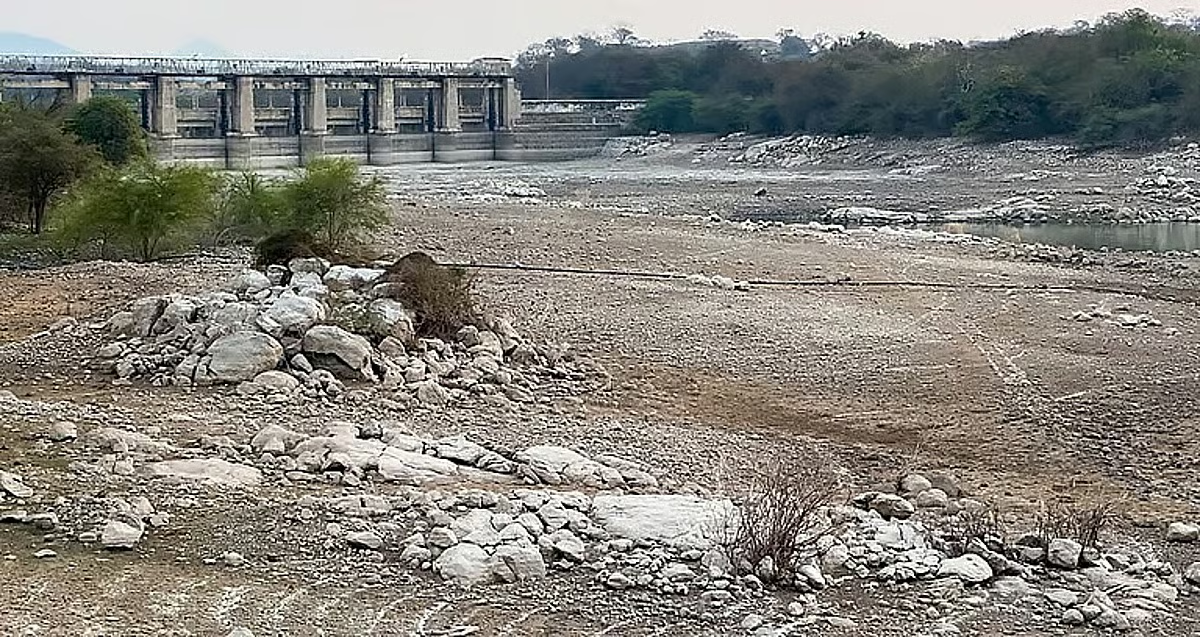
The water storage situation in India is steadily deteriorating. While storage in 166 reservoirs has fallen below 40 per cent, water levels in river basins are also steadily declining. Reservoir levels in Assam, Goa, Karnataka, Kerala, Madhya Pradesh, Tamil Nadu, Tripura, and West Bengal have decreased compared to last year. The weekly bulletin issued by the Central Water Commission (CWC) on April 30, 2026, clearly indicates this.
The CWC monitors the live storage of 166 reservoirs in the country and issues a weekly bulletin every Thursday. Of these reservoirs, 20 are connected to hydropower projects, with a total live storage capacity of 35.299 billion cubic meters (BCM). The total live storage capacity of these 166 reservoirs is 183.565 BCM, which is approximately 71.20 per cent of the estimated total capacity of 257.812 BCM created in the country.
According to the bulletin dated April 30, 2026, the live storage available in these reservoirs is 71.082 BCM, which is 38.72 per cent of their total capacity, as against 44.71 per cent on April 9, 2026.
However, compared to normal levels or last year, the situation is considered better, as during the same period last year, the storage was 62,296 BCM, while the normal storage was 56,176 BCM. Normal storage refers to the average storage over the past 10 years.
But the situation is much worse in eastern, Northeastern, and southern India. Assam has the worst reservoirs, with a depletion of about 43 per cent of normal levels. Tripura’s reservoirs have fallen by about 42 per cent, and West Bengal’s by about 58 per cent. Many reservoirs in these states are below 40 per cent.
Overall storage in South India is reported to be better than normal, but declines in some key states are raising concerns. Karnataka has about 14 per cent less water storage than normal. Kerala has seen a slight decline, but water levels are continuing to fall. Tamil Nadu has recorded a nearly 22 per cent depletion in reservoirs, indicating pressure on the Cauvery basin. Most importantly, 36 reservoirs in South India are below 40 per cent, the highest in the country.
Madhya Pradesh’s reservoirs have seen a decline compared to last year, while Goa in western India has only one reservoir but has seen a decline of more than 12 per cent.
Bad situation
There are nine major reservoirs in the country where water levels have fallen below 50 per cent of normal levels. These include Khandong (21.16 per cent) in Assam, Chandan Dam (0.00 per cent) in Jharkhand, Tattahalla (24.63 per cent) in Karnataka, Periyar (29.21 per cent) in Kerala, Aliyar (48.89 per cent), Karaiar (49.89 per cent), and Vaigai (15.17 per cent) in Tamil Nadu, Priyadarshini Jurala (46.56 per cent) in Telangana, and Kangsabati (28.54 per cent) in West Bengal. The situation in these reservoirs is particularly concerning because many of them are located in states where water storage has already declined compared to last year.
Similarly, out of a total of 166 reservoirs, 22 have water levels at or below 80 per cent of normal. Nine of these reservoirs are below 50 per cent, while 13 are between 51 and 80 per cent. Of these 13, three reservoirs are between 51 and 60 per cent, four between 61 and 70 per cent, and six between 71 and 80 per cent, indicating that a large number of reservoirs are still not in fully satisfactory condition.
Water levels in river basins
Compared to the CWC’s bulletin of April 9, 2026, the latest data for April 30, 2026, presents a mixed picture. At the beginning of April, the Ganga (53.8 per cent), Godavari (47.58 per cent), Narmada (46.09 per cent), and Tapti (60.71 per cent) were in relatively better condition, although they were also only half full or slightly more. The latest bulletin now shows the Ganga basin at around 50.01 per cent, the Godavari at 40.69 per cent, and the Narmada at 38.82 per cent—meaning some decline, while the Tapti remains relatively balanced. The Krishna basin, which was previously at 31.31 per cent, remains in a weak state at around 22.55 per cent, while the Kaveri (now 35.74 per cent) and Mahanadi (43.51 per cent) also show declines.
Changes have also been observed in the northwestern and northeastern basins. The Indus basin was previously at 41.52 per cent and the Mahi at 48.70 per cent. Now, the Mahi has improved to around 44.71 per cent, while the Indus basin has recorded a slight decline. The Brahmaputra, which was previously at 35.20 per cent, is now stabilising near normal. However, the situation in the Barak basin in the northeastern region remains even more vulnerable, still recording a deficit of around 24 per cent from normal, making it the most vulnerable basin.
The disparity has become more pronounced in smaller and coastal basins. On April 9, Pennar was at 73.43 per cent and Sabarmati at 57.19 per cent, while Subarnarekha was in the best position at 80.48 per cent. The latest data shows Sabarmati and Subarnarekha still holding strong, but Pennar has declined and fallen below normal. Brahmani-Baitarani, which was previously at 41.42 per cent, remains below normal. Meanwhile, water levels in the eastern coastal rivers (Mahanadi-Pennar) and western coastal rivers (Tadri-Kanyakumari) remain low, indicating a decline in overall water levels across several basins over the month, further exacerbating regional water imbalances.