On a grey day in early June, a commercial plane landed at Norfolk Island Airport in the South Pacific. Onboard was precious cargo ferried some 1,700km from Sydney: four blue plastic crates with “LIVE ANIMALS” signs affixed to the outside.
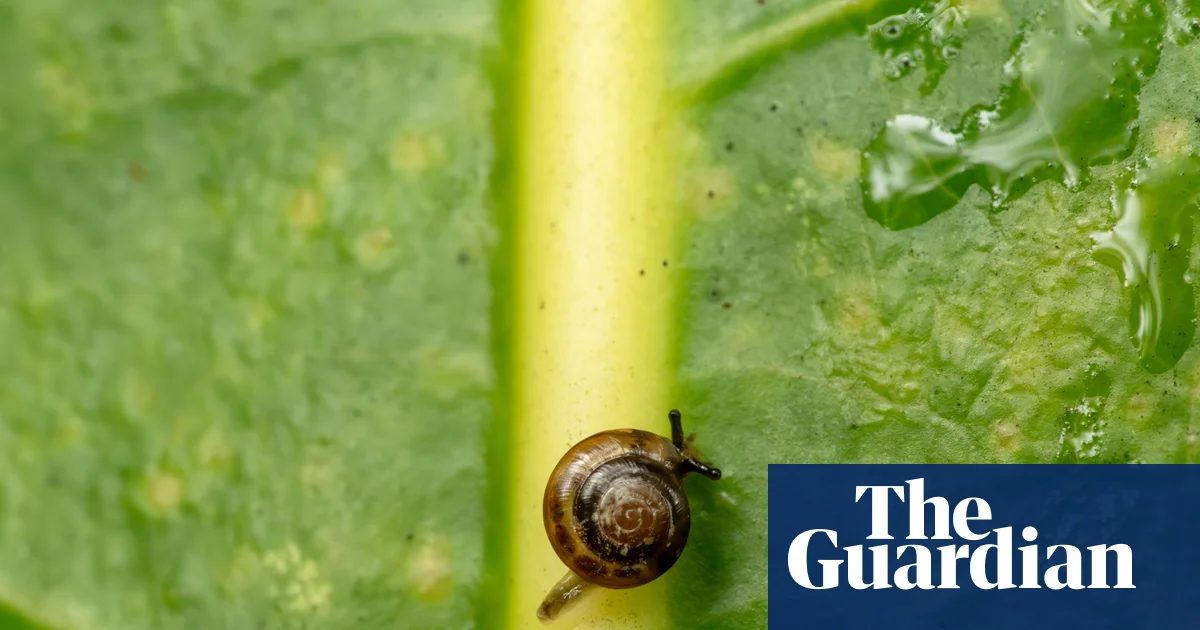
Inside were thumbnail-sized snails, hundreds of them, with delicate, keeled shells. The molluscs’ arrival was the culmination of an ambitious plan five years in the making: to bring a critically endangered species back from the brink.
Officially, the Campbell’s keeled glass-snail has met the same fate as the Tasmanian tiger. It was listed on the International Union for Conservation of Nature red list as extinct in 1996.
But in 2020, Dr Isabel Hyman, a snail scientist – or malacologist – at the Australian Museum received surprising photos from a Norfolk Island citizen scientist called Mark Scott, of “an unusual large snail that he’d found”. Hyman recognised the species immediately as Advena campbellii, which grow to over 2cm in size. (The smallest snails on Norfolk Island, in comparison, are about 1.5mm.) “As far as I knew, it was extinct, so we were very excited,” Hyman recalls.
That March, as countries around the world were locking down due to the Covid-19 pandemic, she and colleagues made a trip to Norfolk Island, and in a sheltered valley found what they were looking for: a lineup of Campbell’s keeled glass-snails, hidden under a decayed palm frond.
In 2021, 46 of the snails were flown to a captive breeding facility at Taronga Zoo, which the team established as the best bet to save the animal from extinction.
The snails give birth to live young from the side of their necks, birthing a new baby every fortnight. For the first two years, the number of births hardly kept up with the deaths of the snails, which only live about 12 months in captivity.
“We did have a lot of deaths among the founding snails initially,” Hyman says, adding that Taronga Zoo staff learned the species was particularly sensitive to both transport and stress from being handled.
But despite the early challenges, the population eventually grew to more than 800 snails, and by June this year the team were ready to attempt what they believe is the first large-scale snail translocation in Australian history.
Disaster, then a ‘beautiful valley’ home
Eagerly awaiting the snails’ arrival on Norfolk Island was Junn Kitt Foon, a PhD student at Western Sydney University and an Australian Museum research associate. Foon had landed on the island in May, for a six-month stint to monitor the snails during their release back into their natural habitat.
Once on the island, the snails were held in a dedicated facility for several weeks before their release, to gradually acclimate to the food that they would eat back in the wild.
Though the animals had survived the journey well, disaster soon struck. A mould outbreak in their holding tanks resulted in a mass die-off which killed 260 of the original 600 arrivals. It wasn’t entirely unexpected, says Foon: previous snail translocation projects conducted elsewhere had experienced similar casualties.
In late July, the 340 surviving snails were released, timed to coincide with favourable wet-season conditions.
“A lot of thought went into where we ended up putting the snails,” says Melinda Wilson, natural resources program manager at Norfolk Island national park. The existing population of Campbell’s keeled glass-snail is found only in a tiny gully of native forest, “but they used to be spread all over the park”, Wilson says.
The team chose a release site that best matched the original habitat’s temperature and humidity, in a steep, “beautiful valley surrounded by palm trees”, with native hardwoods providing shade. “To get down to it we had to cut a new line through thick guava, which is an invasive plant, to be able to get to this pristine valley,” Wilson says.
“It’s on the other side of the park,” she adds. “I don’t think that there’s any way the two populations will ever meet up.”
The site was kitted out with an irrigation system that adds additional moisture in months of scant rainfall, and national park rangers set up bait stations and traps to manage the risk of predation by invasive rodents and feral chickens.
Each snail was painstakingly tagged. Every three days for the first fortnight after release, Foon trudged down the deep gully to monitor their movements. For the first two months he regularly spotted individual snails, but by the time he left the island, at the end of the year, they had become hard to detect.
“I suspect that the snails have spread out beyond the area where we have released them – that’s why it’s really hard to find them,” Foon says. Researchers who have carried out similar projects on other Pacific islands have counselled him. “Sometimes you release the snails and they disappear for a few years with no trace, and all of a sudden [after] a good season of rain … there’s this massive boom in the population,” he said.
Getting an accurate sense of population numbers is difficult at this early stage, Hyman adds. “We’re know that there’s still snails out there because … we’re still finding babies. So we have high hopes.”
Park rangers now monitor the site once every three months. “Invertebrates are a whole group of animals that are probably underrepresented when it comes to conservation,” Wilson says. “To have these snails front and centre as part of our conservation actions … has been really rewarding.”
The team is planning another round of snail reintroductions in 2026. And, Hyman adds, they have some paperwork to file. “We actually are in the process of updating the IUCN listing to show that the Campbell’s keeled glass-snail is not extinct.”