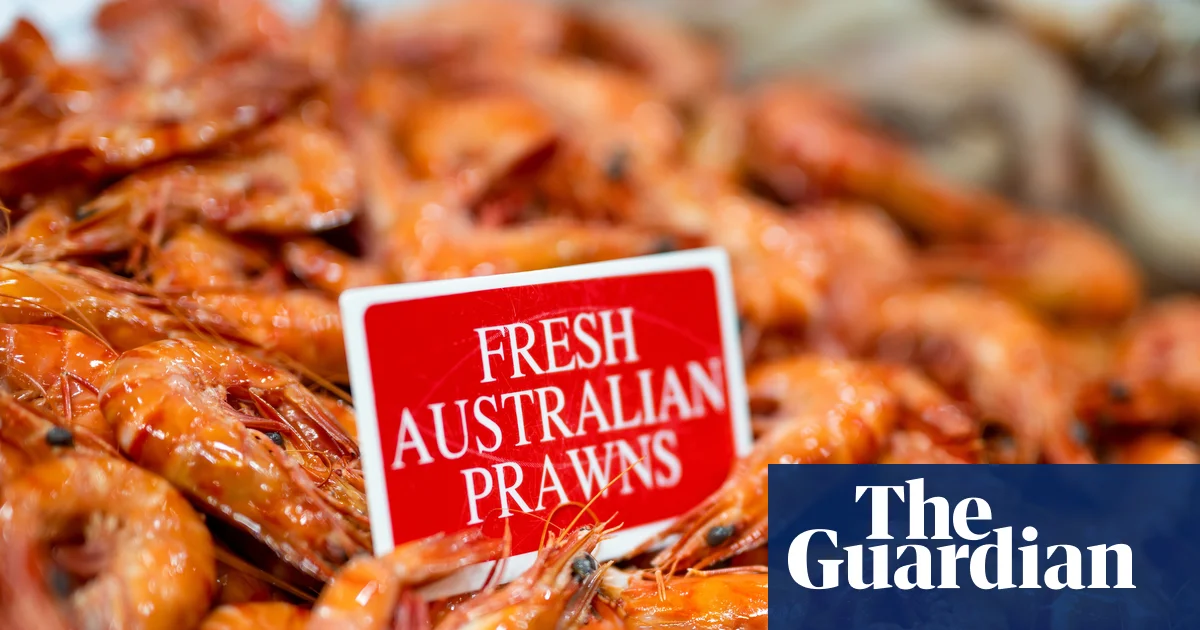
Crustaceans are a festive season staple for many families, particularly in Australia where an estimated 18.5m kilograms of prawns and more than 150,000 lobsters are eaten over Christmas and New Year.
Globally, trillions are caught and consumed each year. Australia is a major producer, with prawn, lobster and crab industries valued at more than $1bn.
It may be an inconvenient truth, but scientists say there is now compelling evidence that these aquatic animals, with their hard shells and soft insides, are sentient, and are able to experience fear, pain and distress.
In the season of goodwill to all, should we spare a thought for crustaceans?
Prof Lynne Sneddon, who leads the aquatic animal welfare group at Sweden’s University of Gothenburg, says sentience implies an animal has the capacity for positive and negative experiences, the ability to form relationships, learn new skills and make good decisions. There are examples of decapod crustaceans doing all those things, she says.
Take the pistol shrimp, a small snapping crustacean with lopsided claws which shares its burrow with a goby fish. The fish guards the doorway on the lookout for predators, while the shrimp is like its clean flatmate, excavating and maintaining their shared quarters.
“They live together in harmony,” Sneddon says, one example among many of crustaceans forming relationships.
Studies also show crustaceans can learn, remember and solve problems, even though the physical structure of their nervous system is totally different to ours. Crabs can solve mazes to find food, they will remember the way, and when the maze is rejigged will adapt using trial and error.
‘Do they feel pain?’
Crustaceans are a diverse group, encompassing more than 67,000 species – from the tiniest shrimp to Japanese spider crabs the size of a small car. Decapods, the group that most sentience studies refer to, are the ones with 10 limbs – including prawns, shrimp, lobsters, crayfish, bugs and yabbies.
Yet despite the accumulating evidence, Sneddon says, people can often find it difficult to engage with the idea of crustaceans having emotional lives.
“We empathise with species that look like us,” she says. Humans tend to be very face-oriented, looking for cues about whether people are sad, overjoyed or annoyed, whereas crustaceans can appear expressionless.
Robert Elwood, an emeritus professor of animal behaviour at Queen’s University Belfast, began investigating the question of pain and sentience in crustaceans 20 years ago, after a chance meeting with seafood chef Rick Stein at a local pub.
“I chatted to him about our mutual interest in crustaceans. And he just asked: ‘Do they feel pain?’”
Elwood’s experiments since have revealed behaviour and stress responses consistent with pain – crustaceans giving up valuable resources to avoid unpleasant experiences, and evidence they retain memories of noxious events.
It’s difficult to prove pain and sentience in other animals, even in cats and dogs, because they can’t tell you what they’re feeling, Elwood says. But there is a high possibility in crustaceans.
“We have lots of evidence that fits the idea of pain,” he says. “Even if you can’t prove it 100%, you should give the animal the benefit of the doubt.”
In light of this, many fishing, transport and food preparation practices are cruel. When crabs and lobsters are placed in boiling water, they can remain conscious for more than two minutes. Territorial crabs may be strapped up with cable ties and piled on top of one another for transport or sale, and later dismembered or butchered while alive. Some prawn farms use a method called “eyestalk ablation”, cutting the eyes off female prawns, in a practice that blinds them but increases spawning.
Prof Culum Brown of Macquarie University says many things people do to crustaceans as part of the food chain are “horrendous”.
He says the standard for vertebrates – sheep and cattle, but also fish – is to stun them in some way before they are killed, so they are unconscious and unaware of what’s going on.
There are also pragmatic reasons to consider crustacean welfare, he says. “Even if you don’t think they’re capable of feeling pain, we do know that the accumulation of stress in their body tissues destroys the texture, flavour and longevity of the product.”
‘Have a think about how you treat them’
Scientists and welfare advocates say crustacean welfare should be given a higher priority when the animals are caught, killed or transported, used in experiments, kept as pets and in their natural environment. Many would like to see a ban on live animal sales, exports and on boiling alive.
Laws in the UKand New Zealand recognise crustacean sentience.
In Australia, protection varies. The Australian Capital Territory considers them sentient beings alongside other animals, while legal protection under animal welfare laws is lacking in South Australia and Tasmania. In many states, welfare rules are limited to animals sold at restaurants or fishmongers. The Australian code that governs how animals are used in science does not currently consider decapod crustaceans as animals.
Dr Ben Sturgeon, a veterinarian and chief executive of the UK-based organisation Crustacean Compassion, says changing public and industry attitudes to crustaceans requires a longer conversation.
“They’re not fluffy,” he says. “They might pinch your toe.”
Consumer demand for sustainable, high-welfare foods is leading to some improvements, he says, such as the increasing adoption of electrical stunning before slaughter.
The best thing consumers can do is ask questions, Sturgeon says. Crustaceans sold live or fresh usually involve some sort of welfare compromise. Instead, he suggests seeking out alternatives where animals have been caught and killed quickly, then flash frozen.
Melina Tensen, a senior scientific officer with the RSPCA, recommends being informed, supporting best practice and never purchasing live animals.
The society opposes the live export and sale of food animals, including crustaceans, she says.
“Live crustaceans should not be made available to the general public for purchase and instead be humanely handled and killed by those who are trained and competent to do so, including stunning before slaughter.”
Crustaceans are much more intelligent and emotional animals than most people understand, and they are affected by painful experiences, Sneddon says.
“Just have a think about how you treat them,” she says. “Think more deeply about ethical choices. When choosing them as food, find out where they’ve come from, what they’ve gone through.”