UK economic growth slows as ‘spectre of recession begins to loom’
The UK economy has grown more slowly than thought during 2025, sparking new concerns that recession fears could loom over Britain.
The Office for National Statistics has revised down its estimate for growth in the second quarter of 2025, from 0.3% to just 0.2%.
That follows 0.7% growth in Q1.
The latest GDP quarterly national accounts also confirm that the UK economy only grew by 0.1% in the third quarter of this year, matching its first estimate, and confirming that the economy slowed after a decent start to the year.
Today’s report also shows that real GDP per head failed to grow in the July-September quarter, and was 0.9% higher than a year ago.
Britons became poorer too, once you account for inflation – real household disposable income per head decreased by 0.8% in Q3, following no change in Q2.
ONS director of economic statistics Liz McKeown says:
“Today’s updated figures paint the same picture as our initial estimate, with growth continuing to slow in the third quarter. Growth in services were partially offset by falls in production, with a marked drop in car manufacturing.
That drop in auto output was due to the cyber-attack at Jaguar Land Rover in September.
[Reminder: we learned earlier this month that the economy sank slightly in October too]
Lindsay James, investment strategist at Quilter, warns that the UK economy is “grinding to a halt” as growth slows.
“Going forward, November’s Budget measures will do nothing for growth after the OBR forecasted zero impact from the policies introduced at the despatch box.
Instead, the government is going to have to hope that previous measures taken to date begin to bear fruit, or that geopolitical challenges calm down enough that global trade can rebound.
Unfortunately, neither seems particularly encouraging right now and as such the first half of next year is likely to be more of the same, if not worse with the spectre of recession beginning to loom.
Key events
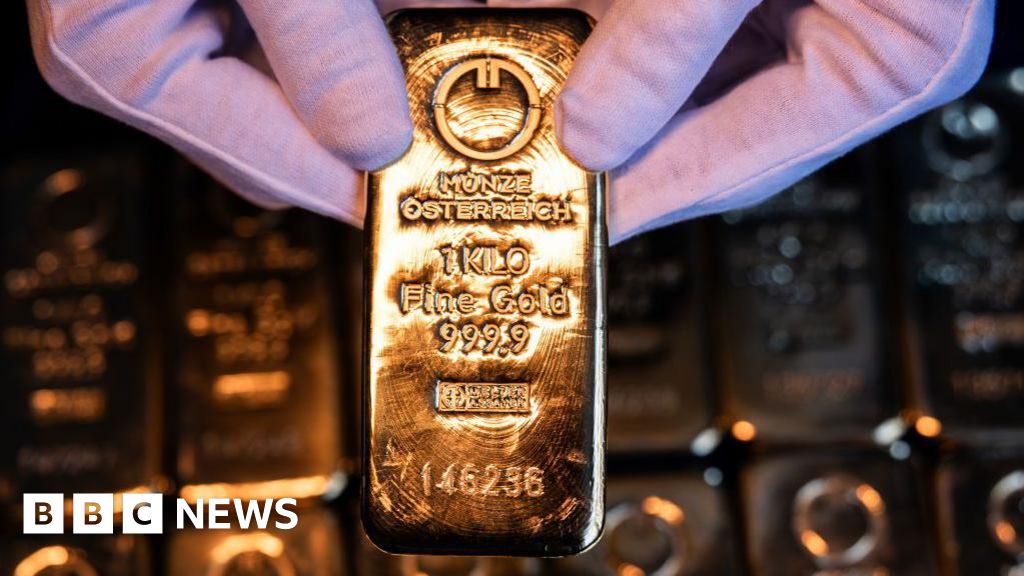
Shares in precious metals producers are rising in early trading, after silver and gold hit record peaks this morning.
Endeavour Mining (+2.4%) and Fresnillo (+1.6%) are among the top risers on the FTSE 100 share index in early trading.
UK household savings ratio falls
Today’s UK national accounts shows that the Household Saving Ratio decreased this quarter by 0.7 percentage points to 9.5%.
That was due to a fall in non-pension saving, an indication that people put less money aside in the July-September quarter.
The households’ saving ratio is estimated to be 9.5% in Quarter 3 (July to Sept) 2025 down from 10.2% in Quarter 2 (Apr to June) 2025. pic.twitter.com/EKMoxVhL0l
— Office for National Statistics (ONS) (@ONS) December 22, 2025
Martin Beck, chief economist at WPI Strategy, points out that savings levels are still relativel high, an indication that people are cautious:
Although the household saving ratio edged down to 9.5% from 10.2% in Q2, amid a fall in real household disposable income, it remained well above its pre-pandemic 2015-19 average of 5%-6%. Households and firms alike continue to behave cautiously.
Household debt as a share of income stood at 116.9% in Q3, close to its lowest level since 2002, while the stock of corporate bank debt relative to profits was close to a 25-year low.
UK economic growth slows as ‘spectre of recession begins to loom’
The UK economy has grown more slowly than thought during 2025, sparking new concerns that recession fears could loom over Britain.
The Office for National Statistics has revised down its estimate for growth in the second quarter of 2025, from 0.3% to just 0.2%.
That follows 0.7% growth in Q1.
The latest GDP quarterly national accounts also confirm that the UK economy only grew by 0.1% in the third quarter of this year, matching its first estimate, and confirming that the economy slowed after a decent start to the year.
Today’s report also shows that real GDP per head failed to grow in the July-September quarter, and was 0.9% higher than a year ago.
Britons became poorer too, once you account for inflation – real household disposable income per head decreased by 0.8% in Q3, following no change in Q2.
ONS director of economic statistics Liz McKeown says:
“Today’s updated figures paint the same picture as our initial estimate, with growth continuing to slow in the third quarter. Growth in services were partially offset by falls in production, with a marked drop in car manufacturing.
That drop in auto output was due to the cyber-attack at Jaguar Land Rover in September.
[Reminder: we learned earlier this month that the economy sank slightly in October too]
Lindsay James, investment strategist at Quilter, warns that the UK economy is “grinding to a halt” as growth slows.
“Going forward, November’s Budget measures will do nothing for growth after the OBR forecasted zero impact from the policies introduced at the despatch box.
Instead, the government is going to have to hope that previous measures taken to date begin to bear fruit, or that geopolitical challenges calm down enough that global trade can rebound.
Unfortunately, neither seems particularly encouraging right now and as such the first half of next year is likely to be more of the same, if not worse with the spectre of recession beginning to loom.
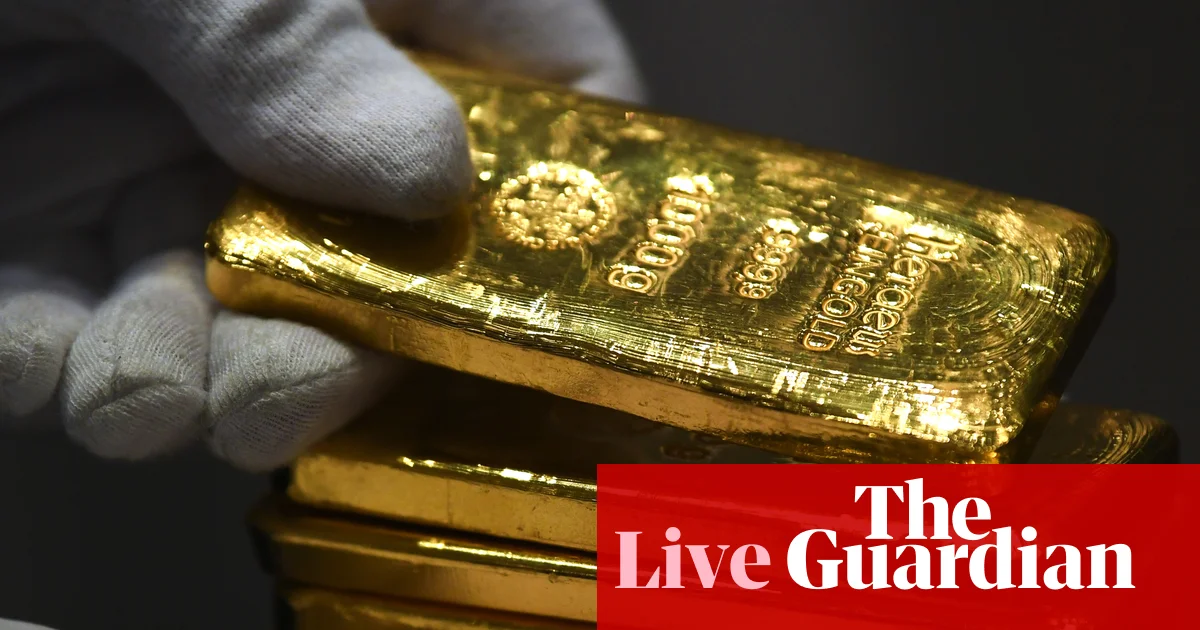
Gold was already on track for its best year since 1979, and is up 68% since 1 January.
Some economists have predicted previous metals will keep rising next year – but others aren’t convinced.
Capital Economics told clients:
Gold prices may be widely expected to keep hitting record highs in 2026, but we’re not convinced. We expect fundamentals to reassert themselves, pulling prices back to $3,500 an ounce by year end. So goes gold, so goes silver: the end of the speculative boom in the former will also kill off the stunning recent rally in the latter.
Introduction: Gold and silver hit record highs
Good morning and welcome to our rolling coverage of business, the financial markets and the world economy.
Any wise men looking to buy gold, or silver, this Christmas face a record bill.
Precious metal prices are hitting unprecedented levels this morning, as investors seek out safe-haven assets that might protect them from geopolitical risks and loosening monetary policy.
Gold has broken through the $4,400 barrier for the first time; it’s up 1.8% today at $4,417.53 per ounce.
The silver price has risen 3% today to a record high of $69.14 per ounce.
Analysts are attributing the rally to growing expectations of further US rate cuts, and also strong safe-haven demand after Donald Trump and his top aides refuse to rule out war with Venezuela.
The US is intensifying its oil blockage against Venezuela, putting more pressure on the government of President Nicolás Maduro; two vessels have been seized off the cost of Venezuela in international waters in recent days, with a third now being pursued…
This comes after gold posted its highest weekly close on record.
Tony Sycamore, market analyst at IG, explains:
The gains were driven by last week’s softer-than-expected US inflation and jobs reports, which reinforced expectations for two 25bp Fed rate cuts in 2026.
The upside was also supported by geopolitical tensions after President Trump announced a “total and complete” blockade on sanctioned Venezuelan oil tankers and Ukraine-Russia peace talks appeared to stall.
Because precious metals don’t provide a yield (unlike bank reserves which earn interest, bonds which have a coupon, or shares which get a dividend payment), they are more attractive when interest rates are falling.
The US Federal Reserve could be more likely to cut interest rates after US inflation slowed in November, although economists have warned that this report appears flawed (some of this data was estimated…).