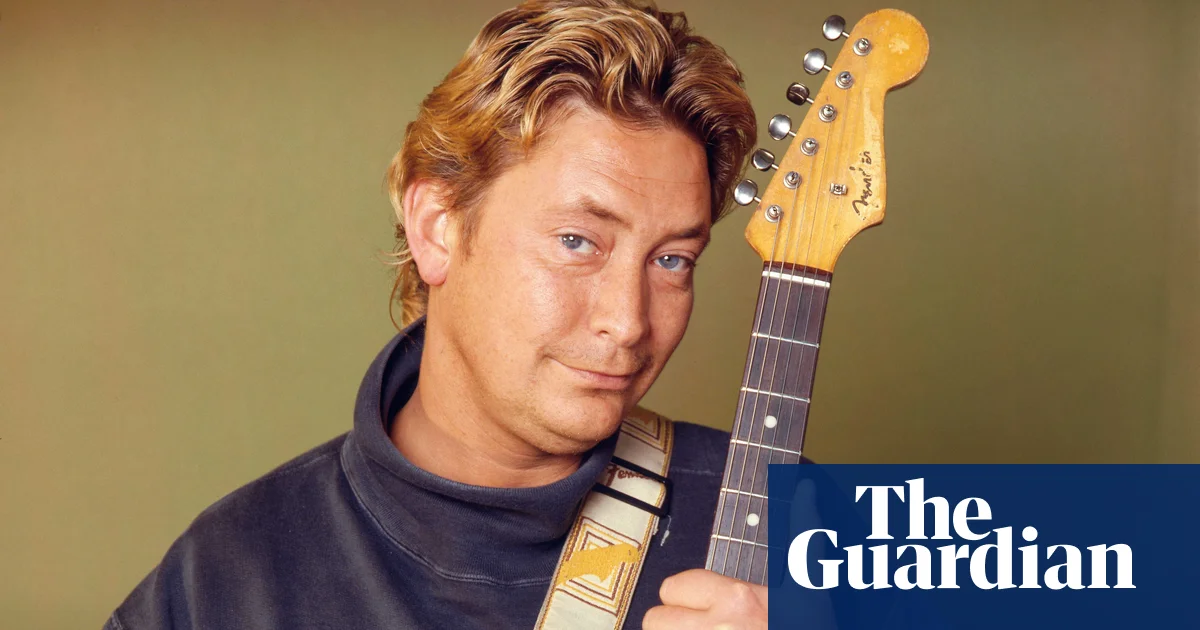
Identifiable by his growling vocal style and fondness for playing bluesy slide guitar, Chris Rea, who has died aged 74, proved that it was possible to become a big-selling international artist while remaining low-key and publicity-shy. “I’m not a hero role model, like Tina Turner or Dire Straits,” he protested in 1991. “I’m a writer of songs.”
He enjoyed his biggest solo hit right at the start of his career, when Fool (If You Think It’s Over), from his debut solo album Whatever Happened to Benny Santini? reached No 12 on the US pop charts in 1978, but it was not until the late 1980s and 90s that he created a solid platform for himself with a string of albums that enjoyed high chart placings in Britain and Europe. Yet despite being steeped in American music, he never enjoyed major success in the US.
He was initially attracted by the idea of writing film music, but realised the scope for this in his native Middlesbrough was limited. He was a late starter on guitar, which he did not begin playing until he was 21, and, as he put it, “I just went sideways into slide guitar.” He had been inspired by hearing such slide wizards as Ry Cooder and Little Feat’s Lowell George, as well as the blues players Charlie Patton and Blind Willie Johnson.
Rea’s best known songs showcased his knack for creating simple but evocative melodies matched to easy-rolling rhythms that sounded as if they could chug along forever. Typical of these, from the mid-80s, were Let’s Dance, the seasonally mellow Driving Home for Christmas, his No 10 hit The Road to Hell, Tell Me There’s a Heaven and Julia, a song for his younger daughter.
He had begun to attract healthy audiences around Europe with his fifth album, Water Sign (1983), and the next year’s follow-up, Wired to the Moon, but it was Shamrock Diaries (1985) that signalled that Rea was making a major connection with listeners in his homeland. The album reached No 15 in the UK, and contained the singles Stainsby Girls (named after the school in Middlesbrough where he had met his wife Joan Lesley when they were 16-year-olds) and Josephine (named after their first daughter).
The platinum-selling On the Beach (1986) climbed to No 11, Dancing With Strangers (1978) – another platinum-seller – went to No 2, and the New Light Through Old Windows compilation (1988) went triple-platinum and climbed to No 5. The album The Road to Hell (1989) finally took Rea to the No 1 slot, as did its successor, Auberge (1991). In 1990, Rea recorded a new version of Josephine with an added Chic-like groove, and it became a pan-European club hit that summer. In 1992, his album God’s Great Banana Skin reached No 4 on the UK chart, and generated the Top 20 single Nothing to Fear. He scored a Top 10 album with Espresso Logic (1993), and the spin-off single Julia was his sixth and last Top 20 hit.
Rea was one of seven children of Camillo Rea, who was of Italian origin, and his Irish wife, Winifred (nee Slee). “I had three older sisters,” he said. “The eldest was into the Everly Brothers and Elvis Presley, while the two younger ones were into the Beatles and the Stones.” The first record he bought was Frightened City by the Shadows.
Camillo was the boss of the Rea ice-cream empire (makers of Rea’s Creamy Ices), which comprised a factory in Cargo Street, Middlesbrough, as well as a chain of 21 coffee bars across Teesside. Chris would recall that: “Dad was a distant figure, a cross between the pope and Mussolini.”
In alternate summers the family would spend three months in Italy. At 12, Chris began working in one of the family’s coffee bars, and as a teenager he helped make ice-cream in the factory. He never saw eye to eye with his father, and left the business to concentrate on music. The first guitar he bought was a Hofner Verithin 3, which cost him 32 guineas in a secondhand shop in Middlesbrough.
After a short spell with a local band, Magdalene, he formed the Beautiful Losers, in which “I just used to write the material and play slide guitar – Lowell George was god.” He started singing only because their vocalist did not turn up one day, and Rea stepped into the breach because he knew the songs, having written them.
The band was awarded Melody Maker’s best newcomer award in 1975, but by then Rea already had a solo deal with Magnet Records, and in 1977 the band disintegrated. He had released a solo single, So Much Love, in 1974, which went nowhere, but Whatever Happened to Benny Santini? brought him both a hit single and a Top 50 placing for the album in the US.
Rea found himself in a whirlwind of trips to Los Angeles for interviews and photo sessions, and felt cut off from his roots. The follow-up album, Deltics (1979), produced like its predecessor by Elton John’s producer, Gus Dudgeon, presented Rea as a singer-songwriter in the John/ Billy Joel mould (whose influence was glaringly obvious in such tracks as Twisted Wheel and Diamonds).
Rea was not happy with the results, and the disc’s lack of success was not rectified by Tennis (1980) or Chris Rea (1982), even though Rea produced those himself. Lacerating reviews did nothing for his self-esteem. When a disillusioned Rea presented a batch of demo tapes to his record company and they decided to release them as they were as Water Sign, Rea feared he was about to be dumped. However, to everyone’s surprise, the album started selling strongly in Ireland, and gradually spread across Europe. It was the start of the Chris Rea revival.
In 2000, the year in which King of the Beach reached 26 on the UK album chart, Rea had to cope with a diagnosis of pancreatic cancer, which necessitated radical surgery. He had been suffering from stomach problems since 1994, and now faced further surgery and a permanent regime of medication.
He contracted diabetes, and had to give himself insulin shots seven times a day. In 2016 he suffered a stroke, which affected movement in his hands and left him with slurred speech. His medical problems prompted him to take stock of what he wanted to do with his life, and he drew some instructional value from it. “If this hadn’t happened, I could have become as big a pain in the backside as any other celeb,” he said in 2009.
He found himself drawn back to the earthy and fundamental values of the blues. Consequently his catalogue became dominated by blues releases, with Dancing Down the Stony Road, Blue Street (Five Guitars), Hofner Blue Notes and The Blue Jukebox appearing on his own Jazzee Blue label between 2002 and 2004.
These were followed by Blue Guitars (2005), The Return of the Fabulous Hofner Bluenotes (2008) – complete with a hardback book of Rea’s paintings, art having become another of his enthusiasms during the previous 20-odd years – and Santo Spirito Blues (2011). Road Songs for Lovers followed in 2017, a quietly intense set of songs he had written while recuperating from his stroke. It reached 11 on the UK chart.
Rea, who took his driving test in one of his family’s ice-cream vans, was also a motor racing enthusiast. He wrote Saudade, included on The Very Best of Chris Rea (2001) as a tribute to the F1 champion Ayrton Senna. He owned numerous historic sports cars and drove a 12-cylinder Ferrari Testarossa before deciding he did not like people staring at him. A close friend of the F1 team boss Eddie Jordan, Rea guested as a pitlane mechanic for Jordan’s team in races at Donington and Monaco.
He switched to a modest Caterham 7, more appropriate for a down-to-earth son of Teesside. However, his infatuation with the Ferrari mystique was genuine enough. As he told Q magazine in 1994, his parents used to tell him about “this fabulous, sunny place where they build beautiful cars that win races … I actually used to look at an atlas and dream of Italy, and in particular of Ferrari cars. That was my first love, long before music.”
He wrote the soundtrack and screenplay for a film, La Passione, a semi-fictional version of his obsession with Ferrari starring Shirley Bassey. It was released in 1996, but only after the producers, Warner Bros, had demanded so many changes that a disillusioned Rea declared the end product “boring”. He supplied the score for the film Soft Top Hard Shoulder (1993), and had a lead acting role alongside a choice batch of British thespians in Michael Winner’s 1999 comedy Parting Shots, though critics slammed it mercilessly.
In 2017, during the 35th of a 37-concert tour, Rea was taken to hospital after collapsing on stage in Oxford.
He is survived by Joan and their two daughters.