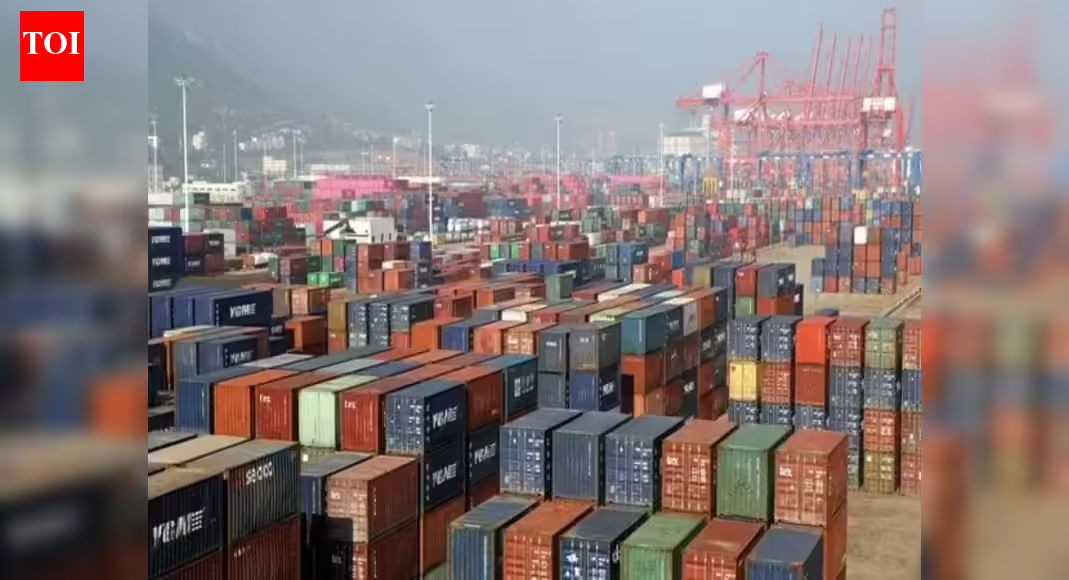
Hello and welcome to Best of BS Opinion, our daily wrap of the day’s Opinion page. India has agreed on a free trade agreement (FTA) with New Zealand, only shortly after it signed a Comprehensive Economic Partnership Agreement (Cepa) with Oman. While neither of these is of significant global scale, they offer a moment to consider India’s fresh approach to such pacts, notes our first editorial. India needs to start meaningful negotiations with its peer economies, despite the belief that there is more benefit to be had in economic integration with richer nations. Any attempts to open new markets and deepen global integration will be a net positive for the Indian economy. While these deals with smaller countries suggest a new attitude in New Delhi, deals with larger economies, like the US or even the RCEP, must remain a priority. New Delhi’s new direction on trade agreements is welcome, but it must show more ambition. Escalating violence and anti-India rhetoric in Bangladesh ahead of elections there next year have raised the stakes for New Delhi in shaping an appropriate response, says our second editorial. So far, India’s response has been low-key. The trading of charges over threats to each other’s consular facilities has raised tensions in an already-fraught relationship. New Delhi’s approach increasingly demands a focus on its immediate and long-term security perceptions. The growing anti-India movement has added an element of uncertainty to the safety of Indian economic assets as well. The interim government has assured India about the security of its assets and personnel but it is becoming increasingly clear that Muhammad Yunus, Bangladesh’s ‘Chief Advisor’, wields minimal control over that government. Despite calls for New Delhi to exercise its heft as a major power, history has shown that temperance has served India better than activist interventions. China opened up its economy in 1978, India in 1991. The difference between the two economies has widened since these policy shifts, points out Nitin Desai. With China’s per capita GDP now more than five times that of India, it is believed that this is largely because of the rapid expansion of the manufacturing sector there. A key difference, however, was that, unlike India, there were hardly any private players in China when it liberalised. India did, and these firms constrained the emergence of newcomers in manufacturing. A key lesson from China’s boom is that government support should be directed at new starters instead of established conglomerates, and rely on competition from newcomers to stimulate existing players. The Indian government can and should focus more on supporting new starters, reducing bureaucratic red tape, encouraging more effective action by local bodies to promote industry, pushing R&D by public institutions, and pressurising private enterprises, particularly large conglomerates, to do the same. India loses about 30–40 per cent of its fruit and vegetables after harvest, typically during transport, storage, and processing, all of which depend on reliable energy. Yet, discussions on food loss tend to focus on infrastructure and logistics while overlooking the energy systems that power them, point out Taniya Sah and Vandita Sahay. Reducing food loss, they write, requires smarter energy systems. Decentralised renewable energy (DRE) solutions can power facilities close to farms while creating jobs. However, policy coordination remains limited since agriculture and energy continue to operate in silos. Scaling up also needs a rethink: instead of vertical scaling, India may benefit more from horizontal replication attuned to local needs. Anchoring transition to green energy in local, adaptive, community-led solutions is essential. India today is awash in content yet increasingly starved of sustained thought, writes Anjali Chauhan in her review of Anurag Minus Verma’s The Great Indian Brain Rot: Love, Lies & Algorithms in Digital India, which, she says, enters this landscape not as a nostalgic lament for lost attention spans, but as a diagnosis of how thinking itself is being reorganised under platform capitalism. Verma, she notes, writes against the grain of moral panic – instead of condemning digital life as evidence of cultural decline, he asks how people come to inhabit platforms structured by competition, performance, and constant evaluation, producing forms of participation that appear open and voluntary while remaining tightly governed by visibility, circulation, and metricised value.
Best of BS Opinion: India must learn from China, support new entrants | Opinion Specials