- Repeated cooling and warming cycles drove population splits, range shifts, and new primate species in northeast India.
- Populations of many primate species peaked during warming but declined sharply during glacial phases, leaving these species with fragmented populations and reduced habitats today.
- These long-term patterns underline the need for species-specific conservation measures as climate change accelerates, threatening already declining primate populations in one of India’s richest biodiversity hotspots.
The forests of northeast India are home to one of the richest primate groups. This region, one of the most biodiverse on the subcontinent, has 14 primate species, including the Phayre’s leaf monkey, hoolock gibbon, Bengal slow loris, and several species of macaques and langurs.
What is the story behind this abundance? The answer seems to be climate change and time.
A study, published in Ecology & Evolution, reveals that historic climate shifts played a decisive role in how these primates evolved, dispersed, and adapted to changing forests. The work used genetic data on nine primate species along with habitat modelling to trace how past climate change drove changes in primate populations.
“This diversity is a consequence of different evolutionary trajectories followed by various species. We have analysed four different genera and each has exhibited unique characteristics. This will allow us to gain a deeper appreciation for the wildlife and geography of the region and hopefully may inspire more conservation efforts,” says Mihir Trivedi, the lead author, who is currently a post-doctoral fellow at the University of Washington.
The results also indicate that population sizes of all the species included in this study have steadily declined, and their habitats have shrunk.
As climate change continues to sculpt habitats with shifts in warming, cooling, rainfall, and vegetation patterns, now, at an accelerated rate due to global warming, studies such as this raise important questions about species-specific responses to climate change. Tracing the population patterns of the past indicate that species-wise conservation measures may be needed to account for climate change for long-term conservation planning.
Population sizes vary across time
One part of the study investigated how the populations of the nine primate species included in this study — stump-tailed macaque (Macaca arctoides), Assam macaque (M. assamensis), Tibetan macaque (M. thibetana), northern pig-tailed macaque (M. leonina), Phayre’s leaf monkey (Trachypithecus phayrei), capped langur (T. pileatus), Gee’s golden langur (T. geei), hoolock gibbon (Hoolock hoolock), and Bengal slow loris (Nycticebus bengalensis) — changed over time.
To do this, the researchers used DNA extracted from blood samples collected from rescued wild animals in zoos and rescue shelters. By sequencing the genomes of these animals, a ‘demographic history’ or a reconstruction of the family history of these species, was done by examining changes in their genetic codes.
As populations expand, shrink, or split, random changes in the genetic code, called mutations, accumulate in predictable patterns.
“With genetic data, we could see how mutations accumulated in the species due to the changes in their population sizes. To do this, we used a tool called the MSMC (Multiple Sequentially Markovian Coalescent) model,” says G. Umapathy, one of the authors, who is Chief Scientist with the CSIR-Centre for Cellular and Molecular Biology. “The genomic data of even one member of the species is enough to map out past demographic patterns, as we look at hundreds of genes to trace these patterns,” he adds.
When these patterns were examined, a fuzzy picture of past populations spanning the Pliocene (5.3–2.6 million years ago) and Pleistocene (2.6–1.8 million years ago) was reconstructed. The estimated population numbers show that Assam macaques, Tibetan macaques, and stump-tailed macaques had population peaks at around 1.3–1.4 million years ago, with a steady decline thereafter. The northern pig-tailed macaques, however, faced two sharp population rises and declines at two million years ago and 350,000 years ago.
Amongst the langurs, the capped langur populations peaked at about 3.3 million years ago and then steadily declined. The Phayre’s leaf monkey, Gee’s golden langur, and Bengal slow loris all had population peaks in the mid-Pleistocene (1.25–0.7 million years ago) with gradual decreases since then. The hoolock gibbon seems to have had a population peak at 800,000 years ago, followed by a decline similar to those seen in most of the other species.

Distribution of species also varies across time
A series of species distribution models (SDMs) were used to digitally reconstruct where these species could have lived at different points in time and under different climate scenarios.
First, data on where the primates occur in the present (from reports on sightings or camera traps) and the environmental conditions (maximum and minimum values for temperature and rainfall across different seasons/conditions) in those areas was collected. This was then used to train an algorithm called MaxEnt (Maximum Entropy Modelling) to predict what combination of environmental factors best predicted a species’ presence.
Once this was done, the relationship between the environmental factors and species presence was “projected” onto maps of the past. Paleoclimate datasets that simulated global conditions during the Pliocene and Pleistocene were generated, and the MaxEnt model was plugged into this system to map out where suitable forest conditions likely existed thousands to millions of years ago.
These maps revealed some fascinating patterns. For most species, rainfall seems to have been the main factor driving their distributions, though temperatures also had a role to play. The distributions of all species increased in the Pleistocene (787,000 years ago) as compared to the Pliocene (3.3 million years ago) and then continued to decline till the present (1979–2013).
This decline was likely brought on due to the sharp climatic swings that set in around 750,000 years ago, during the mid-Pleistocene. During cooling periods, the monsoon rains weakened, forests shrank, and populations of primates were trapped in fragments of suitable habitat. During warmer and wetter cycles, forests expanded again and reconnected once-separated groups.
The genetic data and SDMs show that these cycles of fragmentation and expansion of forests match periods of divergence in primate lineages, suggesting that repeated shifts in forest cover likely set the stage for multiple speciation events in northeast India. Speciation is an evolutionary process by which populations evolve to become distinct species.
“Working with the two different datasets — one for the SDMs, and the other for the population demographics using genomic data — was one of the most challenging aspects of this work. Integrating and interpreting these two sets of results in tandem for nine species was tough,” says Kunal Arekar, one of the authors of this study, who is currently a lecturer at the College of Information, University of Arizona. “Another issue was a limitation in resources. Working with high-resolution data for the SDMs requires a lot of computing power, and doing this with the resources I had at that time, namely, laptops, was quite difficult,” he adds.
Trivedi agrees, saying, “Processing the geographical data was a major challenge. Occurrence data from GBIF (Global Biodiversity Information Facility) and climate data from PaleoClim.org required extensive filtering and standardisation before they could be used effectively.” However, the team was lucky to have access to biological samples for their work. “Usually, in ecological studies, obtaining samples is often the greatest challenge, but we were fortunate enough to have zoos backing us for this,” says Trivedi.

Species evolve with warming and cooling events
The study also found that different primate species evolved differently across these changes.
For example, the Assamese macaque and the Tibetan macaque were probably a single species until the mid-Pleistocene cooling. This event likely split their ancestral population, with Assamese macaques moving westward into the Himalayan foothills, while the Tibetan macaque spread along the northeast into Tibet and southern China. The present-day distributions of the two species echo this ancient divide.
Amongst the other macaques, the present-day stump-tailed macaque (now found in mainland Southeast Asia), likely arose as a new species over three million years ago, possibly as a hybrid between its ancestor and rhesus macaques. The northern pig-tailed macaque likely split from its ancestral population about two million years ago in Indochina and expanded into northeast India. It is hypothesised that later cycles of cooling and warming isolated a southern population of these primates, which are thought to have evolved into the lion-tailed macaque of the Western Ghats.
The leaf monkeys in northeast India also underwent speciation events linked to climate change. Based on earlier work and this work, it may be likely that this region was a centre of origin for the Trachypithecus genus. The ancestor of the capped and golden langurs is thought to have split from other Trachypithecus about 4.5 million years ago, with these two species emerging around 800,000 years ago, likely during a mid-Pleistocene cooling. As habitats fragmented, the golden langur probably evolved from a capped langur population that found refuge along the Assam–Bhutan border, after possible hybridisation with Hanuman langurs. The Phayre’s leaf monkey, which belongs to a different lineage within the group, diverged roughly 1.4 million years ago and maintained stable populations across northeast India and Bangladesh through successive cooling and warming cycles.
The hoolock gibbon seems to have thrived in the warm mid-Pliocene before its populations also dipped during the climatic swings of the Pleistocene. The slow loris, which traces its roots to the Miocene over 11 million years ago, seems to have persisted through all these climate changes, but suffered sharp declines in its population during the cooling periods as forests shrank.
“Lorises, whether the Bengal slow loris of the northeast or the slender lorises of southern India, are extremely sensitive to climatic fluctuations and habitat changes,” says Smitha D. Gnanaolivu, a conservation and climate mitigation expert with the IUCN, who has worked on the Malabar slender lorises in the Western Ghats. “Their slow life histories and dependence on dense, undisturbed canopies make them vulnerable to both historical climatic shifts and modern habitat fragmentation. The demographic decline seen in fossil and genetic records mirrors the challenges these nocturnal primates still face today — survival depends almost entirely on the continuity of native forest cover,” she adds.

Limitations with samples
The major strength of the study was the number of species analysed, use of whole genome data for at least one individual from each species and correlating this historical climate data.
Although the narrative for this work is compelling and the genetic data fit neatly with the SDM results, it is important to remember that the study rests on many assumptions and uncertainties. For example, the population histories in this study are based on inferences drawn from genetic data, which could have been influenced by past bottlenecks, gene flow patterns, and selection pressures (other than climate and habitat), of which we know nothing. In addition, the speciation events may have been driven by factors such as competition, predators, disease, and geological events other than climate change.
In addition, Narayan Sharma, Assistant Professor at the Department of Environmental Biology and Wildlife Sciences, Cotton University, points out a few more caveats.
“While the study develops interesting hypotheses regarding primate evolution in northeast India such as declining population sizes and possible ancestral overlap between M. assamensis and M. thibetana, all conclusions rest on very limited sampling, with several species represented by only a single genome, and the demographic and speciation inferences are thus far less reliable. More crucially, the study does not take into consideration the major biogeographic barrier of the Brahmaputra River, which has shaped primate distributions across the region. Without considering this key feature of the landscape, the evolutionary explanations will be incomplete,” he says.
Trivedi acknowledges these points, saying, “One of the caveats of this study is the geographical distribution of samples collected and the total occurrence data points for each species. Large portions of the region remain unexplored and inaccessible, making sample collection and species reporting difficult. Future studies could achieve greater accuracy if more data points are recorded and more samples are collected from diverse subpopulations.”
Why this matters for today’s world
Why should this story of past primates interest us today? Because climate change is again reshaping habitats — this time at speeds far faster than in the deep past. Many species may not have the luxury of time to slowly adapt or shift ranges.
An addition factor is human interference. In many ecologically fragile areas, the corridors and refuges that once aided evolutionary resilience are already fragmented or destroyed by human activity.
This study reminds us that the landscapes of our past were not static; they constantly changed. To help species persist through our own age of change, preserving connectivity is vital, and conservationists may need to use clues from such historical reconstructions to prioritise protection, restoration, and reconnection measures.
Read more: Fragmented forests and food scarcity threaten capped langurs
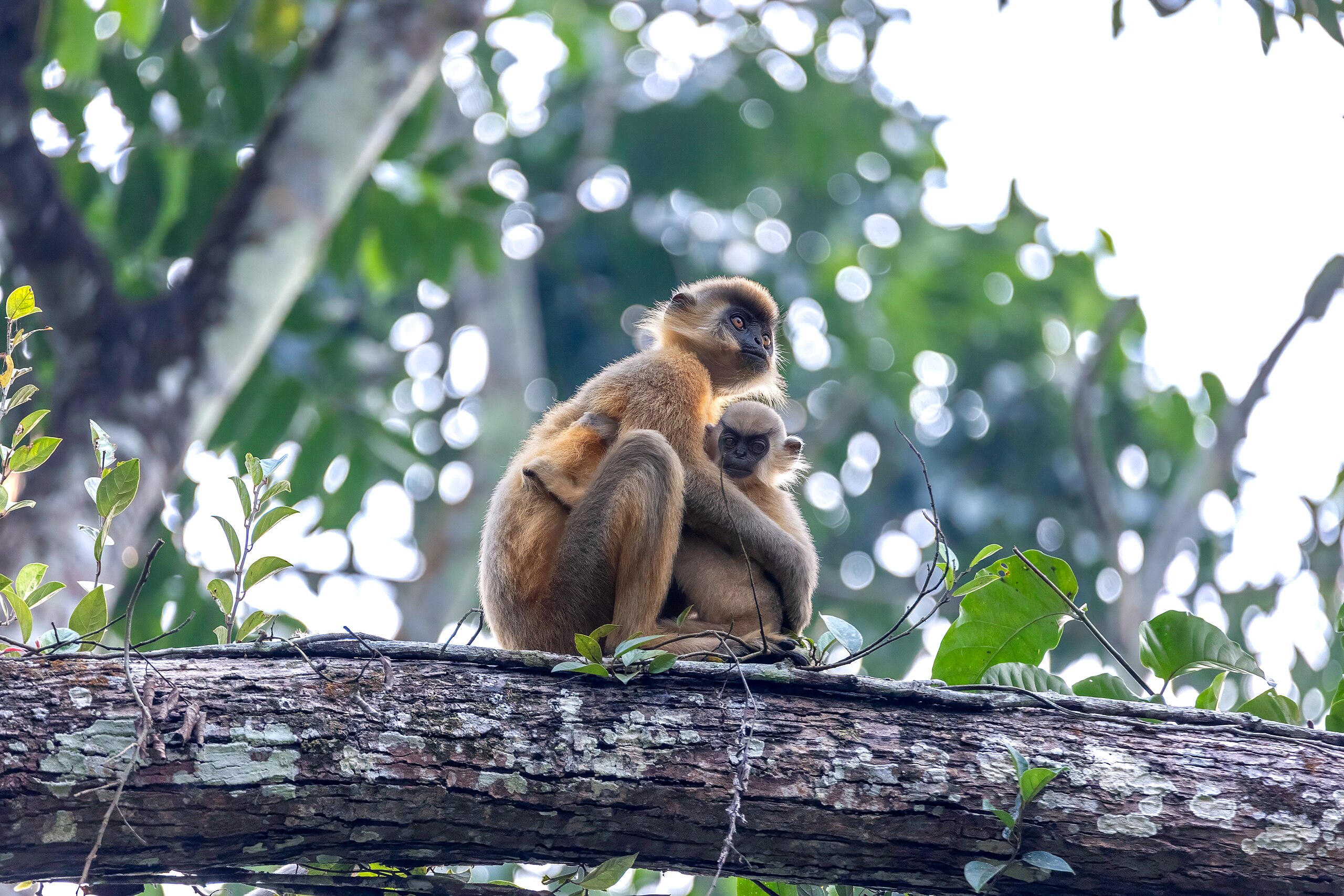
Banner image: Capped langurs on a tree branch. Image by Krunal Desai via Wikimedia Commons (CC BY-SA 4.0).