
ITR filing FY 2024-25 (AY 2025-26): The Income Tax Department is stepping up scrutiny for tax returns and many taxpayers are getting alerts to check their exemption and deduction claims. The last date to file income tax returns for FY 2024-25 was pushed to September 15, 2025 this year since the tax department took time to release forms and update the portal. However, the last date to file an updated or belated return for the current assessment year remains December 31, 2025.Several taxpayers are also facing delays in their returns and refunds being processed. Ahead of the important deadline, the Income Tax Department has issued a clarification on why some taxpayers are getting alerts to review their ITRs.The Income Tax Department has said that in the ongoing financial year 2025–26, over 21 lakh taxpayers have already updated their ITRs for AYs 2021–22 to 2024–25 and paid more than ₹2,500 crore in taxes. Also, over 15 lakh ITRs have been revised for the current assessment year.

Investor Action Checklist
Why are some taxpayers getting intimations from the tax department, what is the nature of deduction and exemption claims being questioned, and what should taxpayers do? We take a look:
What’s the Income Tax Department’s ‘NUDGE’ campaign?
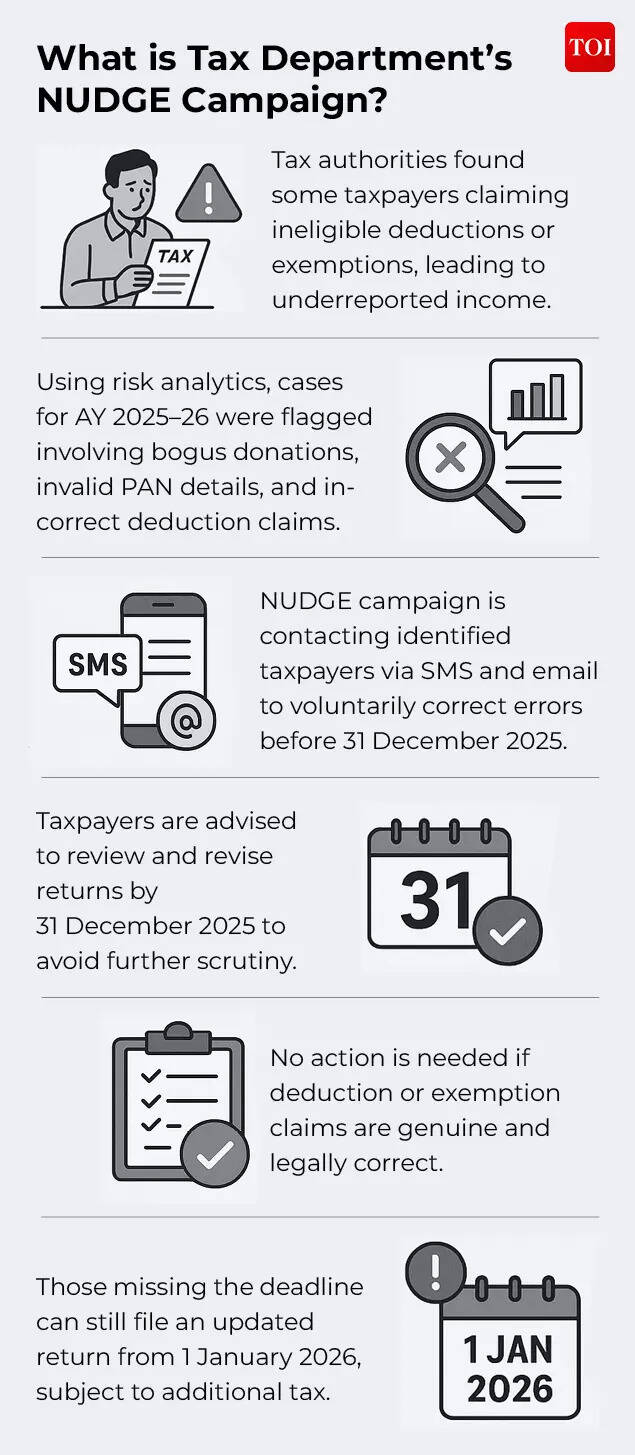
In a press release, the Income Tax Department has said that some taxpayers have claimed ‘ineligible’ refunds – through the deductions and exemptions route. This has led to their income being underreported.“Under the risk management framework, and through the use of advanced data analytics, cases for Assessment Year (AY) 2025–26 have been identified,” the Income Tax Department said.The tax department on its part is ‘nudging’ taxpayers to update their tax returns in case there is some discrepancy in the deductions and exemptions.
What is NUDGE campaign?
Identified taxpayers are being sent SMS and email under the government’s “Non-intrusive Usage of Data to Guide and Enable (NUDGE)” campaign. The aim is to encourage these taxpayers to correct errors in tax return filing, ahead of the December 31, 2025 deadline. “This initiative reflects a trust-first approach to tax administration, under which taxpayers are provided an opportunity to review their Income-tax Returns (ITRs) and voluntarily correct any ineligible claims, wherever required,” the tax department said.“The campaign leverages data analytics and technology to enable a transparent, non-intrusive, and taxpayer-centric compliance environment, with an emphasis on guidance and voluntary compliance,” the department adds.The tax department has advised the concerned taxpayers to “review their ITRs, verify the correctness of their deduction and exemption claims, and revise their returns, if required, within the prescribed time by 31 December 2025, so as to avoid further enquiries in the matter.”
ITR filing & Refunds: Why are taxpayers getting ‘nudges’?
Amarpal Chadha, Tax Partner at EY India explains that the NUDGE campaign is an initiative of the Income Tax Department aimed at encouraging taxpayers to voluntarily review deduction or exemption claims that have been identified as potentially ineligible through data analytics. The Department is also leveraging global information-exchange frameworks such as the Automatic Exchange of Information (AEOI), Common Reporting Standards (CRS), and the Foreign Account Tax Compliance Act (FATCA) to identify possible discrepancies in foreign asset reporting, Chadha told TOI.
Under the tax department’s initiative, taxpayers may receive an email or SMS explaining the reason for the communication and advising them to verify the accuracy of deductions or exemptions claimed, as well as the correctness of foreign asset disclosures. Where a taxpayer believes that corrective action is required, a revised return may be filed on or before December 31, 2025, which is the deadline for filing updated income tax returns for FY 2024-25
What kind of exemptions and deductions are likely under scrutiny?
Tanu Gupta, Partner, Mainstay Tax Advisors LLP has a clear message: In principle, all those exemptions and deductions which are not genuine are likely to come under scrutiny. “Even those deductions and exemptions which are inconsistent with the income tax department’s records/information/data, may also come under scrutiny. The most sought-after deduction/exemption currently includes “Donation to Political Parties”, “House Rent Allowance” to name a few,” she told TOI.According to Amarpal Chadha, any deduction that is claimed for donations to political parties where an incorrect or invalid PAN of the donee has been provided may come under the Income Tax Department’s scrutiny. The tax department has said that there are also cases where the taxpayers have given incorrect or invalid PAN details. Other cases pertain to the extent of deductions and exemptions that are being claimed by the taxpayers.“In addition, any deduction or exemption claimed in the income-tax return over and above what is reflected in Form 16 such as HRA exemption, exemptions under the Double Taxation Avoidance Agreement (DTAA), gratuity exemption etc. are also under tax department’s radar,” he told TOI.
What should taxpayers do if they get a ‘nudge’ from tax authorities?
Tanu Gupta recommends that for all the claims including exemptions and deductions, the taxpayer should always keep in handy the following documents: receipts / invoices of the payments for which exemption / deduction is claimed, bank statement evidencing such payment through proper banking channels, receipts from the recipient to corroborate with such payments.
These are broad guidelines for the documents which the taxpayer should anyway keep on files for a good financial housekeeping, she says.Is there a need for panic? No, says Tanu Gupta. “Instead, the taxpayer needs to revisit their claims of exemptions and deductions in the return and take action accordingly viz file the revised return if needed. As the name suggests, the abbreviation and the complete name of it (Non-Intrusive Usage of Data to Guide and Enable), it is to facilitate the taxpayer to file compliant tax returns voluntarily, with correct, justified and genuine claims of deductions/exemptions,” she tells TOI.“There are cases where the taxpayers have received the communication from the department, although they believe that they do not have any inconsistency for the claims made in the return. They only need to see if they have all supporting documents for such payments to submit to the tax authorities when asked for,” explains Tanu Gupta, adding that wherever such exemptions / deductions are not authentic, the taxpayer needs to immediately revise the tax return by reversing such claims in the returns; and pay due income tax along with interest.Amarpal Chadha shares a checklist:
- Verify Deductions and Exemptions: Check all deductions and exemptions claimed in the income-tax return and ensure adequate documentation exists to substantiate each claim
- Identify Discrepancies: Compare the return filed with Form 16, bank statements, investment proofs, and other records to spot any discrepancies.
If any claim or reporting needs correction, file a revised return within the prescribed timeline currently on or before December 31, 2025, he says. “However, if the taxpayer believes that the exemptions or deductions claimed are accurate and valid, they may wait for further communication from the Income Tax Department,” he adds.It is important to restate here that taxpayers do not have to worry where their tax claims are genuine.The Income Tax Department has clarified that taxpayers whose claims are genuine and correctly made in accordance with law are not required to take any further action. “It is clarified that taxpayers who do not avail of this opportunity may still file an updated return from 1 January 2026, as permitted under law, subject to payment of additional tax liability,” it has said.