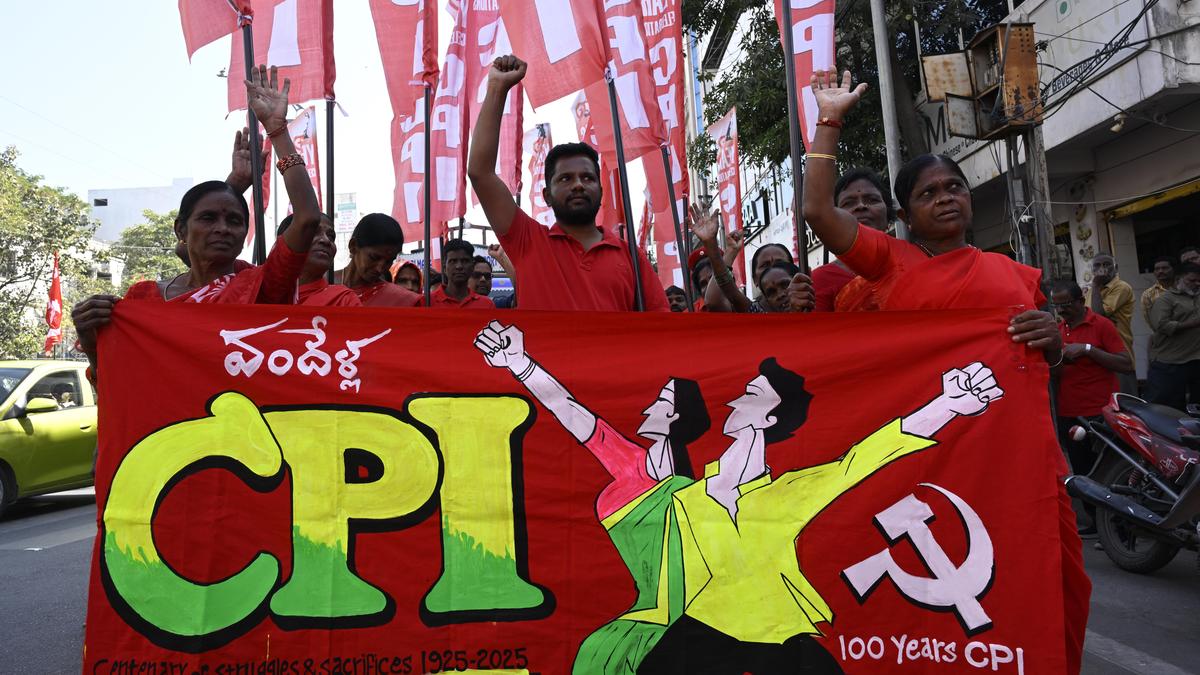
On December 26, 2025, the Communist Party of India turns 100. This centenary is not merely the marking of time for a political party but a moment of historical reflection on a movement that profoundly shaped India’s freedom struggle, its vision for the future of the nation, and its social and economic vision. From its earliest years, the CPI gave voice to the revolutionary slogan “Inquilab Zindabad”, coined by Maulana Hasrat Mohani — who chaired the Reception Committee of the historic Kanpur Conference — and immortalised by Bhagat Singh and his comrades. Through communist activists, this call for revolutionary transformation travelled to every nook and corner of the country, becoming a living expression of resistance, hope and patriotism. The CPI emerged confronting colonial rule and sought to answer a fundamental question confronting the national movement: freedom for whom and to what end. Over a century, the CPI has consistently argued that political independence without social and economic transformation would leave the masses trapped in old and new forms of exploitation.
The historical roots of the CPI lie in its uncompromising struggle against colonial capitalism. British imperialism subordinated India’s economy to the needs of foreign capital, destroyed indigenous industries, imposed exploitative land relations, and produced widespread poverty. At the same time, it created a modern working class and exposed Indian revolutionaries to global currents of socialist thought, particularly after the Russian Revolution of 1917. Indian activists and revolutionaries who encountered Marxism abroad or through international networks began to see that national liberation and social emancipation were inseparable. This understanding matured into organisational form with the founding of the CPI in December 1925 at Kanpur.
Marxist theories, Indian realities
The formation of the CPI in Kanpur was deeply symbolic. Kanpur was a major industrial centre with a strong working-class presence, and its selection reflected the party’s conviction that workers and peasants must be central to the struggle against imperialism. The Kanpur conference brought together revolutionaries, trade unionists, and anti-imperialist activists committed to building a revolutionary party rooted in Marxist theory and Indian realities. From the very beginning, the CPI faced severe repression. The colonial state criminalised communist activity, leading to arrests, long imprisonments, and conspiracy trials such as the Kanpur, Peshawar, and Meerut cases. Yet repression failed to extinguish the movement. Instead, it sharpened its ideological clarity, organisational discipline, and commitment to mass politics.
The CPI’s role in the fight against colonial rule was uncompromising and profoundly patriotic. Unlike strands of nationalism that sought accommodation with imperial power, the communists understood colonialism as a system of economic exploitation sustained by political domination. They fought British rule through trade union struggles, peasant movements, underground resistance, and ideological battles. Their patriotism was rooted not in elite negotiations but in the lives and struggles of ordinary Indians. Crucially, the CPI extended the anti-colonial struggle beyond British India. It played a pioneering role in mobilising resistance against French and Portuguese colonial rule in Pondicherry, Karaikal, Mahe, Yanam, Goa, Daman, and Diu. Long before these issues occupied the centre of national politics, communists organised workers and peasants in these regions and asserted that freedom was incomplete as long as any part of India remained under foreign domination.
One of the CPI’s most enduring contributions was its emphasis on building mass organisations. The party recognised that political emancipation could not be achieved without mobilising society in all its diversity. It helped build and strengthen platforms such as the All India Trade Union Congress, the All India Kisan Sabha, the All India Students’ Federation, cultural and writers’ organisations like the Progressive Writers’ Association and the Indian People’s Theatre Association, and, later, organisations of women and youth. Through these formations, the CPI united workers, peasants, students, intellectuals, and artists around shared struggles. These organisations transformed everyday economic grievances into political consciousness and carried the ideals of justice, equality, and dignity into the heart of the freedom movement.
It was through mass struggles that communist politics acquired its deepest roots. The CPI led historic movements for land and dignity, including the Telangana armed struggle against feudal oppression, the Tebhaga movement in Bengal that asserted peasants’ rights over their produce, the Punnapra–Vayalar struggle in Kerala against landlord tyranny, and the militant land struggles of the Thanjavur delta. In industrial centres such as Kanpur, Bombay, Calcutta, and Puducherry, the trade union movement under communist leadership won major labour victories, securing rights, wages, and dignity for workers. In the post-independence period, struggles for land capture, redistribution, and reorganisation reshaped agrarian relations in Bihar, Tripura, Kerala, and other States. These movements did not merely address material deprivation; they challenged centuries-old hierarchies and asserted the humanity of the oppressed.
The CPI decisively radicalised the agenda of the national struggle. At a time when dominion status was being debated as a possible compromise, the communists insisted on complete independence. They were among the earliest and most consistent advocates of the demand for a Constituent Assembly, arguing that only a sovereign body elected by the people could frame a democratic Constitution. This demand later became central to India’s transition to independence. The party placed structural reforms at the centre of the freedom struggle, arguing that independence without land reforms, labour rights, and social equality would merely replace foreign rulers with indigenous elites.
Land redistribution, abolition of landlordism, protection of tenants, trade union rights, minimum wages, and social security were pushed into the national agenda through communist-led movements. The CPI articulated the vision of a classless and casteless India, recognising caste not as a cultural residue but as a material system deeply intertwined with class exploitation. By linking caste oppression to economic structures, the party broadened the meaning of social justice and gave the freedom struggle a transformative content. Many of these demands found reflection in the Constitution and in post-independence policy debates, demonstrating the lasting imprint of communist intervention.
Global struggle
Internationalism was integral to the CPI’s political worldview. The party consistently opposed imperialist wars, fascism, and militarism, and took the lead in building solidarity with anti-colonial and progressive movements across the world. Whether opposing war as an instrument of imperial domination or standing in solidarity with peoples struggling for peace and self-determination, the CPI affirmed that the fight for justice in India was inseparable from the global struggle against exploitation and aggression.
The final phase of the struggle against British rule witnessed a dramatic intervention by the working class in the form of the Royal Indian Navy mutiny of 1946. The CPI regarded this uprising as the last war of Indian independence. Indian sailors rose against racist treatment and colonial authority, and their revolt quickly won the support of workers and students, particularly in Bombay. Communists played a critical role in mobilising solidarity strikes and mass support, despite facing brutal repression. The mutiny exposed the erosion of colonial control over the armed forces and convinced the British that their rule was no longer sustainable. It underscored the CPI’s belief that organised mass action, especially by the working class, could decisively alter the balance of power.
Independence in 1947 did not end the CPI’s struggle. It marked the beginning of a new phase focused on dismantling feudal structures, resisting monopolistic capitalism, and deepening democracy. The party led historic peasant struggles against landlordism and played a decisive role in advancing land reforms in States such as Kerala, Tamil Nadu, West Bengal, Tripura, and Bihar. In parliamentary and extra-parliamentary arenas, the CPI championed public ownership of key sectors of the economy and consistently advocated the nationalisation of banks, coal, insurance, and other core industries, arguing that strategic resources must serve national development and social welfare rather than private accumulation.
The CPI was also a strong defender of federalism and linguistic and cultural diversity, strengthening India’s democratic fabric. Its commitment to social justice found expression in its defence of the rights of Dalits, Adivasis, minorities, and women, as well as its steadfast adherence to secularism and rational thought. Across decades, the red flag symbolised reform, progress, and resistance to reactionary forces. It stood for scientific temper against obscurantism and solidarity against divisive sectarian communal politics.
Grave challenges
Today, as the CPI enters its second century, India confronts grave challenges. Communalism and emerging fascism threaten the foundations of the Republic. Economic growth has been accompanied by massive unemployment, precarity, and widening inequalities. Ecological crises driven by unregulated capitalism endanger livelihoods and the future itself. New technologies, particularly artificial intelligence, are transforming work in ways that intensify insecurity and weaken labour protections, raising urgent questions about ownership, control, and human dignity in the age of automation.
For the Left, the challenge is to once again become synonymous with the aspirations of the masses. This requires renewing its understanding of contemporary capitalism while remaining anchored in its core values of equality, democracy and justice. Technological change cannot be accepted as inevitable progress divorced from social responsibility; it must be critically analysed and politically contested so that human advancement serves collective well-being rather than deepening exploitation.
At this critical juncture in our history, the centenary of the CPI is not merely a moment of remembrance but a call to action. Democracy itself is under assault, people’s rights and livelihoods are being systematically eroded, and the achievements of the freedom movement are being deliberately undone. The RSS–BJP combine seeks to dismantle our social solidarity, hollow out our economic sovereignty, and subvert the Constitution to impose an authoritarian, exclusionary order. This danger cannot be resisted in fragments. The CPI and the Left must be strengthened and brought closer together to form a broad democratic resistance. Class exploitation, caste oppression, and patriarchy remain formidable structures of domination, demanding organised and uncompromising struggle. The task before us is clear: cleanse institutions of their corrosive influence, reclaim the Republic, and rebuild India on the foundations of equality, secularism, and justice. United we must resist. United we must advance. United we must create a new India: egalitarian, democratic, and prosperous. The red flag must rise higher. The people must prevail. The future must be ours.
As the Communist Party of India turns 100, its history stands as a record of courage and sacrifices. From its founding in Kanpur to its role in anti-colonial struggles, from radicalising the freedom movement to shaping post-independence reforms, the CPI has consistently sought to align national sovereignty with social transformation. The challenges ahead are immense, but the legacy of a century affirms that organised people, guided by communist ideas, can change history. In a time of uncertainty and crisis, the red flag must rise again as a symbol of hope, reminding India that a just, democratic, classless and casteless socialist society is not only a dream but a necessary and achievable future.
Liberating the country from the BJP-RSS raj, unifying the Left and Communist forces and strengthening the CPI are the tasks ahead.
(The writer is the Communist Party of India’s general secretary)